

We’ll mostly look at tech and our hyperscalers who had to answer a few questions to justify continuous spending in AI infrastructure; is demand for AI compute still strong and growing, are past investments generating returns, are they going to continue those investments and will the market support that choice.
I’ll spoil it for you, everything went well. Jury’s still out on the last question and today was not good, but the others are nothing but a big yes.
It is a great time to be invested in hardware, which remains the best way to capitalize on this technological revolution as other verticals come with headaches about ROI, growth, demand, disruption… while selling hardware means producing a piece and selling it, generating cash directly, and demand is massive. Simple and efficient, while so many investors wish to complicate it…
The Cloud Kings
AI Demand & ROI
I could write 10,000 words going over each data point, but I’ll just illustrate my point with a single graph and a few comments. This is Google Cloud’s backlog and YoY revenue growth.
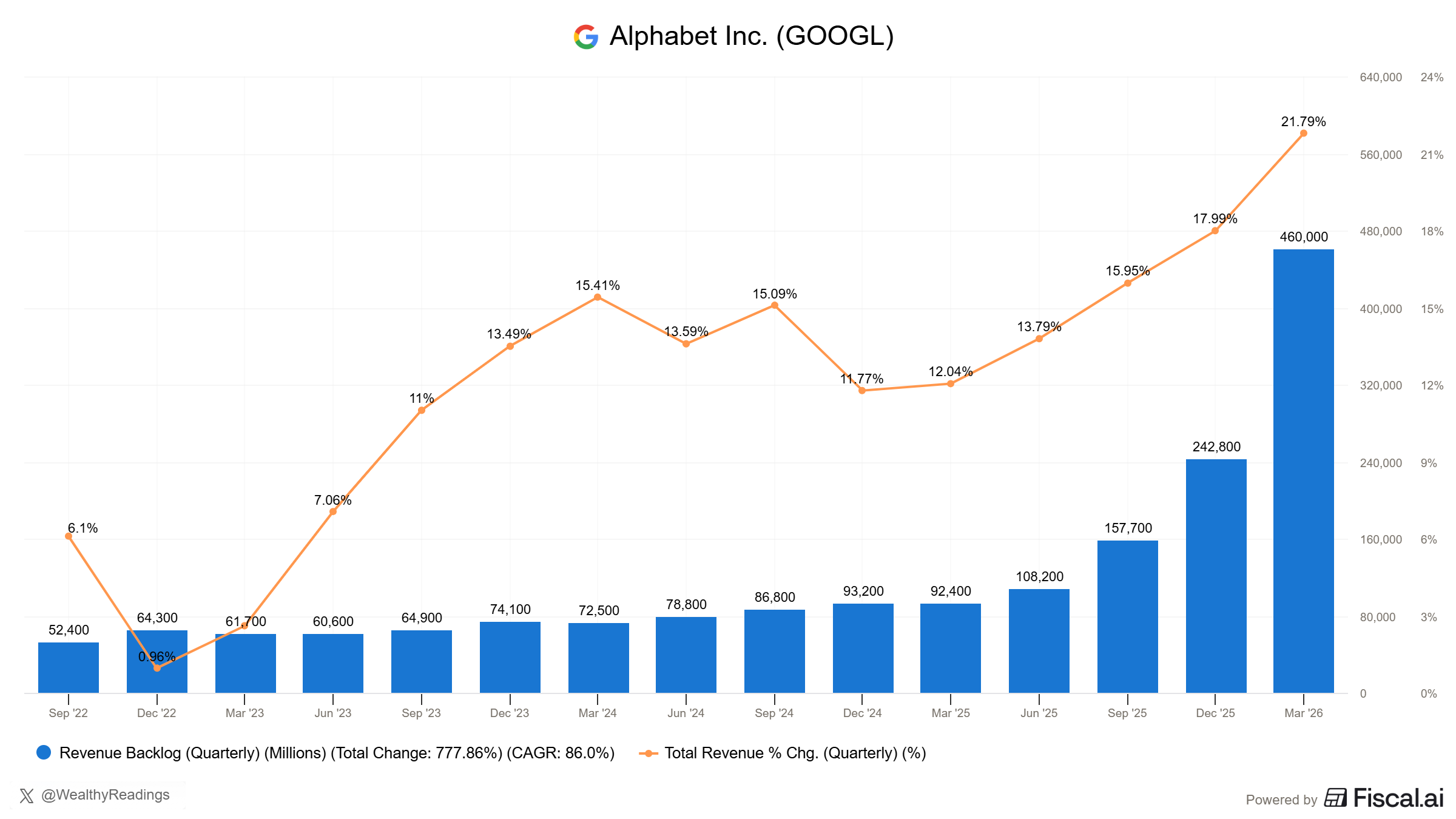
This chart should be enough to answer questions about AI compute demand and ROI, although the market will look at ROI in terms of cash generation, not just revenues but I’ll make that point a bit later. While I use Google to illustrate, we have already seen comparable charts from Microsoft and Oracle with the bearish argument that most of it came from OpenAI, which isn’t the case for Google - although it comes partly from Anthropic. All hyperscalers are seeing a rapid and large increase in RPOs/revenues.
That should answer AI compute concerns, but I’ll also give you some quotes.
Obviously, we are compute-constrained in the near-term. As an example, our cloud revenue would have been higher if we were able to meet the demand. We are working through that moment and... we are investing, but we have a robust... long-range planning framework. — Sundar Pichai, Google CEO
We are seeing strong deal momentum, doubling the number of $100 million to $1 billion deals year-on-year and signing multiple $1 billion+ deals. — Sundar Pichai, Google CEO
Broad and growing customer demand continues to exceed supply, and we continue to balance the incoming supply we can allocate here against our other high ROI priorities, first-party applications, R&D, and end-of-life server replacement. — Amy Hood, Microsoft CFO
Even with these additional investments and continued efforts to bring GPU, CPU, and storage capacity online faster, we expect to remain constrained at least through 2026. — Amy Hood, Microsoft CFO
“Trainium2... is largely sold out. Trainium3, which just started shipping at the start of 2026 and is 30%-40% more price performant than Trainium2, is nearly fully subscribed. Much of Trainium4... has already been reserved.” — Andy Jassy, Amazon CEO
Our experience so far has been that we have continued to underestimate our Compute needs, even as we have been ramping capacity significantly as the advances in AI have continued... — Susan Li, Meta CFO
Besides cloud, if you look at Google, you will see that advertising revenues are also accelerating while other verticals are flat at worst but most importantly, both gross and operating margins are increasing, meaning the company is growing both revenues and cash generation and therefore could continue doing so as efficiency improves. Amazon and Meta are also both using AI internally with impressive results - confirming my thesis that AI is by design deflationary.
People no longer search in fragments. They search conversationally and share more context. We launched AI Max to help advertisers adapt to this new way of searching. — Philipp Schindler, Google Senior VP
Traditional search really started with 10 blue links. Now we have AI Overviews and AI Mode. They have made Search more intelligent than ever. They let you ask far more complex questions. — Philipp Schindler, Google Senior VP
Normally that would've taken 40 or 50 people about 1 year to do, and we took five really smart people, AI forward-thinking people building on agentic coding tools, and those five people rebuilt it in 65 days. — Andy Jassy, Amazon CEO
We are seeing more and more examples where one or two people are building something in a week that would have previously taken dozens of people months. — Mark Zuckerberg, Meta CEO
Looking at Meta more closely, as it is a different beast from the others - not renting part of its compute but using it all internally, you’ll see how AI has impacted its business, as plain as the nose on your face.
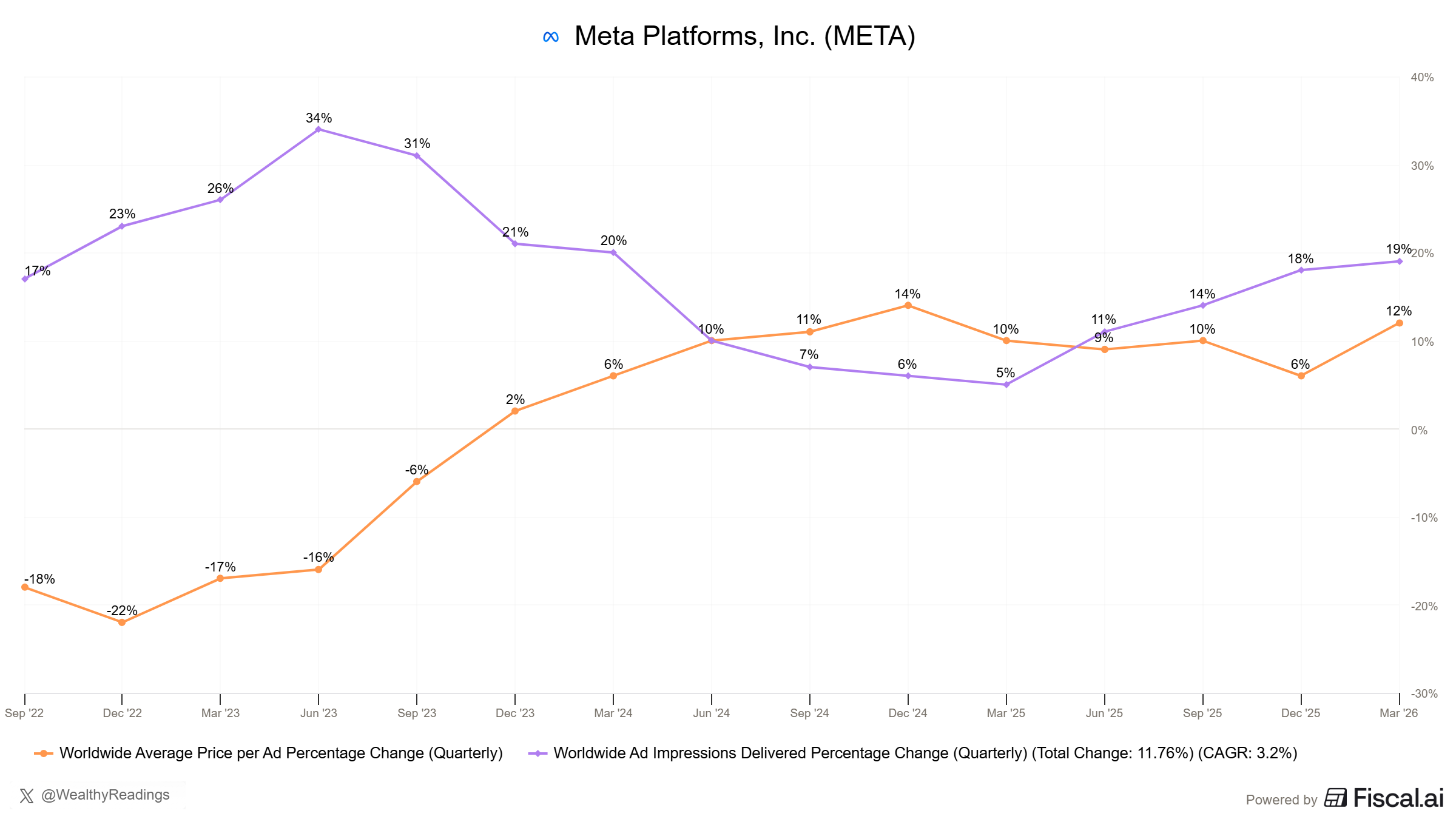
Both ad impression and ad pricing growth continue to accelerate as their models get better at predicting what users will interact with and improve the chances to convert potential buyers into buyers. This is AI; it doesn’t show as clearly as others with massive RPOs, but this is what Meta has been capable of doing with its AI models; and it showed as the company grew 33% YoY this quarter, its fastest growth rate in the last five years.
Without dragging this out much longer, the conclusions here are simple.
Demand for AI is through the roof and all compute providers are using 100% of their capacity with demand for more, today - resulting in quarters of pre-bookings with financial commitments.
CapEx spent the last years is generating revenue growth at an accelerating rate. This isn’t an isolated event but a global revolution.; all companies are seeing their cloud, core and AI businesses accelerate.
Investments into AI aren’t slowing down; from a management perspective, this results ask for more investments. They have to continue pushing as the results are really convincing.
Now, everything isn’t perfect, as we’ll see now.
The Less Good
There is actually one “negative” point to those quarters, one we already talked about and knew would generalize. The market looks at ROI from a cash generation point of view, not revenue growth, which means as long as spending doesn’t generate increased income, it isn’t a success. The first step to increased cash generation is increased revenues, we’ve covered that. The second is increased margins, and the third one is decreasing spending.
This is where Google is an anomaly this quarter as all others have stable/declining operating margins, while Google’s are rising.
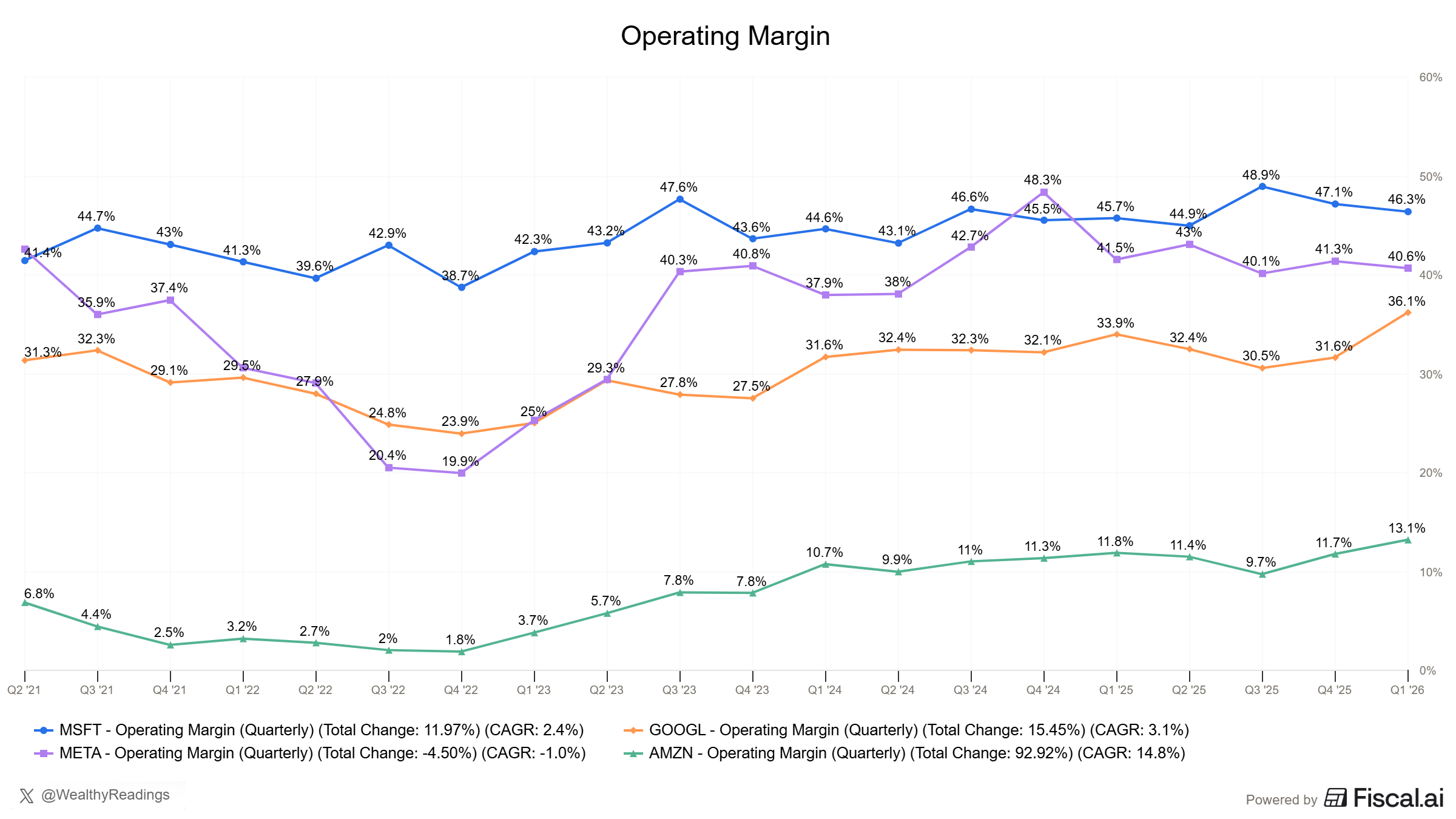
Even if this quarter was great for everyone, most have a tendency to see their costs grow faster than their revenues which signals problems for the next few quarters as this dynamic is not going to reverse. Decreased spending is not going well, not helping margins, and cash generation won’t be any better as all of them confirmed they’ll increase - once again, their investments.
However, in times of very high growth like now, where the CapEx growth meaningfully outpaces the revenue growth, the early years free cash flow is challenged until these initial tranches of capacity are being monetized — Andy Jassy, Amazon CEO

The market continues to have the same worries; AI is in high demand and revenues are growing but if it ends in increased CapEx and costs, cash generation decreases and you guys know that the market only cares about future cash generation. This is what needs to grow for the market to continue rewarding the stocks.
So the market might not reward those stocks as much as we’d like, except for Google which comes from another planet and is certainly helped by its vertical integration which mitigates costs and proves once more that optimization is everything in this new era. Which brings me to my next point: AI hardware and how bullish those earnings are for the most important vertical of the market.
Silicom Ltd
Silicom crushed earnings, and improved my bull thesis. The stock jumped a massive 38% today, with good reasons, and is now up ~115% since my investment thesis.
My thesis was simple; the company’s business is to resolve networking bottlenecks with adaptable hardware called SmartNICs. Networking is one of the main issues with inference today and hyperscalers work at optimizing their infrastructures as much as possible while focusing on hardware diversification so eventually… SmartNICs will be an answer.
Not only is my bull thesis still holding as management is still working with hyperscalers to meet their needs - two of them, and confidence seems pretty high as management vocabulary isn’t about “maybe” or “if”, but “when”.
I think probably it's more 2027 rather than 2026 in terms of significant revenue for AI inference. We may see some this year, definitely making some good progress, as I said before. Hopefully we can share more in future, as we meet more milestones. I would say significant probably in 2027.
While the company’s core business is re-accelerating after winning 4 new contracts in one quarter - while guiding to win seven to nine this year, without AI inference designs yet.
A networking and security service leader doubling its run rate from $4M to ~$9M.
A long-time cybersecurity partner with an initial $1M order and an engagement to double that, plus develop other products.
An encryption and communication leader with a $3M per year design we already talked about.
A streaming infrastructure provider with a $12M run rate during five years.
Business is booming while my bull case hasn’t materialized yet.
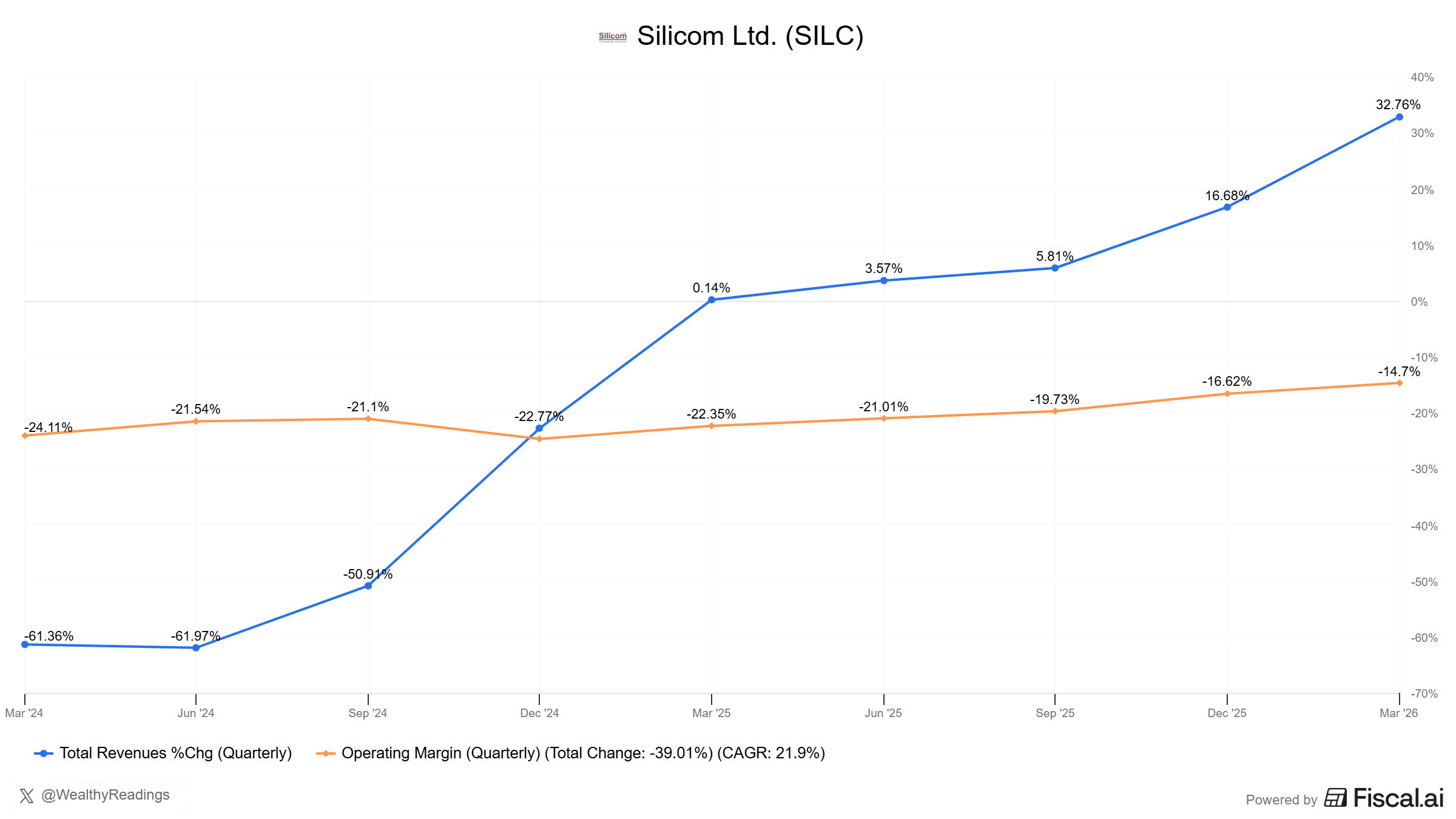
Above-expectation growth and margin improvements, helping the company stabilize its balance sheet - although it doesn’t need much help with $63M net cash but a slower cash burn is always better. And this quarter isn’t a fluke, it is the new normal for the company as Q2-26 guidance is set at 40% YoY growth; constant acceleration.
The bull thesis is even stronger after this quarter.
I Am So Very Bullish
But only on hardware. There are other great names in AI and in the market, but AI hardware is the best place to be, without any doubts. The strongest vertical.
If you are invested in companies selling AI services, you have to understand that the market will continue to doubt future cash generation as monetization and margins for AI services are still unclear. This is why SaaS are getting killed - with reason, and why this kind of quarter doesn’t shoot hyperscalers stocks up 20% higher while many assume it should - except for Google which did show margin improvements.
This is normal. We don’t know how much cash will be generated in the future; we can have opinions and speculate, but until the numbers show increasing margins and cash generation, we won’t be sure, and the market will be skeptical.
The economic model has to evolve - is evolving, but the market is waiting for numbers.
The basic transformation of, I’ll say, any per-user business of ours, whether it’s productivity, coding, security, will become a per-user and usage business... At the end of the day, it’ll come from some eval and outcome that a business has, where these agents have created value. — Satya Nadella, Microsoft CEO
“When I think about that model, I start to think about it as a license business plus a consumption business... you’ll just bill for usage, and if that usage has great value to customers... then you’ll keep spinning and you’ll keep using those agents. — Amy Hood, Microsoft CFO
There is one business we know how it works: hardware. Companies sell hardware in exchange for cash going directly into the bank, and move on to produce the next piece, or engineer their next generation. This is where liquidity goes today because demand is rocketing and the market knows how cash is generated.
As long as demand for hardware is here - and we know volume is dictated by end customers, the market will reward these safe and growing cash generating beasts. Do not overcomplicate investing, look at the safest/potential growing cash generation vertical and buy those names. Those verticals will one day be SaaS and AI services providers, we will buy them then. Until then, keep it simple.
Now, what our favorite CEOs told us yesterday is that the future of AI runs on diverse and custom hardware to answer thousands of different agentic use cases, which require different optimization patterns as the ultimate goal for them is to answer a rapidly growing demand, which can only be done by optimizing compute per unit of space and energy.
We’re optimizing every layer of the tech stack, from DC design to silicon to systems software, the model architecture, as well as its optimization... We delivered a 40% improvement in inference throughput for our most used models across Copilot. — Satya Nadella, Microsoft CEO
We expect Trainium will save us tens of billions of dollars of CapEx each year and provide several hundred basis points of operating margin advantage versus relying on others’ chips for inference. — Andy Jassy, Amazon CEO
While the largest number of AI chips we’re bringing in are Trainium, we continue to have a deep partnership with NVIDIA... we will always have customers who want to run NVIDIA on AWS. We will also have a very large chips business ourselves. Customers always want choice. — Andy Jassy, Amazon CEO
We made advances in the model architecture and co-designed the system with the underlying silicon so it maintains the sub-second speed that is required to serve ads at scale. — Susan Li, Meta CFO
What else should I say from here?… The world continues to increase its spending for AI hardware and isn’t only spending on Nvidia’s GPUs anymore as it realized that more wasn’t the answer for everything: better is, which means spending is now directed towards solutions capable of optimizing those GPUs, or towards new and entirely custom silicon - which plays in my thesis of diversified hardware.
That’s where my entire portfolio is today, between current needs with companies like Silicom or ARM and future needs with companies like Soitec and Global Foundries.
Before moving on, I want to talk about both Viavi and AEHR who both released extremely positive earnings - or followed by positive announcements in AEHR’s case. Those two companies are designing testing platforms for optical hardware, which reinforces my thesis that Soitec, Global Foundries and the entire photonics space has a very bright future. Companies do not invest in testing platforms if they do not intend to produce at scale.
We can also talk about Sandisk which delivered a monster quarter tonight, beating on all analysts’ expectations and proving once again the massive demand for hardware with some customers locking in future supply with financial commitments. Memory is in a clear supply shock but this still highlights the need for hardware and plays into my narrative and portfolio positioning.
And this all comes after last week’s earnings which confirmed more of the same with TSM and Intel. Why would anyone be bearish or refuse to be involved in this sector?
Smartphone & Other Hardware
I have an interest in the smartphone market as it is a large demand for both Soitec and Global Foundries’ core business, and a stabilization or return of growth would improve the bull case - which relies on photonics for me today but the market would love to have this explosive new vertical coupled with a re-accelerating core business. I also have an interest in wearables as I shared Nordic Semiconductor with you in February - the stock is up 45% since my buy recommendation.
On the smartphone market, let’s start with some comments from Qualcomm which is expecting a bounce in the smartphone market as demand for its chips powering Chinese systems is apparently increasing with a bottom expected this, or next quarter. This is just one small signal in a very large market, but Apple is also doing well lately with return of growth in its iPhone sales.
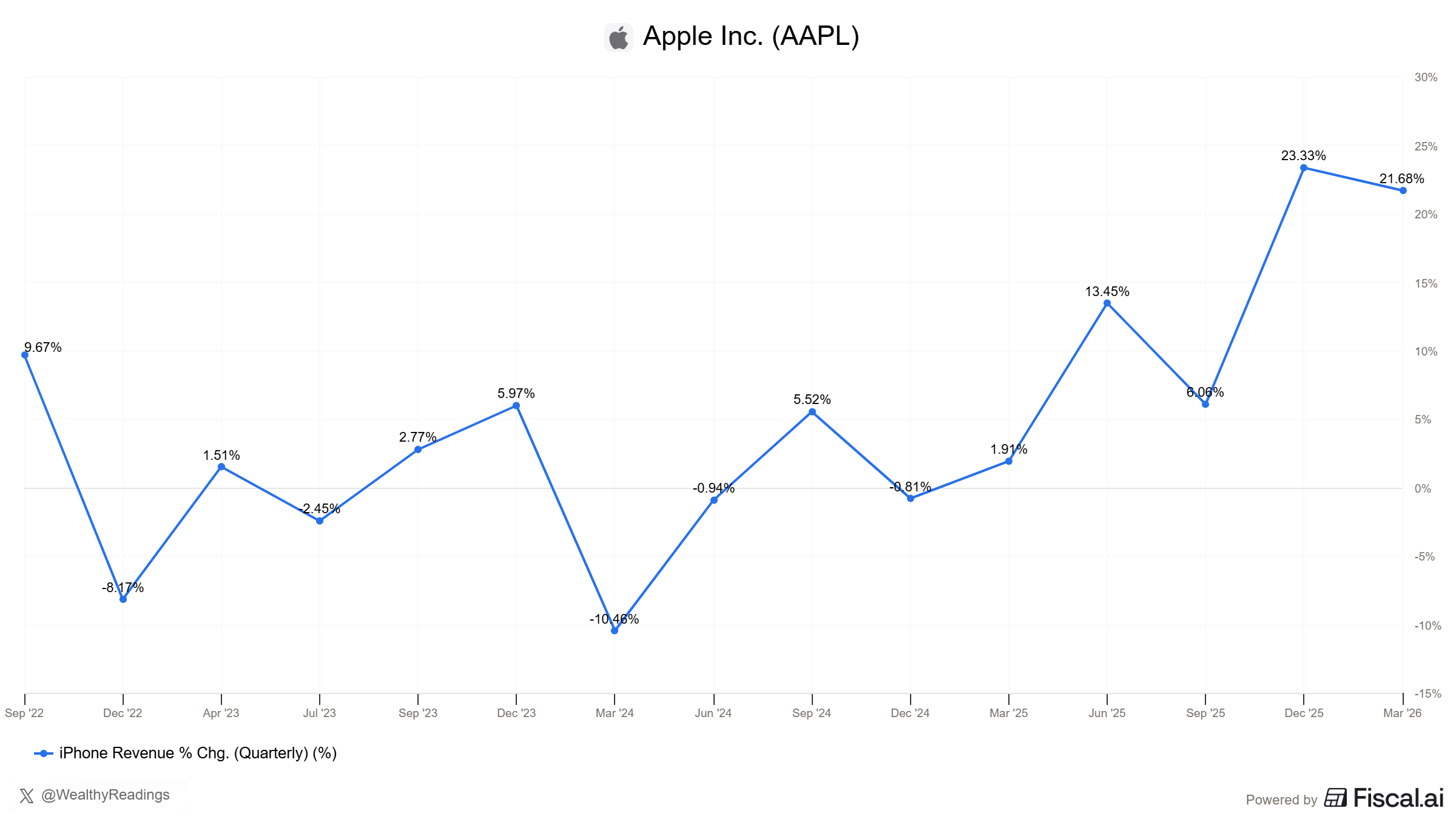
More than a year of healthy and accelerating growth now, a pretty healthy sign that consumption is bouncing, and even if it might not be broad yet, and if some brands might still struggle, there are signs of a renewed appetite for smartphone.
As for Nordic, revenue continues to accelerate as the market recovers from its post-Covid inventory building while margins are also improving.
The main thing which we clearly see is that the market is continuing to improve, and we do see our customers selling more end products. That’s clearly... truly what we see a lot of, and we see increases and increasing forecasts because of that. — Vegard Wollan, Nordic CEO
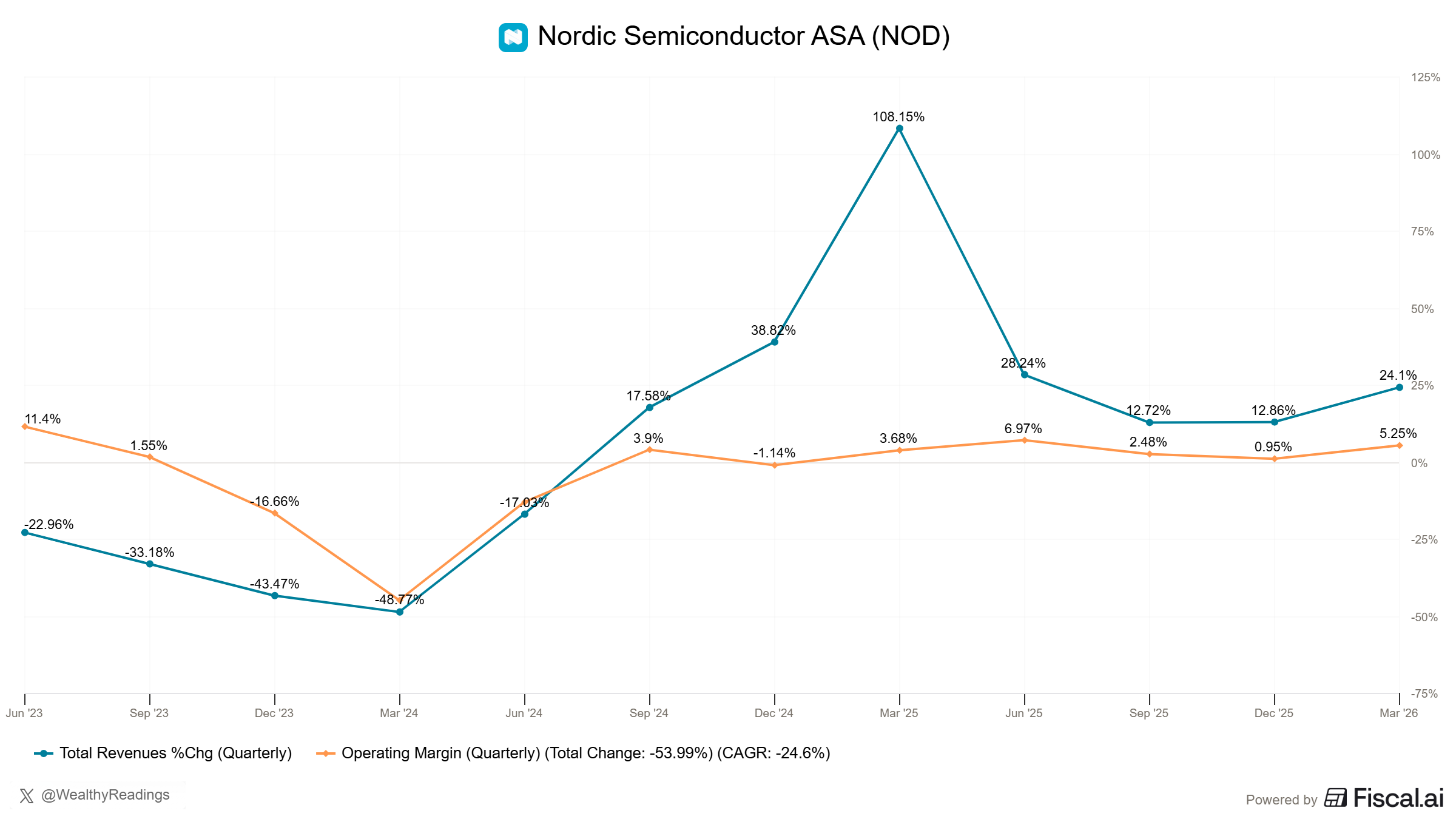
And their new flagship product is gaining traction, slowly as we expected, but steadily.
It has been a clear priority for us to regain traction in the broad market, and it is encouraging to see that growth is now picking up in this segment. We see an increasing number of customers, former customers returning, new products entering the market. — Vegard Wollan, Nordic CEO
The design activity and the way we measure design-ins is still continuing very strongly with both key customers and the broad market... It is very clearly supporting our expectations for the nRF54 Series, that with these very leading market-leading products, that will be a very key long-term growth driver for Nordic Semiconductor. — Vegard Wollan, Nordic CEO
Nordic was never meant to be an explosive beast, but a great and stable play on a return to normal for Bluetooth hardware combined with the democratization of AI wearables, which hasn’t really started yet - or very slightly. The thesis is still alive and well, nothing to do but hold.
Energy Earnings
Two interesting verticals to look at here.
Enphase reported bad earnings, there are no other words and the households’ solar market is not bouncing yet, at least not for their premium products which are also less competitive after a few years of competition - which is why I chose SolarEdge. The market hasn’t punished the stock too much as its price is already in the gutter. This is a positive as we know where the bottom-ish is if a turnaround in demand were to happen.
On the contrary, Bloom Energy delivered another excellent quarter, the company selling energy providing solutions to datacenters is going through immense demand, which proves that demand for alternative sources of energy is through the roof and that shouldn’t slow down as more datacenters are planned, not fewer.
Somehow, this makes me bullish on SolarEdge as the bounce in household demand is going to their hardware and they are also pivoting towards B2B, large corporations with a need for alternative source of energy. Not to say their technologies will be used for AI datacenters, but a classic B2B business would already be interesting, coupled with a bounce of domestic demand - to be confirmed.
Disclaimer: I am not a licensed financial advisor, analyst, or broker. This content reflects my personal opinions and investment decisions for informational and educational purposes only. I hold positions in securities discussed and may buy or sell without notice. Nothing here constitutes a recommendation to buy, sell, or hold any security. Past performance does not guarantee future results.
Always conduct your own research and consult a qualified professional before making investment decisions. I accept no responsibility for any financial losses.
on solar, have you come across CSIQ yet?
Awesome write up as always!