

This is the first part of an article I usually write at the beginning of the month. But given the current macro, I wanted to talk again about the importance of having - and following, a system when investing.
So today we’ll review the importance of not letting sentiment take over, as well as my personal system and the safeguards I use to avoid emotional mistakes, and Tomorrow I’ll share the top five assets that currently fit my system.
Why Systems Matters
The answer is simple: investing solely based on opinion doesn’t work. It might work for some times but it fails over long decades. All super investors have a system and it’d be fullish not to have ours.
Druckenmiller sizes up aggressively on high risk-reward after a deep review of the trade and is famous for his “buy first, study later”. Buffett and Munger are known for buying value below their assumption of intrinsic value & popularized “moats” - which is misused 99% of the time nowadays. And Lynch is known for focusing on growth, categorizing stocks and ignoring volatility.
These are systems. Different from one another, but all successful because they are adapted to the investor’s personality and objectives. Looking deeper, we’d find checklists and methods to follow those systems in their stock picks.
If you don’t have a system… You’re very probably doing it wrong, or doing it for not very long, and that should change. Otherwise, you will make mistakes. I’ve shared mine this year with Nebius; a big, costly mistake that happened only because I ignored my system. We’ll talk more about that tomorrow. Bottom line being a system shields you from yourself.
Take the last year as an example. In roughly 360 days, we had
A tariff war and escalations with China.
A stealth attack on Iran by the U.S.
The removal of Venezuela’s president.
A never-ending war in Ukraine.
More conflicts in Iran
Now, disruptions of oil supply.
This comes after covid, other attacks on Israel, interest rate hikes, and countless other events. If you told me that none of this affected you emotionally or made you question your portfolio, I’d say you’re lying. And if I asked how many of you ended up rushing a pick - to buy or sell, I’m sure the “guilty” rate would be high.
Systems prevent that. If you follow one, you can go through your checklist and tell yourself.
No. This shouldn’t be done, so I won’t do it.
My System & Stock Picking
The situation in Iran hasn’t changed. It has now been a week since oil transport was disrupted in the region and the disruption now is real. It is being managed as most countries are using their strategic reserves, but a week of delays means ships that were navigating have reached their destinations and depleted their stocks while new ones remained stuck. And shut down or damaged production sites will take weeks or more to start again.
The question now isn’t will there be consequences, but how big. They still could be brief and reasonable but we’d need the situation to be resolved soon for it to be the case.
In such situations, you know things could happen, but you have no idea if they will. That’s where systems matter. Your system should drive your actions, not your personal perception of geopolitics which is likely as flawed as mine - nothing wrong with that the subjects are so complex.
If your system says to buy, buy. To sell? Sell. Here’s mine to illustrate
My System.
I know this sparks debates in the investing community but I do rely heavily on price action because it tells me what the market thinks and what it fears. This is one more selection process which help me filter stocks worth buying.
My process is straightforward.
I have a clear selection process.
Strong fundamentals and narrative.
Within an uptrend (above weekly 50 with higher highs/lows).
At a reasonable valuation based on my assumptions.
A clear buying process.
Identified supports.
Breakouts with volume.
Weekly 50 retests.
And a clear selling/trimming process.
Trimming on extensions (RSI heating up + extension from key averages).
Selling under three conditions only.
My original thesis is broken.
The stock falls below identified support/weekly 50.
I identify another stock with a better expected R:R.
That’s me, it shouldn’t be you or doesn’t have to be. What matters is having clear conditions for every action you take.
This is what this Substack and stock picking in general is all about: finding high potential stocks and concentrating liquidity on them. I track all my picks on my website for follow up purposes, but I do not own all of them. I only focus on those I consider the best opportunities available at any given time.
Liquidity Attribution
Concentration is key. I usually hold fewer than five positions at a time. I can do so because I have a crystal-clear plan for every pick. I know why a stock should appreciate, the price I want to pay, and the target price I expect it to reach.
I’m not always right, I certainly never have everything playing as expected, but I don’t need to. A roadmap helps me make emotionless decisions, leave a stock behind if necessary (as I did with Duolingo, Palantir, and Hims) or go heavy on a mispriced opportunity (as I am with Transmedics today).
It helps me make decisions based on my assumptions, not my emotions, with a clear plan, clear conditions.
Everyone calls this game “stock picking,” but its real name is position sizing. I like to say that we aren’t here to play Pokémon and holding 10 or 20 positions is most of the time a waste. Our goal is the find the best ones, not the most.
Imagine a $100k portfolio with ten positions of $10k each. If one returns 100% in a year, your total portfolio is only up 10%. You’d be better off putting 20% into a “safer” name with a 50% expectation to generate that 10%.
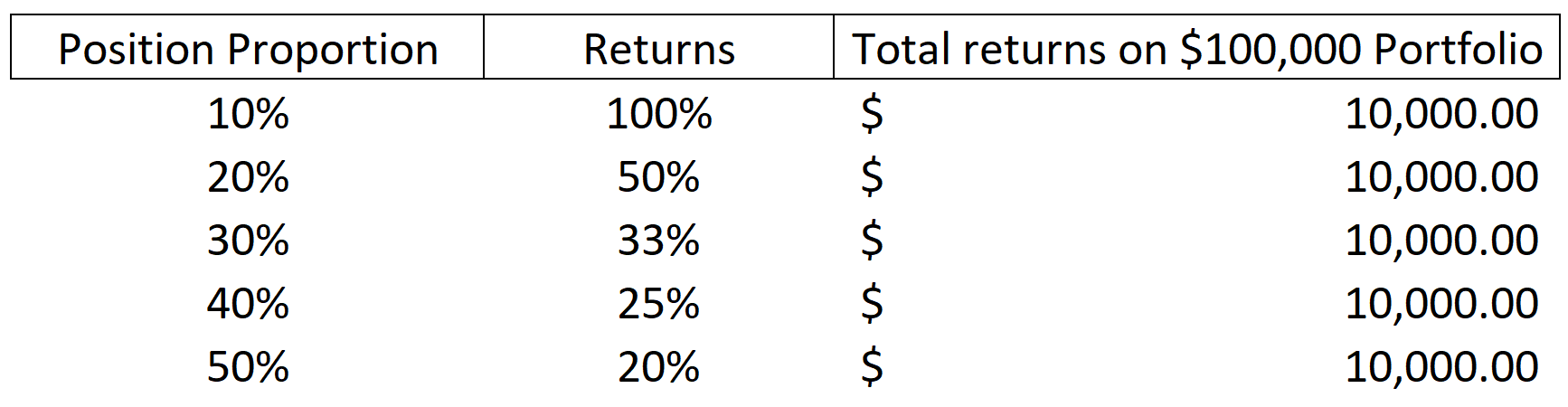
If you don’t think in total portfolio returns, you aren’t playing the game right. So many believe a small moonshot could make them a fortune but it is rarely the case and most would be better off with much bigger positions on safer stocks. The game isn’t to find a 10 bagger, but to be heavy in that 10 bagger.
If I expect a stock to return 100%, I go big. If I’m scared to go big, my conviction isn’t strong enough so maybe I just shouldn’t own it and should grow another position, maybe with a lower upside but with a bigger position.
You won’t always pick the #1, but you’ll still be better off with a 30% position in the #3 performer than you’d be buying 5% position of the top 10.
The game is about total portfolio returns.
Not stock pick returns.
Diversification & Dilution
We’ve discussed systems and liquidity attribution. Let’s talk about diversification and portfolio composition, both vital when managing a concentrated portfolio.
Many investors believe diversification means owning different stocks. That is plain wrong. Diversification means owning assets that are not driven by the same narratives.
If you own both IREN and Nebius, or ASML and TSMC, you aren’t diversified; you are diluted. This is poor capital allocation because these pairs are highly correlated. You’d be better off putting your capital on the highest potential, and then seek for true diversification elsewhere.
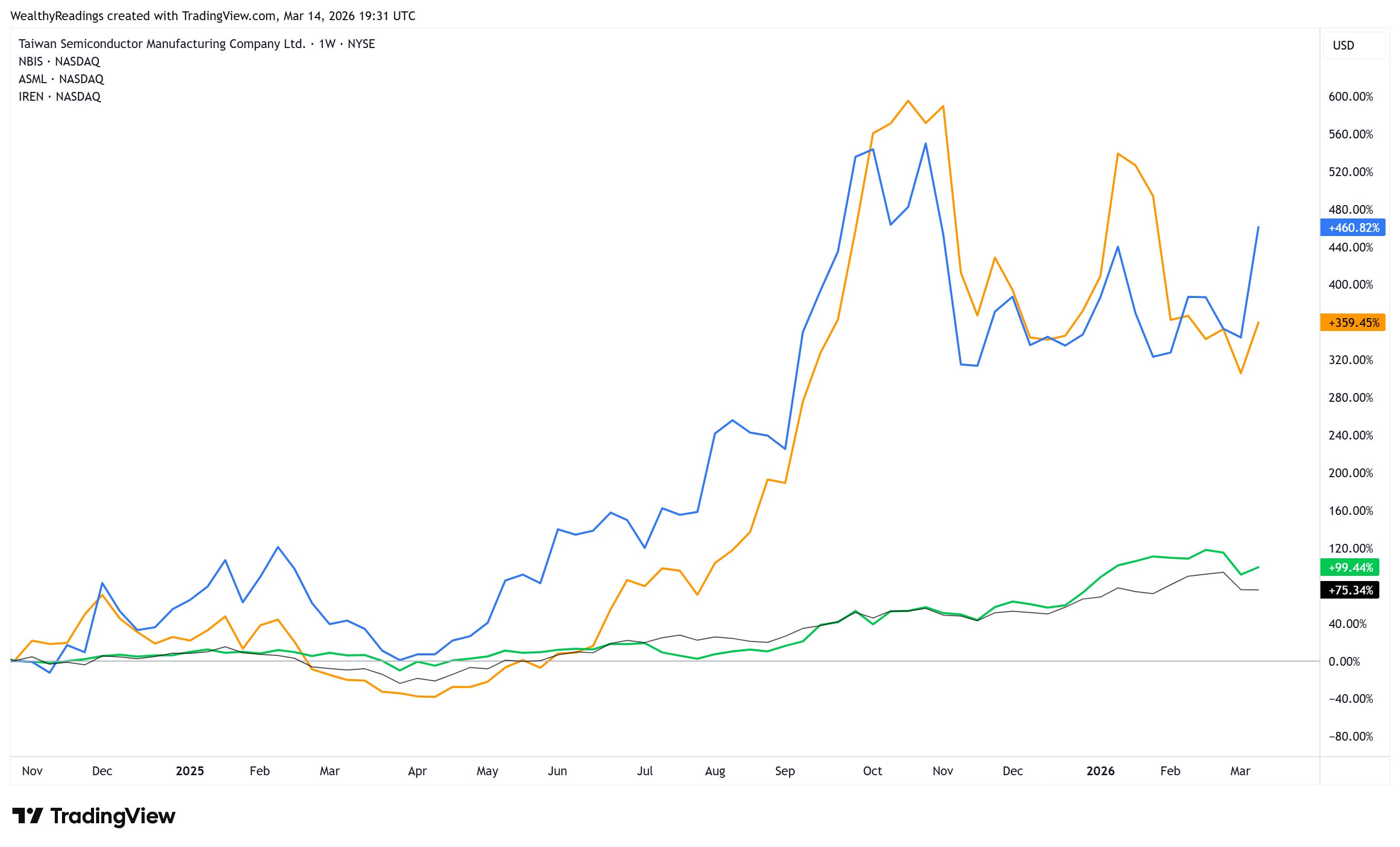
Diversification means buying assets that are uncorrelated to balance swings. At the moment I own Transmedics (Healthcare), Nebius (AI Compute), SolarEdge (Energy), and Nordic Semi (Tech Hardware). While all markets move on liquidity and will share some baseline correlation, these names won’t be as correlated as the examples above because they follow different narratives.
With my system, holding a handful of positions is easy as there aren’t that many great opportunities in every sector. We usually look at many stocks within the same sector hence the wish to hold many names but as they are correlated, this is like only collecting fire type Pokémons.
Go get that water badge.
No, when you get to the league, your team usually has six Pokémons, different types, only the best one of each, because that’s what makes a team efficient. Only the best on each of their category, with a clear plan on how to manage them during the fights to come, which to use when, to sacrifice against which, everything planned in order to win.
Clear selection. Clear strategy. Clear focus.
In Brief
We have covered the importance of having a system & the discipline to follow it. Systems are personal, they must be adapted to your personality, objectives, and strategy. There is no wrong system as long as it works for you & performs, but not having one is a guaranteed path to mistakes and underperformance.
Second, liquidity attribution is key. Small positions will not have a significant impact on your wealth. They might make you feel good, but if they don’t make you real money, what is the point? I now always ask myself this before pressing a button.
Will this matter?
This covers both the upside and the downside. Is this investment enough to matter? Is it safe enough not to jeopardize my account? Is this the best asset I can buy today?
We are all playing Pokémon, but not the catch ‘em all version. Do not mistake diversification for dilution. We are playing the final fight against the League Elite. And for that, we need the best stocks, versatile and optimized.
Not six Pikachus.
No. To win, we need to have a clear selection process, a clear method on which actions to do and when to do them, a clear focus on which names we want to optimize and use more than others, and a clear objective.
I’ll share my Top 5 tomorrow.
Disclaimer: I am not a licensed financial advisor, analyst, or broker. This content reflects my personal opinions and investment decisions for informational and educational purposes only. I hold positions in securities discussed and may buy or sell without notice. Nothing here constitutes a recommendation to buy, sell, or hold any security. Past performance does not guarantee future results.
Always conduct your own research and consult a qualified professional before making investment decisions. I accept no responsibility for any financial losses.
Interesting take of having only one per industry my only problem is you're putting all your eggs into that one company of that industry which is a huge risk my preference for safety is to have 2 in an industry. The difference between you and me might be you actually do more deep dives into the companies where admittedly I don't always do as deep of a dive so that is probably why I feel more comfortable with two per industry.