

We are two weeks into earning season now and we should talk a bit about it; most of what I saw was bullish enough for the sectors I invest in at the moment - AI hardware and space.
AI Compute & Hardware
The strength in this sector is unmatched and has been the source of most of investors’ returns year to date - combined with some defensive names. We finally are in a stock picking period, which requires investors to be involved with strength if they want to overperform.
It would be a mistake to ignore it. This is where performance is, and returns are confirmed by fundamentals. Do not ignore strength.
ASML & TSM
Both companies, which are the starting points of AI hardware, have reported good earnings and confirmed that demand is overwhelming supply. Three years into AI scaling and we are apparently still pretty far from the top.
ASML gave a bit more of the same: stable growth, healthy margins, returns to shareholders; a dream, although I wouldn’t be a buyer today. Demand for its systems continues to be through the roof and its market will remain supply-limited for a few more quarters at least, with no stabilization in sight as clients’ expansions continue while manufacturing is constrained.
Many of our customers, TSMC, Samsung, Micron, SK hynix, to mention only a few of them, have both announced major investment, major fab construction. This is still happening. There was even this morning some more announcement from SK hynix of additional investment. Despite all those investments, despite this unprecedented wave of fab buildup, of capacity buildup, we are most probably still going to look at a supply-limited market for the years to come, meaning everyone in the next two-three years is going to try to build up capacity as much as possible.
ASML is also investing to meet that demand and manufacture more, faster, and they are doing so because they are confident in the future.
The complexity with hardware cycles is that demand comes from the final client, which triggers a supply chain manufacturing increase. If you start buying all of your hometown bakery’s bread, then the bakery will start to increase its flour purchases to make more bread, right? They do so because you started buying more bread (that’s a very French analogy of me). Imagine you move out tomorrow; the bakery is left with materials it paid for to meet your demand, which just disappeared.
Any product cycle is the same; it starts with final demand. Looking at ASML’s or TSM’s commitments to judge the health of the current hardware cycle is a mistake; we have to look at the top, at hyperscalers. And those are insatiable now, which is why this cycle is slightly different from many others: final buyers commit in advance, which is a significant difference. You wouldn’t pay for six months of bread if you were going to move out.
Our customers are really telling that actually for the first time, they're really looking at longer term contracts with their customers, right? Their customers, they are entering into longer term contracts with both volume and price. Of course, that dynamic gives them a lot more confidence
It shows confidence and allows manufacturers to invest. So when hyperscalers publicly state they never have enough, privately commit to multi-million or billion-dollar deals, and have/find the financing for it, the cycle is still pretty healthy - despite what most social media was telling you six months ago.
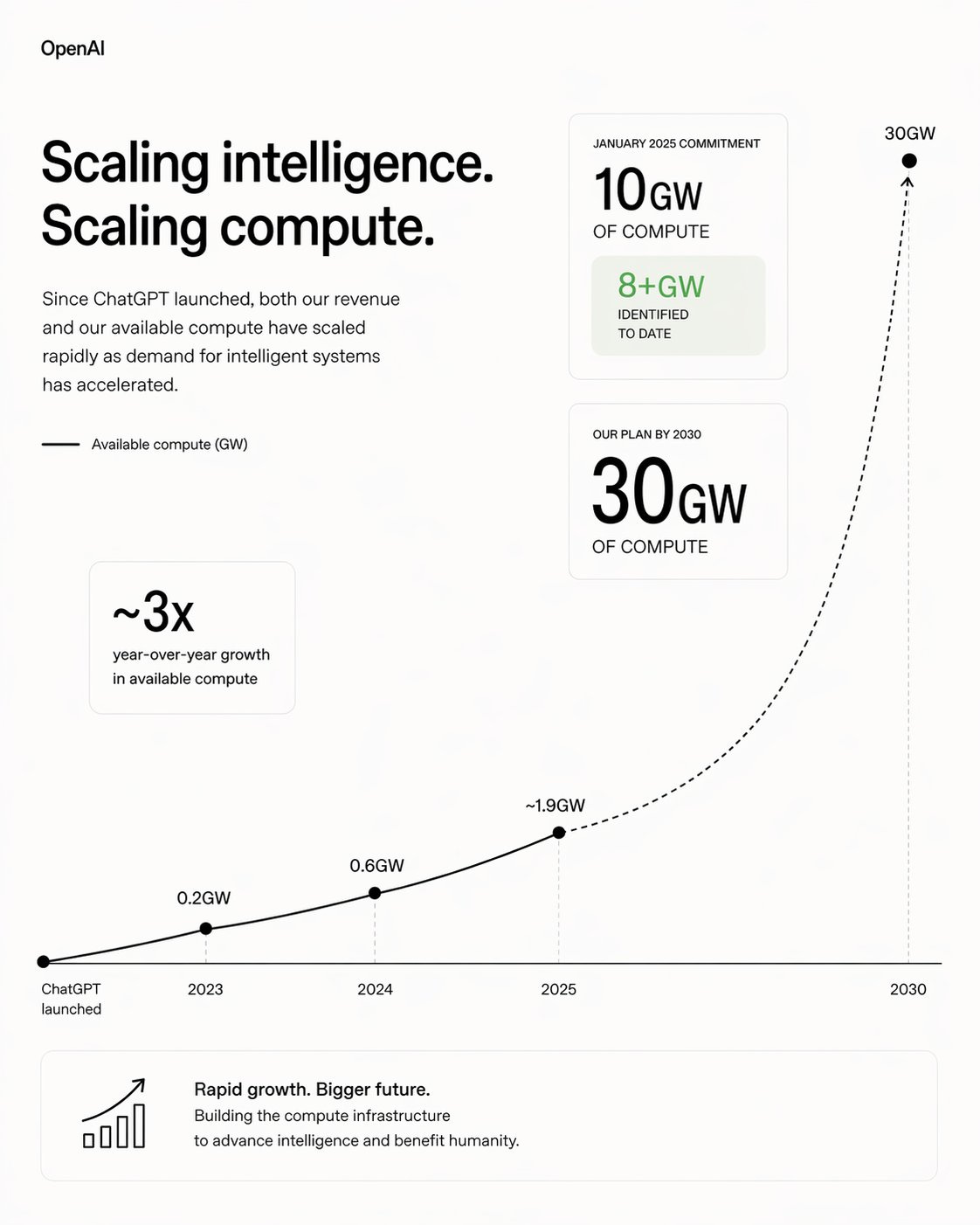
It doesn’t mean everything will continue to push higher for decades, but it shows that for now, demand is strong, with no signs of slowing down. We’ll need to get out when we see those signs, as the market will rapidly anticipate and price in normality when it happens - not if.
TSM is the same - maybe even better. Continuously explosive growth and increasing operating margins, hence their highest multiples ever as cash generation is reaching new highs and guiding to even higher highs. The market is struggling to figure out until when this will remain true - it could be a long time, as TSM will be at the heart of any AI innovation, including photonics.
Its business is going through the same, maybe even a bigger supply constraint than ASML, as they are the go-to for most semiconductor production and are sold out for quarters, expanding their fabs as fast as possible to meet demand and improve their technology. The 2nm chips are now ramping up and are the reason for improved margins and growth, while their new 1.4nm node is still under development with great expectations.
Compared with N2, A14 will provide 10%-15% speed improvement at the same power, or 25%-30% power improvement at the same speed, and close to 20% chip density gain... Volume production is scheduled for 2028.
Compute power per unit of space and energy is the most important metric in the coming years for hyperscalers, and it is the only solution to scale AI and inference further. Compute providers have no choice but to buy better hardware, as we’ll see now.
TXN & Intel
Very brief comments on TXN, as I do not cover the company. It focuses on other types of semiconductors - not focused on compute optimization, which have not been in high demand lately as AI required new compute architectures, not new power managers and the like. But we reached the point in the cycle where even demand for this kind of semiconductor is through the roof. Inventories - which have been building for years now, are starting to deplete as new specifications emerge. This is a new vertical for the sector and another confirmation of the constantly growing demand for hardware to populate data centers.
Intel, on the other hand, is a pure AI play. We’ve gone over the differences between CPUs, GPUs, ASICs, and FPGAs, and how they all treat data differently with their own optimizations. AI runs mostly on GPUs and ASICs optimized for parallel computing, and CPUs had been left behind as seemingly less necessary - as if parallel computing was enough and compute didn’t need orchestration. That assumption was of course wrong.
If you look at training solutions, they're generally running in the kind of seven to eight GPUs to one CPU. As we look into inference, it's probably getting into the three to four to one kind of level. As you get into agentic and multi-agent, it's... potentially even flip in the other direction a little bit.
That is all there is to know to be bullish, but not necessarily on Intel itself. What these results and quotes tell us is that as inference scales, GPUs will need more optimized orchestration to know how to process information. This doesn’t really exist today; Intel is working on its next generation and demand is through the roof for its latest AI-oriented products.
A year ago, the conversation about Intel was about whether we could survive. Today is about how quickly we can add manufacturing capacity and scale our supply to meet enormous demand for our products.
This means demand is through the roof for any hardware capable of helping GPUs compute efficiently and orchestrate inference; and I have two other companies capable of doing so in mind:
Arm: A company designing and licensing proprietary CPU architectures for different usages - notably used by Apple, on which we opened a trade this week as the stock broke out a 2y+ resistance.
Silicom: A company designing SmartNICs - hardware designed to offload compute, storage, networking, or other tasks from the main components.
This Intel quarter is just another proof that our AI data centers are far from their final form, that any hardware capable of helping optimize energy consumption and compute quality will be used - as expected six months ago, which makes me even more bullish on Silicom than I originally was… And on the entire AI hardware sector at large, including photonics, optimizers, neoclouds…
The market - and the world, continues to underestimate AI, the compute needs for efficient inference and the market’s strength. It isn’t our place to doubt any of it; our job is to ride the trend until it stops. Not until we believe it stops.
In Brief
Everything points to more. More compute, more optimization, more hardware, more spending... More AI. This was my assumption at the end of 2025 already, while most of the market was starting to call hardware names expensive, or even a bubble. It is finally starting to be accepted now, which makes me confident we will see another strong leg up for those names.
Maximizing compute per unit of space & energy is core for any provider’s profitability. Demand for the hardware capable of doing so will grow because providers have no choice but to buy it. They are in a race against their own leverage & need efficiency to generate cash as fast as possible.
It doesn’t mean a straight line; there will be pullbacks and breathers. And the cycle will end as it usually does: with high inventory and an end triggered by lower demand from hyperscalers and compute resellers.
But we aren’t there just yet.
Space & Iridium
Iridium disappointed the market with lower earnings mostly due to rising costs, clear signs of Starlink competition with lower broadband revenue growth, and lower hardware sales, which raises questions about future subscription sales. On the positive side, cash generation remains really strong, growth is healthy, and most of the negative points are attributed to competition, not to a structural issue in the business model or service demand.
It was a tough week for space names; between the failure of AST SpaceMobile’s BlueBird 7 and the “meh” quarter for Iridium, the sector has taken a pretty large breather. That doesn’t change my thesis, though. The names ran hot and are now having a healthy pullback, which will give us great accumulation prices if we come down and retest key supports and trends. There’s nothing more to do than to be patient.
Tesla
I won’t spend much time on it. Its EV business is back to growth, helped by easier comps as H1-25 was the bottom. Also worth noting that production of the Cybercab has started. But what is interesting with Tesla is FSD, robotics and energy.
On the first front, subscriptions are picking up with 1.28M active subs today, up 51% YoY and 16% sequentially. This is a direct reflection of consumer demand for physical AI - which is a very big question as the leap to use this technology is pretty massive in terms of psychology. They also announced a partnership with Intel for their Terafab project, which once again highlights the value of their new hardware series and the need for more than GPUs for compute.
No interesting news on Optimus except to say that production - to start this year, will be longer and more complex than expected. Surprising comments from Elon.
On energy, revenues and demand have been a bit sluggish. It is also hard to judge as Musk has always said deliveries were impacted by various delays, so the vertical’s revenues would fluctuate. I believe most of the market would have expected fluctuation with an uptrend while this quarter comes with 15% decline in GWh delivered. They confirmed demand for residential in the U.S. was still slow, while grid-scale batteries are very strong, which also validates SolarEdge’s move to transition from households only into the B2B business.
I do not own Tesla but the company is present in so many verticals that it is always interesting to see what they do.
SaaS & ServiceNow
As you know, I do not follow SaaS nor ServiceNow, but I believe it is my job to rub salt in the wound as I write about stock picking and believe buying SaaS in an environment where AI hardware is ripping with fundamental confirmations is one of the worst mistake a stock picker can make.
Our job is to pick performers. Not what feels good or we think is great.
Those companies come with real risks and reasons for their stocks to fall, and ServiceNow is a perfect illustration of it, even if social medias are full of “Look at this great quarter!” and “The market is stupid to sell this name!”.
A stock is not a company. A stock’s price is the representation of the market’s trust in a company’s future cash generation years into the future, not just next quarter. If you look at the company today, everything looks good enough. Revenues are growing, operating margins are flattish but healthy, the company is increasing its buyback programs, and overall beating expectations while multiples decrease.
An easy buy!
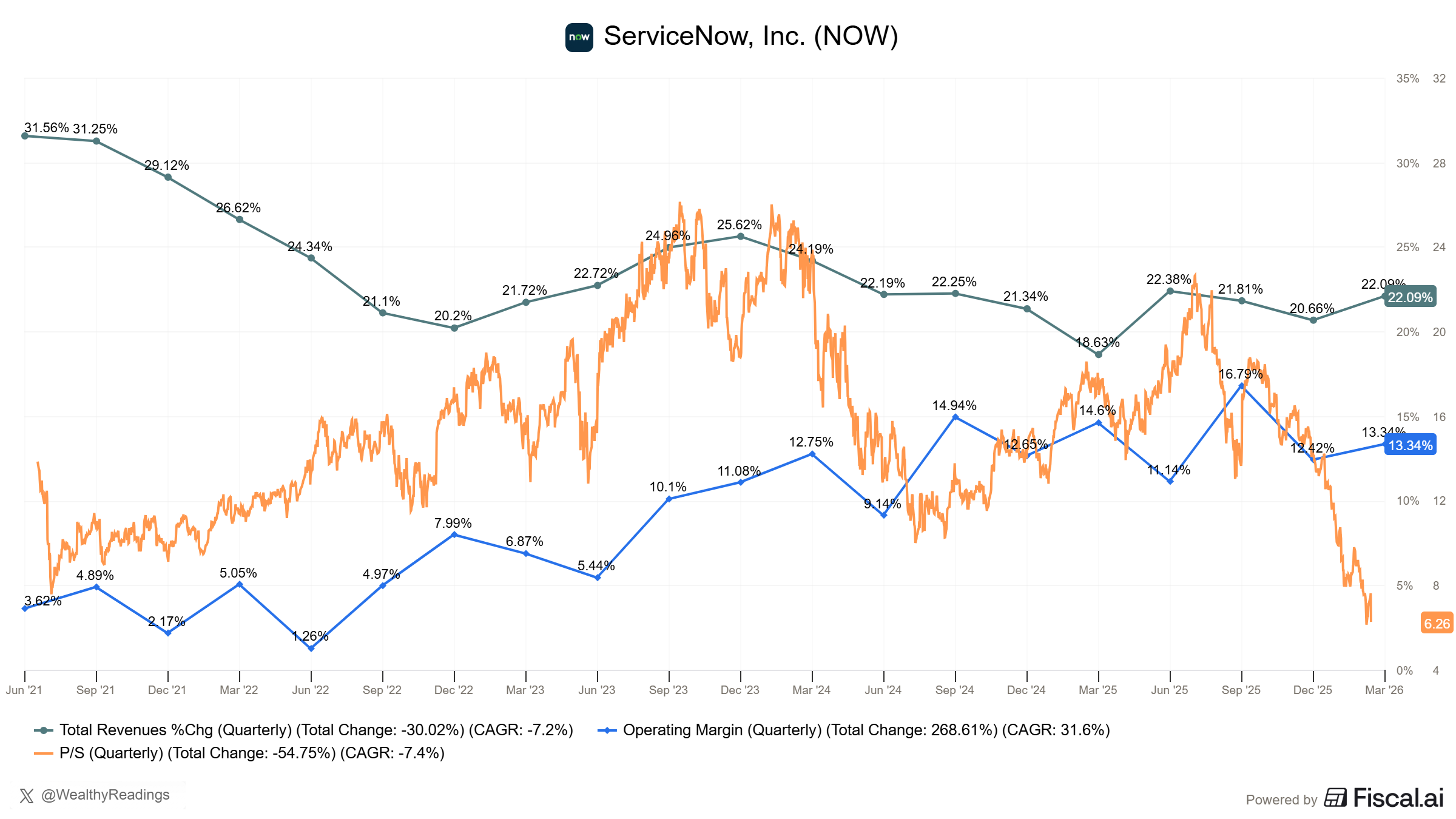
In the meantime, gross profits have been under pressure for quarters and will likely continue to be in the next ones. The market is skeptical about their delays due to “geopolitical concerns” and RPOs are not accelerating, which isn’t normal in the AI era. The market wants to see concrete results that AI will generate either acceleration or margin expansions, and so far, it is doing neither while companies like Palantir or Anthropic continue to accelerate their growth at unreal artes, which raises the question of whether AI is really a tailwind for SaaS…
And don’t give me a “but those companies are different”. Of course they are, but they also prove that AI can be leveraged to boost your financial profile and increase demand of a value added product.
So the real question is: Why aren’t we seeing an acceleration in SaaS when AI is now advanced enough to do so, and ServiceNow has had long quarters to implement it by now? And why would the company deserve more than 6x sales if its margins and revenues aren’t going to accelerate?
ServiceNow is the perfect representation of SaaS issues today. Be factual and reasonable; don’t fall into the “but it’s cheap compared to earlier multiples” trap. Performance comes with buying winners. Hopefully ServiceNow will be a winner in the future and I’ll gladly buy it.
Today, SaaS are losers. Leave them behind.
Disclaimer: I am not a licensed financial advisor, analyst, or broker. This content reflects my personal opinions and investment decisions for informational and educational purposes only. I hold positions in securities discussed and may buy or sell without notice. Nothing here constitutes a recommendation to buy, sell, or hold any security. Past performance does not guarantee future results.
Always conduct your own research and consult a qualified professional before making investment decisions. I accept no responsibility for any financial losses.