

We need to talk about space.
As you guys know, I have been running my screeners for a few weeks and besides photonics/AI hardware - both of which we talked about at length, another recurring theme the last three weeks has been space related names, with ~10 stocks the last two weeks only.
So instead of doing one write up per opportunity, I will summarize the bull case in terms of both fundamentals and narratives and list the names I found to be the most interesting. There will be more in the next weeks as the bull run on this sector seems to only be starting so I will just use this write up as a support to recap the bull case when new ones show up.
Space tickers are ready to rocket.
The Growing Narrative
It isn’t new but it is accelerating, for valid reasons. First, let me add a disclaimer right away as most space-related names have massive CapEx and no commercial source of revenues - most not all, there are some exceptions - some we’ll see today. Still, they overall mostly rely on governmental contracts and burn cash, and it is normal.
Space exploration and exploitation isn’t going to happen commercially tomorrow, it will take decades to reach its peak. Today, we are going through the R&D phase with companies receiving governmental contracts to set up the stage for commercial exploitation in the future. So I wouldn’t call those companies long term investments yet, but narrative driven positions - and narrative matters more than fundamentals in the markets; it is possible that one of these becomes a fundamental winner in the next decade, but it is impossible to foresee today.
But the narrative is certain with key events happening over the last few months and accelerating lately, with more space missions and enthusiasm, focus even around the sector, also driven by technological improvements and most importantly, competition as there is a relatively new player in the game: China.
The race for the stars is factually a race. There was no rush without competition post-Cold War and USSR collapse, but this is changing now.
First… Why?
This is a core question for many around the world - especially ecologists, tearing their hair out watching rockets go and come… There are reasons to launch those rockets, you can agree or not with them but space discovery and exploitation is important for humanity, for different reasons.
Humanity needs to be interplanetary. We do not realize this because we - personally, will be long dead when the need comes; but a species cannot survive without escaping its home planet. This isn’t a fantasy, the Earth will go through another ice age/hot age, our civilization might destroy our climate or the earth itself with weapons/wars, the sun will eventually die, and that is only what comes at the top of my mind. The need to leave could not materialize for the next million years but it will, and IF our species is still alive then, we will need to leave. One of the best movies of all time explains this very well; it isn’t fantasy.

Now if you start from the premise that it doesn’t matter because our species won’t survive or because you personally won’t be there, fine by me, and then all of this can indeed look pointless.
Known & new resources. Not only are other planets full or resources that we could use for hardware but they also have different structures which could help us manufacture hardware we cannot on earth because of its gravity. We are already manufacturing semiconductors or doing healthcare research in space because of this lack of gravity and having access to more space/different ecosystems would create opportunities - if only because materials would behave differently. The same movie also shares this.

Today’s space usage. Shorter term, space is interesting for many verticals.
Earth Observation. Most of the satellites in low orbits have one objective: retrieve data. They allow scientists to observe and collect datasets from weather to animals passing by natural disasters and farming… The amount of valuable data collected from space is unimaginable.
Communications. Many hardware can be integrated into custom satellites and communication has been a focus for years now, for commercialization with ASTMobile or SpaceX but also for emergency services and remote connectivity. Some are even talking about datacenters in space.
Warfare. Whether we like it or not, the reality is that space is used in warfare with intercontinental missiles leaving our atmosphere to travel faster at a lower energy expense. Control of space means control of the next warfare generation, just like controlling the ocean or the skies a few decades and centuries ago.


Those are already solid arguments and whether I personally agree with them or not is somehow irrelevant. This is where we are headed and this means capital will be allocated to those research and sectors which after all is what we talk about on this Substack as it will create opportunities.
The Race Acceleration
The race for space dominance started years ago, during the Cold War, and slowed down after the Eastern block collapse as the U.S. ended up the clear winner with no serious competition and focused shifted.

But there is a new adversary today, not a small one: China, which on the contrary has been accelerating spending over the last decade.
Today's Chinese successes are proving that the U.S. either needs to accelerate or be left behind - and they will not accept to be left behind. Here are some of the Middle Kingdom’s achievements over the last decade, starting from virtually nothing three decades ago…
The Chang’e Program (2019 - 2024) - Chang’e-4 is the first-ever soft landing on the lunar far side; Chang’e-5 drilled into the lunar surface and returned samples to Earth, Chang’e-6 landed in the South Pole-Aitken basin on the lunar far side, scooped up material, launched an ascender back into lunar orbit, and successfully returned those far-side samples to Earth.
Tianwen-1 & Zhurong Rover (2021) - the first nation to successfully enter orbit, land, and deploy a rover on the Martian surface on its very first attempt.
Tiangong Space Station (2022) - launched and fully assembled modular and permanently crewed space station in Low Earth Orbit (LEO), comparable to the ISS with a continuous human presence since its completion, serving as a hub for international research.
BeiDou-3 (2020 - 2022) - global satellite navigation constellation. This means China’s military, commercial shipping, and smartphones are no longer reliant on the U.S. military’s GPS network for positioning and timing data. They also proved their capacity to “tow-truck” satellites into a graveyard orbit which not only shows they now have the technology to maintain their constellations but also push others - attack really, in case of conflicts.
China isn’t just a competitor, it is a leader in some sector and lots of specialists tend to say they will achieve the next major steps before the U.S, with Chang’e-7 and 8 focused on moon’s resources extraction, Tianwen-2 and 3 to collect and return components from an asteroid and Mars respectively, becoming the first country ever to achieve this, or their satellite constellations expansion which could become bigger than western ones before 2030, while the next steps on the moons are also part of the race.
One of the critical technologies to move forward in space conquest is reusable rockets and while SpaceX is incontestably the leader, Chinese tests are very promising and like in the U.S. led by private companies subsidized by the government - which forces competition and innovation.
China is not lagging in technology anymore and has tailwinds the U.S. doesn’t have, notably when it comes to manufacturing. The winner of this race will not only be the one that lands the first human on the moon, it will be the one with the technological knowledge to build a base on the moon and extract resources. All the Chinese missions are designed to reach this target ~2030 with a very healthy momentum while the U.S. is waking up from a very long nap and starting to scale their expenses, accelerate missions. They have the first mover advantage and an edge in technology - especially communication, but the gap is closing extremely fast.
And the only way to win is to accelerate.
This is what they are doing; I already talked about NASA’s missions acceleration towards the moon in my review of Intuitive Machines and Firefly Aeropspace - two space opportunities shared last week.
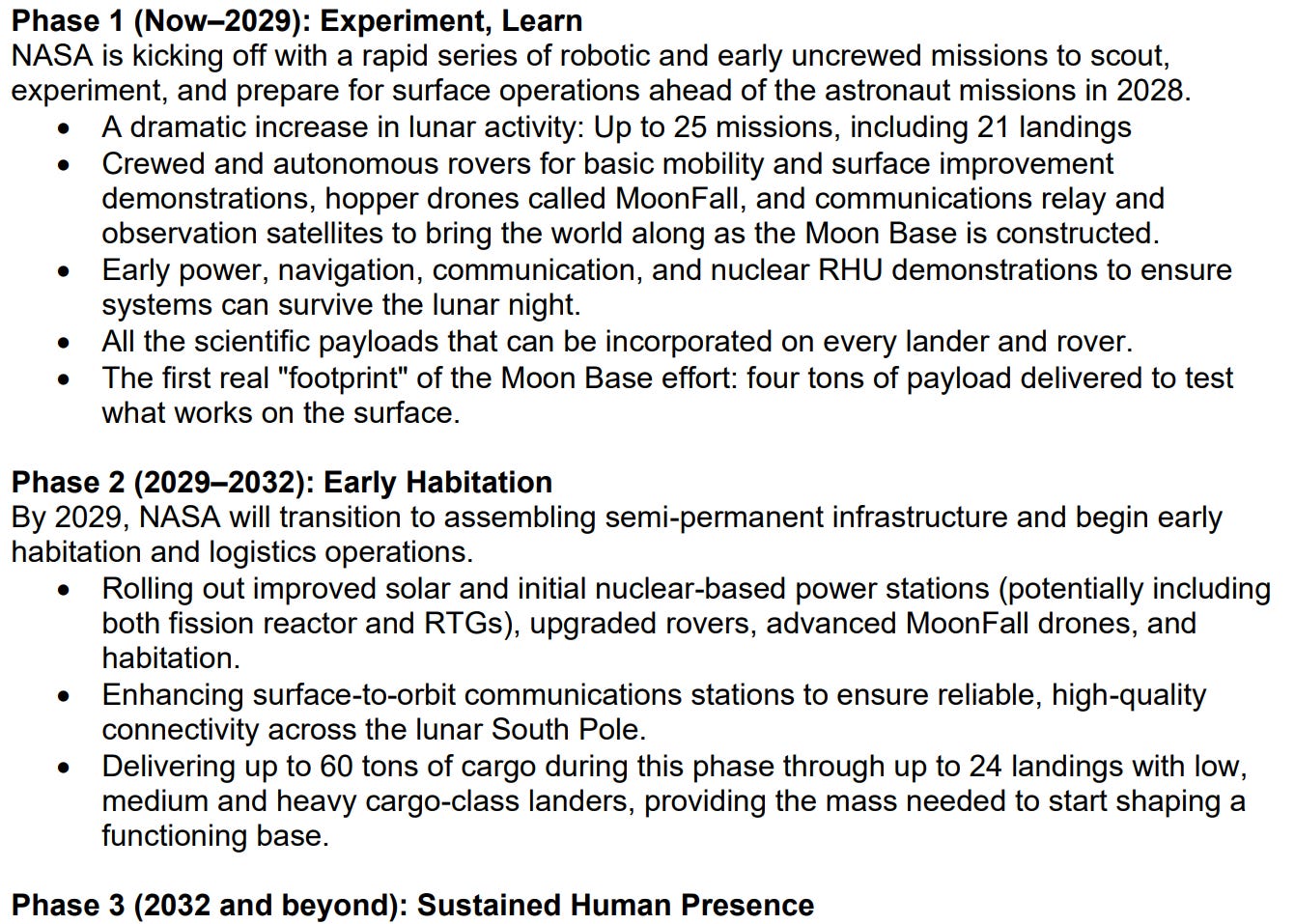
This release is dated from March 2026 and talks about 25 missions until 2029 - one every two months, expensive missions which require tons of equipment and money flowing to the companies manufacturing or servicing them.
This is the core narrative, boosted by Chinese successes, with a global thrill from narratives like SpaceX and Rocket Lab successes - especially the former’s reusable rockets and Starship test flights, the Artemis II success last week with its flight around the moon resulting in large datasets and incredible pictures, and the excitement around Artemis III planned for 2027 to demonstrate U.S. private companies capacity and technologies to land a crewed ship to the moon, while Artemis IV, planned for 2028, should see the second real human landing on the moon.
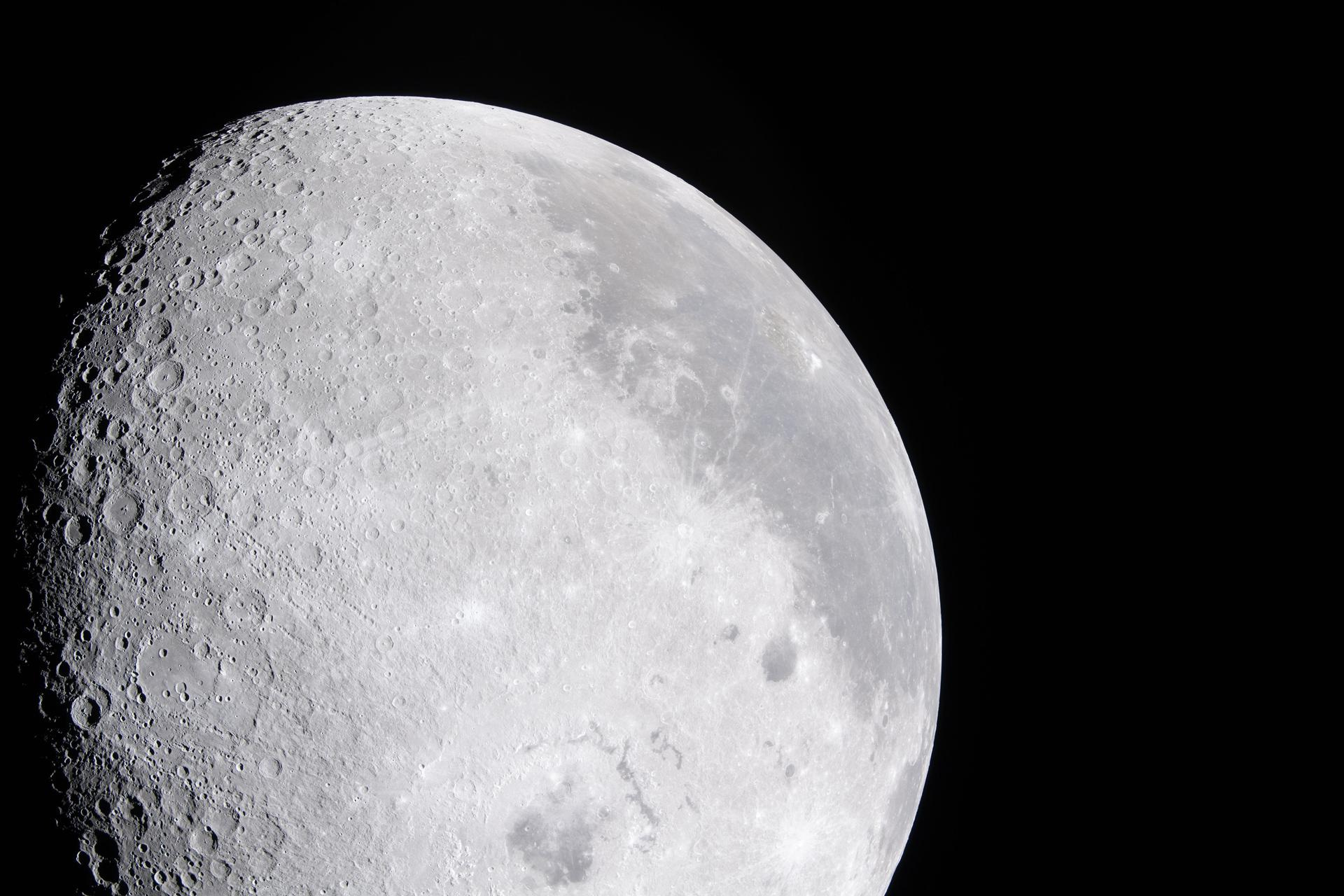
The space is a now priority again for the U.S, spending is unlocked, missions are accelerating and the enemy isn’t joking while control of space will unlock advantages for the first mover in terms of resource exploitation and warfare.
Liquidity, Narrative, Fundamentals
You know how the market works now and I’ve already answered why I expect space-related stock to push higher over the coming years - some already have.
Liquidity from a business perspective is a matter of governmental spending which we know can be unlimited if deemed necessary and investors will go where revenues accelerate the most - and space has the potential to be that sector after or in parallel of AI datacenters and compute demand.
Narrative is a matter of momentum driven from the current frenzy around space plus SpaceX and China’s successes which revived the space race. Governmental contracts are also diversified by design as the government wants to maximize its chances of success, meaning diverse companies with thoughts and processes give more potential - and more winning stocks.
Fundamentals are real; they are the last vertical of what make stocks move but even if we are talking about speculation, R&D, cash burn and negative FCF, the winners will unlock contracts for the most important human expansion to ever happen: colonizing space. Finding the winners today is impossible but there will be some, probably some named in today’s article, and our job will be to cut the fat as the market progresses while ridding the narrative.
From here, the only question left is what to invest in?
As usual, most of my stocks come from price action screeners as we want to invest in sectors with structural tailwinds and market action. I’ve had ~10 stock in my screeners over the past two/three weeks which is significant and means market participants are buying those names big time. You want to be with them.
This write up is meant as a presentation of opportunities, not a detailed review of each company so depending on your system and investment strategy, more research will be needed. I personally intend to play the momentum as it is impossible to value those companies - cash generation isn’t their strong suit. It’s all about narrative, contract announcements, momentum, optimism, and that is the game I’ll play.
The Already Winners
The sector isn’t starting now, one of the main narratives is SpaceX IPO planned later this year - no date set yet, with a capitalization expected ~$1.75T, making it the 9th biggest capitalization on the U.S. market in front of its brother Tesla. This IPO is going to attract lots of capital towards space names and push momentum. But SpaceX isn’t the only space winner and momentum is already here.
Rocket Lab, the only proven orbital launcher publicly traded - until SpaceX joins, up 1,154% since 2024.
Planet Lab, a low-latency satellite imagery provider, up 1,434% since 2024.
AST SpaceMobile, a company with a proprietary satellite technology for mobile connectivity, up 1,519% since 2024.
I am not here to say those will not be winners in the future but they ran a lot already and I would look at them only for short trades assuming their stock holds key support and give great retests. They are already very extended and expensive, even if revenues and cash generation are impossible to predict, the R:R isn’t here long term to me.
The Winners to Be
I selected a few names which met my framework and will present them today with a brief fundamental review, how they integrate in the space supply chain, why they should benefit from the actual narrative - besides speculation, and a price action review to see how we can ply them. I already talked about Firefly Aerospace and Intuitive Materials so I won’t again, you will find everything you need here.
Orbital Infrastructure, Telecom & Data
These companies own and operate satellites constellation and offer different services.
Iridium Communications
This one already popped on my screener in February but I did not have time to do my research - and missed ~50% returns in a few weeks.
The company operates a L-band constellation in Low Earth Orbit (LEO) and offer different services to different sectors, focused on communications or geolocalization as their signal is designed to penetrate severe weather, making it the go-to for maritime/aviation transport or remote location.
Iridium is not a speculative asset.
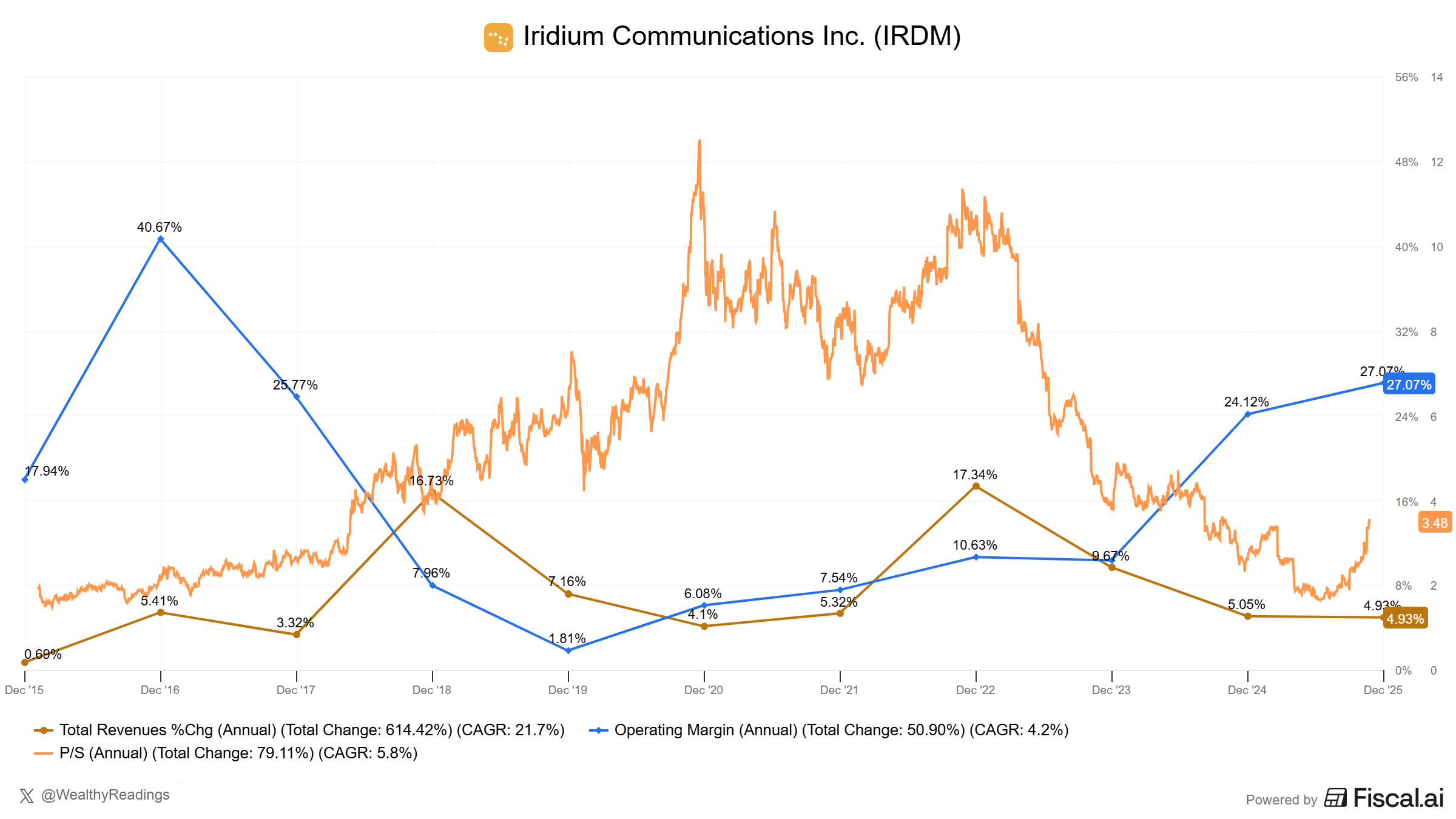
It is a well established company with recurring revenues and growing margins as its services increase in value added while its stock has been left behind by the market and is now catching up on “fair value”, helped by the ongoing space narrative.
We could talk about Viasat and Globalstar with comparable fundamentals and chart profile but Iridium remains the strongest play with large cashflow, strong position even with Starlink knocking at the door, and funds to expand its constellation and service added in the years to come. This is the safest space play I can share today, at a great valuation and with a clear investment plan, but optimism could lift the two others as well.
The stock ran ~50% since its breakout a few weeks ago and only went higher since, now triggering my trimming alerts so I wouldn’t jump on it here, at all. This was the first breakout on growing volume and we should see a retest in the coming weeks/months. This is what we wait for.
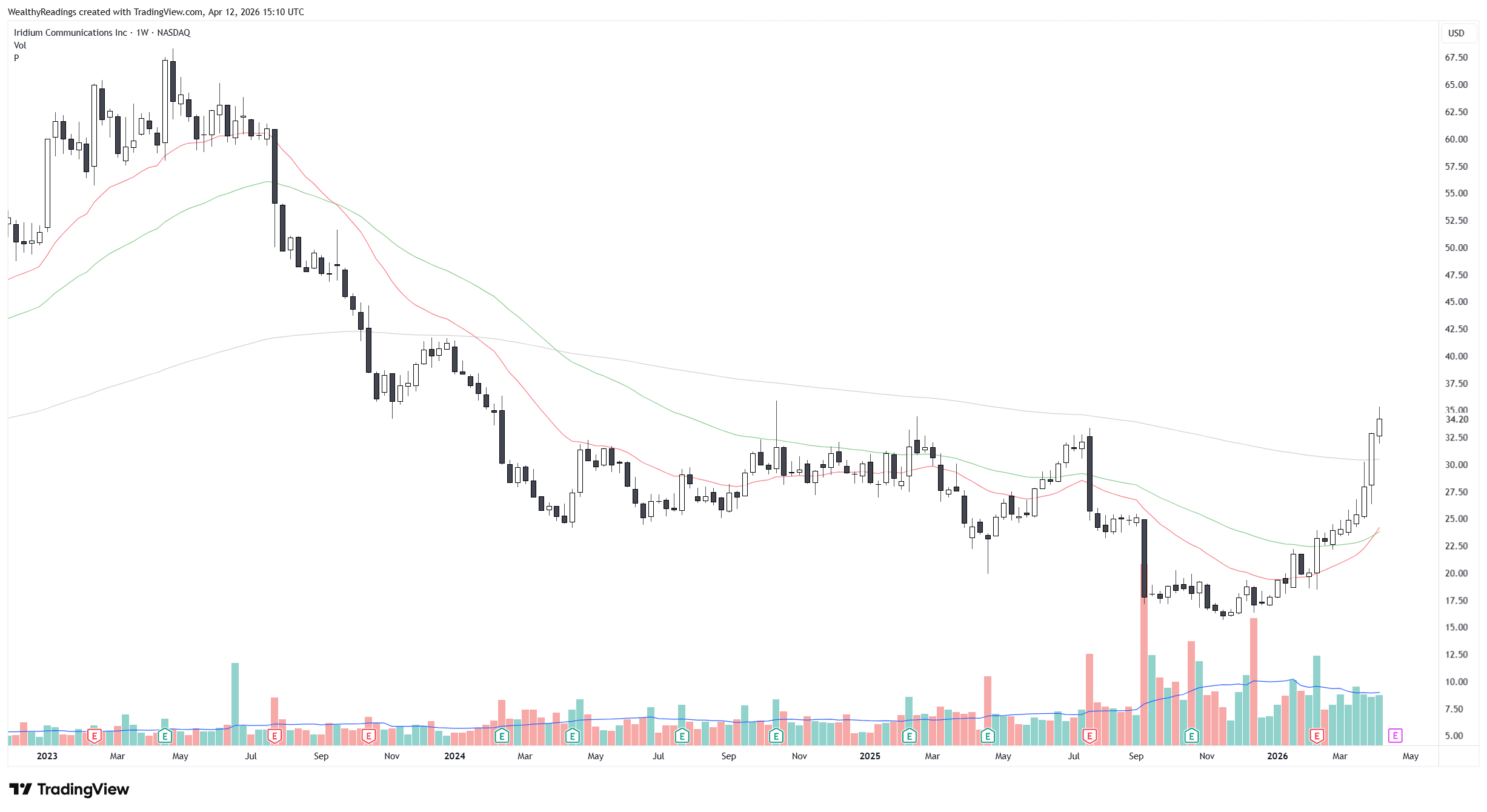
W50 now sits ~$25 and could climb a bit higher, I personally would be interested sub $30 if the retest was given. There is no rush for when an entire sector starts an uptrend, nor lack of opportunities. We have to be patient and attribute liquidity to the best prospect, not chase the best runner.
EchoStar
This one isn’t a great play, even though Social Medias are spamming it lately, so I wanted to share some words here not to be fooled. EchoStar is a SpaceX proxy, they own shares after selling to SpaceX their spectrum licenses. It isn’t an opportunity at all and I’d avoid it at all cost as the market now expects a $1.75T valuation for SpaceX and has priced in EchoStar’s shares for it.
Earth Observation & Analytics
We’ll find some more explosive opportunities here with lower valuation and newer business models, leveraging AI and new systems. Higher risks and potential rewards.
Spire Global
The company operates a constellation of nano-satellites to collect radio frequency data to track maritime, aviation and weather patterns, and resell this data through API, or let them deploy their own software within their satellites for local treatment.
Satellites are usually equipped with high quality cameras to take pictures which means nights our cloudy weather impact their service. Spire satellites work like bats, sending radio waves and looking for their return to map their environment regardless of light or weather… except these satellites do not send waves, they only look out for them. Every technology or movements generate waves which can be captured and used. This is what Spire’s satellites do.
Spire is also a turnaround story as it sold its maritime business for ~$240M in April 2025 and used the proceeds to pay down its debt, leaving ~$110M of net cash to operate its business which at ~$17M quarterly burn gives the company a year and a half of running. The second turnaround narrative came in March with their quarterly report and a 50% YoY growth guide with EBITDA profitability and positive cash flow early 2027 while excluding their Canadian WildFireSat program - meaning there is upside to this guidance.
The source of growth? Spire proved that they can use a single satellite to detect S and X bands radar signal used by military radar system. This enters a warfare part of space called real-time electronic warfare intelligence (RFGL), meant to detect when radars are used in specific geographies as they by design will release radio waves and make themselves detectable as they try to detect what is around them. This could allow to find dark ships, defense systems, GPS detections and more. Spire intends to 15x its RFGL capacities over the next year with manufacturing in the west, funded mostly by the U.S. DoD and allied nations fundings.
Spire is currently engaged with 17 countries and is negotiating sovereign constellation contracts in the high 8-figure to low 9-figure range while agencies like NASA and NOAA are outsourcing satellite manufacturing and are increasing their fundings for RFGL-like systems for non-defense purposes.
Spire hit in a handful positive narratives at the same time with uncertain geopolitical times, a global enthusiasm around space, a very healthy financial restructuration and profile, a new technology for radio waves leveraging AI, and an increasing spending for defense purposes in the west. All those news were fairly new and justified a massive spike in stock price and volume interest.
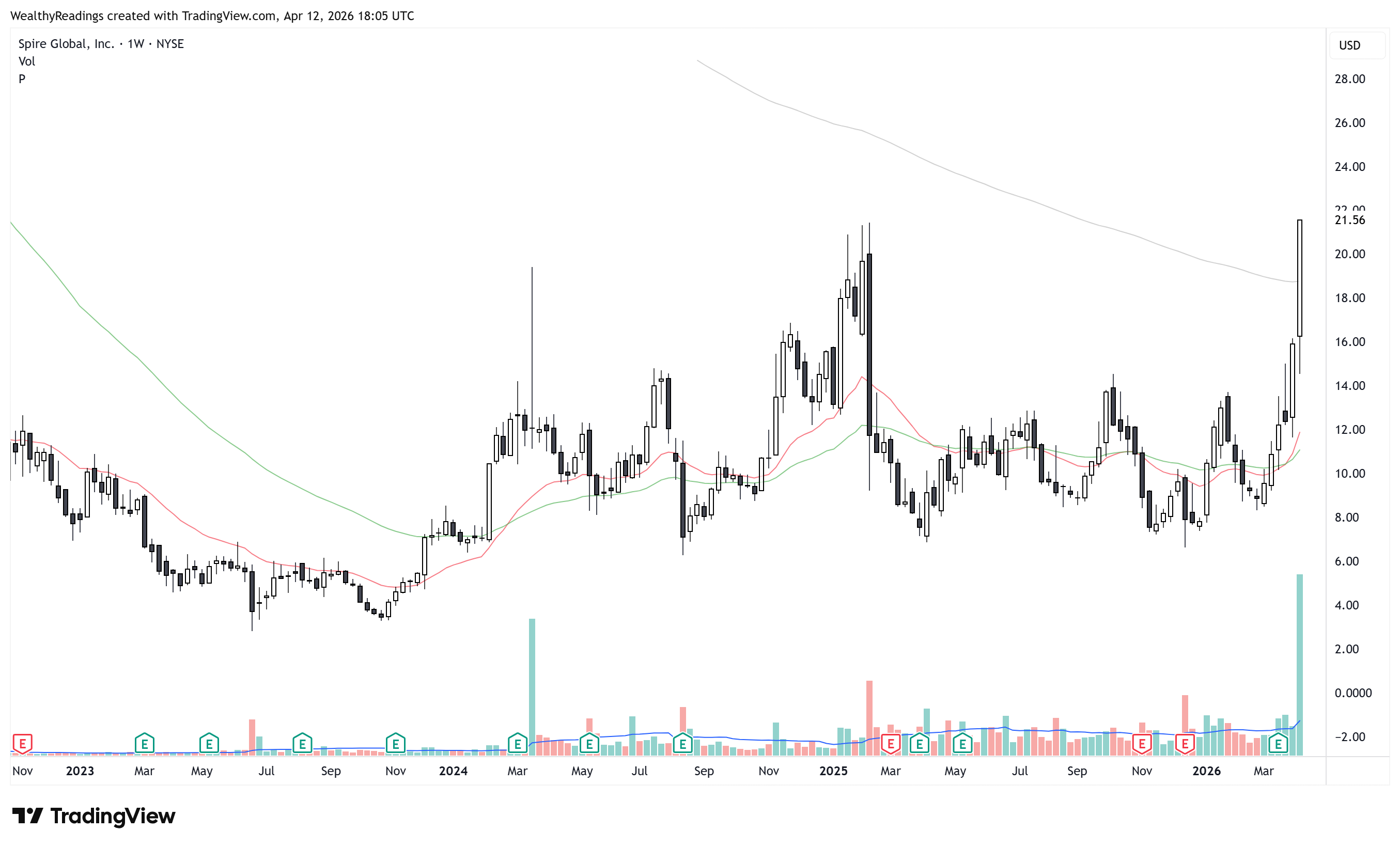
As usual, exactly what I look for in a chart, with a perfect entry ~$14 on the breakout retest as the market and traders digest this massive 72% push in two weeks, hopefully as soon as possible. This is a high risk high reward play, the only of its kind as competition is only in the private sector. Be careful of volatility.
Spire is the most interesting high risk high reward opportunities in this write up.
BlackSky Technology & Satellogic
I will treat both together as their core business is identical: earth observation with lenses this time - traditional observation and data collection with images from LEO satellites. The difference lies in their customers and their specialty.
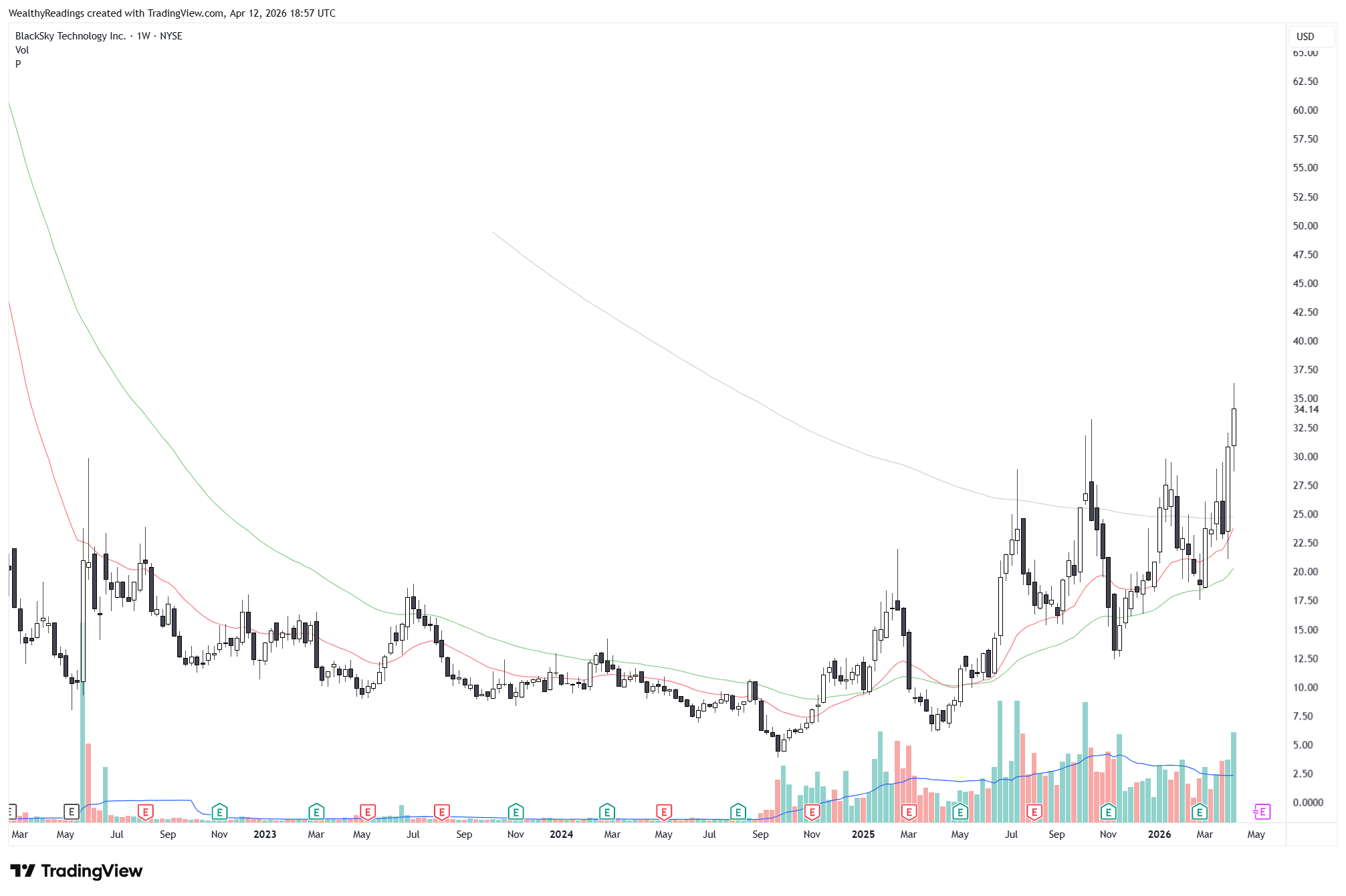
BlackSky is focused on AI interpretation of images focused for defense. They do not sell images, only interpretations after analyzing hours, days or weeks of the same high priority target, like Iranians’ military bases to find the numbers of jets hidden within hangars or caves for example. Their business is defense systems and high precision observations for allied governments who need real-time tactical analytics, not just raw data images, and the thesis relies on growing demand for such analysis as the west is increasing spending - U.S. and Europe alike.
Investing-wise, same pattern as usual with growing volume, clear breakouts and W50 retests; purchase zone either aggressive at the $30 retest or waiting for a deeper retest on the W50 ~$22 for a better R:R - if it happens.
Satellogic is a bit different; their public objective is to map the entire Earth to the meter with high resolution images and leverage AI analytics, just like BlackSky, but not only defense focused - even if they did sign a contract with the DoD recently. The company builds its own satellites in house and focuses on rendering the service as cheap and fast as possible, to ship a usable satellite in months at the lowest market cost to large companies or states for sovereignty purposes, and proved this concept by signing two satellites and their operation for Portugal with a $80M multi-years contract - significant as the company generated $15M revenues FY25.
Satellogic is a small actor operating cheap satellites focused on rapid image capture and AI analysis if necessary which gives a flexibility which doesn’t exist in the industry, images can take days and be expensive from legacy players. This is their value added and they intend to push it further with their Merlin constellation designed for the continuous remapping of the Earth to the meter, combined with AI compute directly in the satellite for final analysis sent down to Earth. Very comparable to BlackSky but cheaper and not military focus.
The narrative is also boosted by the financial restructuring and FY25 ending with 25% reduction in opex making their operation healthy financially while sitting on $38M of net cash and a $65M non cancellable backlog for the next years with $28.6M to be recognized over the next year - an expected growth of 90% YoY after growing 94% YoY this last quarter organically.
I’ll let you guess the chart pattern.
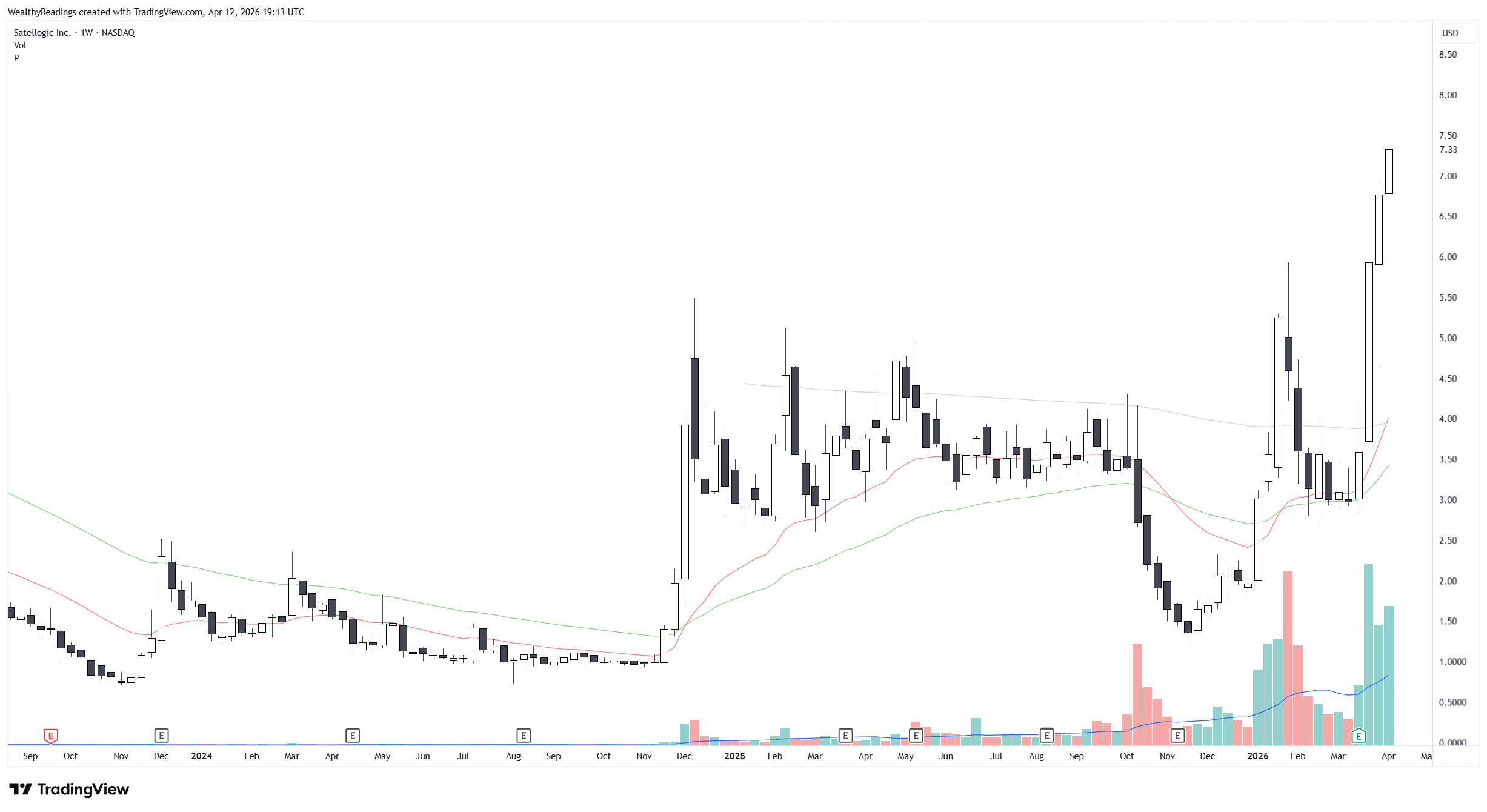
Vertiginous today, yes, but we aren’t FOMO investors, we are patient. Volatility goes both ways and we will see a retest eventually, even if it takes weeks as a 143% in a month triggers profit taking. Aggressive buying would be the breakout ~$5.5 which could be a bit high as we are talking about a small capitalization and lots of volatility - to treat lightly. Key averages are between $3.5 and $4 which seem much more reasonable but would require a ~50% drop - possible but still deep. Both would be great entry depending on your profile and system.
Satellogic could become a new giant of Earth observation, but the risk comes with the potential reward here within a pretty competitive industry.
Conclusion
Once again, this is a rapid review of interesting opportunities I would invest in based on narrative and price action, with interesting fundamentals/potential. These remain speculative and to be treated lightly as most are high risk high reward. Nevertheless, they are worth spending a bit more time if one of them interests you - I personally have seen enough to put my money where my mouth is at the right price.
Space seems to be one of the theme for 2026 and even if most of those companies will need years to fulfill their fundamentals and reach their full cash generation potential, the market is a forward looking engine.
This write up, combined with my previous one gives you a concrete overview of why space is so important, why the market is looking at it and six names which all share the same setup, plus four more which already ran massively but still can be traded on key support if that is something you do.
Disclaimer: I am not a licensed financial advisor, analyst, or broker. This content reflects my personal opinions and investment decisions for informational and educational purposes only. I hold positions in securities discussed and may buy or sell without notice. Nothing here constitutes a recommendation to buy, sell, or hold any security. Past performance does not guarantee future results.
Always conduct your own research and consult a qualified professional before making investment decisions. I accept no responsibility for any financial losses.
Tickers: ASTS LUNR FLY RKLB PL TSLA IRDM VSAT GSAT SATS SPIR BKSY SATL
As an investor in Echostar, I need to ask why are you bearish on the stock? The current value of SpaceX makes Echostar look undervalued at least according to AI and if we consider there could be huge hype into the IPO and after that will also boost Echostars price as it will go up and down in lockstep for obvious reasons at least in the short term. Of course once the hype dies down it may collapse as people will just prefer to own SpaceX directly but I don’t see any problems as a short term trade to ride the hype cycle , I will probably sell after some profits and buy actually SpaceX stock once hype dies down, though I have been told Space X will have another huge bump 3-4 weeks after ipo as it enters all the ETFs
SATL is indeed very interesting if you check the list of institutional holdings and board of directors … it’s definitely a company with VERY strong connection with this US administration. But I guess we are too late to the party. Wait for the next dump-pump. Right now it’s better to fish elsewhere for asymmetrical speculative asset bets… such as those nuclear SMRs tickers that were beaten down heavily since late October