

No one talks about selling, which is arguably the most important part of investing as your gains are decided when you press that button. Buying and stock picking are obviously as important, but those are meant to set you up in the best conditions for the future. Selling secures the gains.
Stock picking, buying and selling are the trinity of investing.
And social media only focuses on two of them.
There is a reason for this, something called the sunk-cost fallacy.
It is a psychological phenomenon triggered after studying the same subject for hours, days sometimes; spending so much time and effort on it that we become emotionally attached. In plain English, this is falling in love with your stock. This happens to most investors who end up so caught up that they’d rather just hold through thick and thin instead of building an exit strategy to secure their gains when the time has come.
One of the most blatant examples I’ve seen of this effect was Hims; fundamentals were clearly deteriorating but the Hims community just kept encouraging each other to hold through it, because that is what investors should do. The stock plunged 78% right after and is down 56% since. The same happened with Duolingo and so many others.
The ugly truth is that selling a stock hurts us, emotionally, to the point that shrinking returns feel better to us - seems crazy and yet…
Selling is key. But it has to be made emotionless not to fall into the traps of human nature, which can be to never sell just as to sell too early thinking “I don’t believe we can go higher even if I don’t know why”. Selling has to be made mechanical to avoid these traps, and that is why it has to be part of a well-oiled cycle, just like stock selection and purchase.
My Process
As with everything in investing, a system is personal.
Traders will sell once their targets are reached. Some investors never sell. Some sell on fundamental changes, others on technical… There are no rules to what a system should look like, but we all need to have one. To buy, hold and sell.
I have two categories of positions:
Core positions, assets bought at a healthy price after market’s confirmations.
Swings, shorter-term positions bought to extract pre-defined performance.
I look at the same kind of assets for both, but I treat selling very differently.
Swings
My swings always come with a crystal-clear plan. I already know the narrative and the fundamentals, I look to buy on a key support and know where I want to sell. I usually use margin for those positions so my focus isn’t on the position’s potential risk but on my capital’s potential loss.
I don’t care if a name ran 2,158% and trades at 181x sales; if I can risk 1% of my net worth with high probabilities to return 10% with margins, it is a good deal. I do not intend to build a position for the next decade, just to extract a defined performance with a defined risk.
Let’s look at my Axti swing as an example. I bought the name because I follow the photonics vertical and am aware of the fundamentals and narrative behind each of its leaders - Axti being one without any doubts. I wouldn’t swing a name I do not know.
Since its bull trend started, the stock pushed on constantly accelerating volume and has never lost its D50, which makes it a logical entry point. Statistically, buyers and algos should step up on this level (they did).
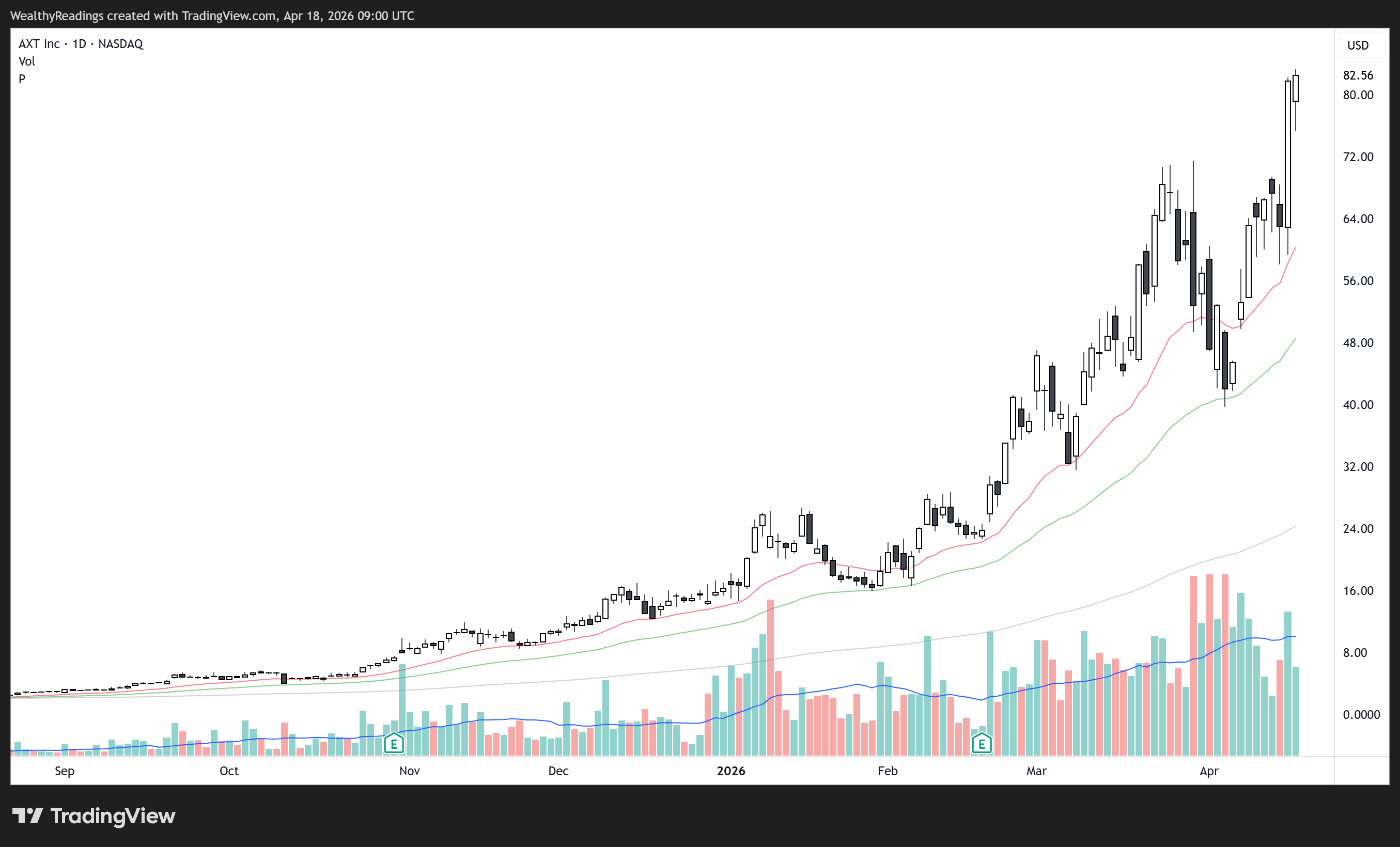
Entry is set, position is built on margin, which makes its risk higher than a normal cash secured position so stop loss follows - in this case a 5% flat below entry price. And as I did not want to overdo it, I set up a take profit slightly below all-time high at $69.
This is a swing. Clear entry in terms of narrative, fundamentals, trend and support with a non-negligible probability of success, tight stop loss as capital preservation is the #1 rule when using margin, and profit targets to avoid greed. Yes, sometimes - like here, the name breaks out after your profit, leaving you behind.
But this trade, bought on margin (cash I didn’t have in my account), returned 64% in six sessions while risking 5%. This is a net bonus on an investing account. It is better to cut a margin position after a great trade than let it run and fall into our human nature traps like greed or FOMO, for the stock to reverse and burn you. Margin is a dangerous tool, to use only within a clear system.
If I were to complain about potential gains, I’d do so with IQE which had the exact same setup but ended up running 104% after I took my profit at the previous ATH.
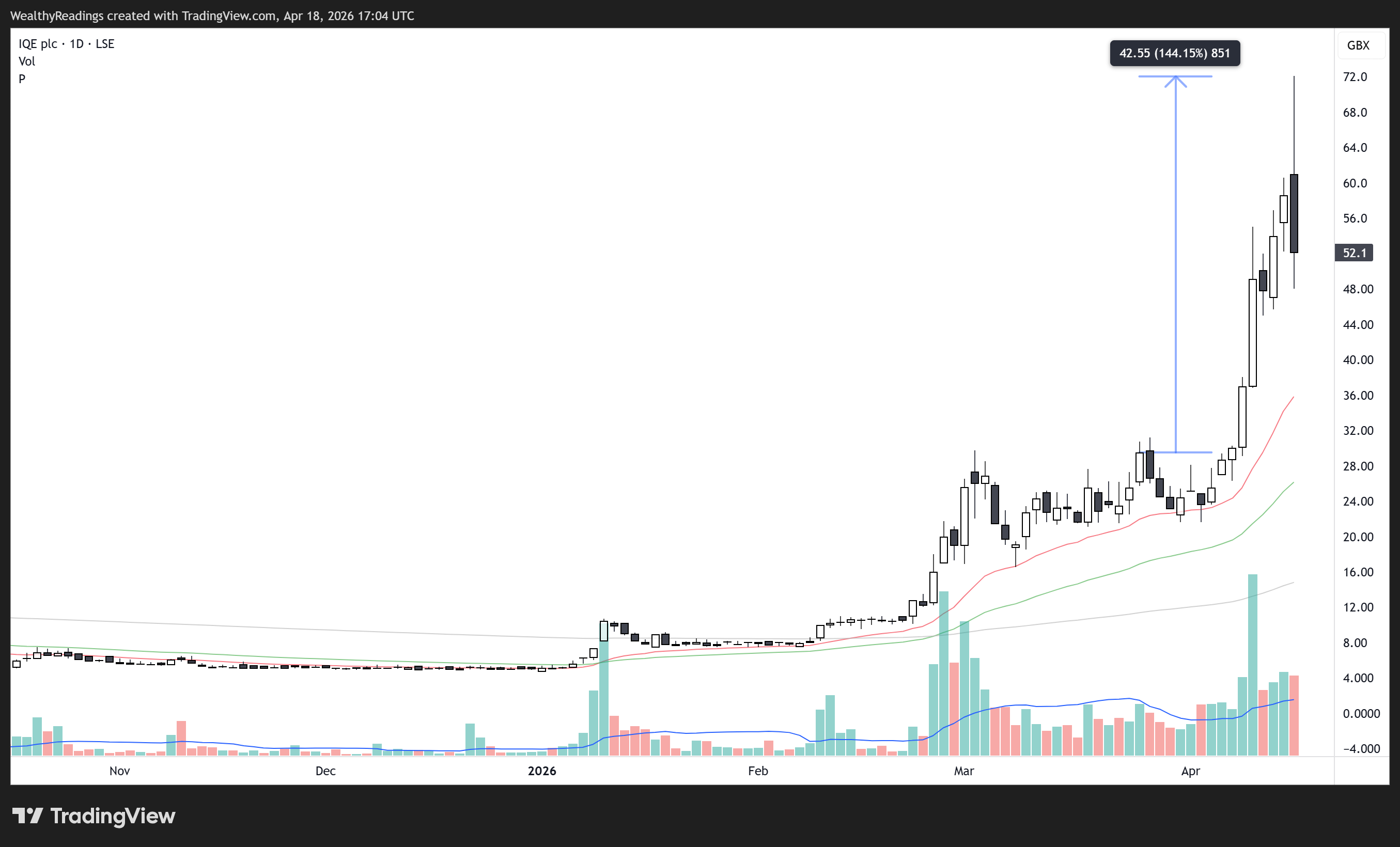
Selling is a plan for swings, not a reaction. Every entry comes with an exit and there is no coming back. The trade works or doesn’t, no in-between.
Core Positions
I treat my core positions very differently because of the conditions they were bought in: healthy prices at the start of an uptrend; their run should span through months at least and go through many ups and downs, which as long as key levels are respected, I will gladly stomach.
Selling the position only happens for two reasons.
My thesis is broken, which is what happened on Hims for example. I had a reason to buy and own the stock and this reason wasn’t true anymore; I it stock go and moved on.
The uptrend breaks, which means even if my thesis is still holding, the market is not buying it anymore. This is usually a sign of weakness which can happen for many reasons - from the market’s stupidity to mine as I could have missed something on the narrative or fundamentals. I’d rather not take risks; I always respect the market.
As long as my thesis and key support/trendlines hold, I have no reasons to sell even if the stock seems “expensive”. Just like “cheap”, those words mean nothing in the stock market. Palantir was judged “expensive” post $40, went on to run to $207 and broke down its W50 at $140.
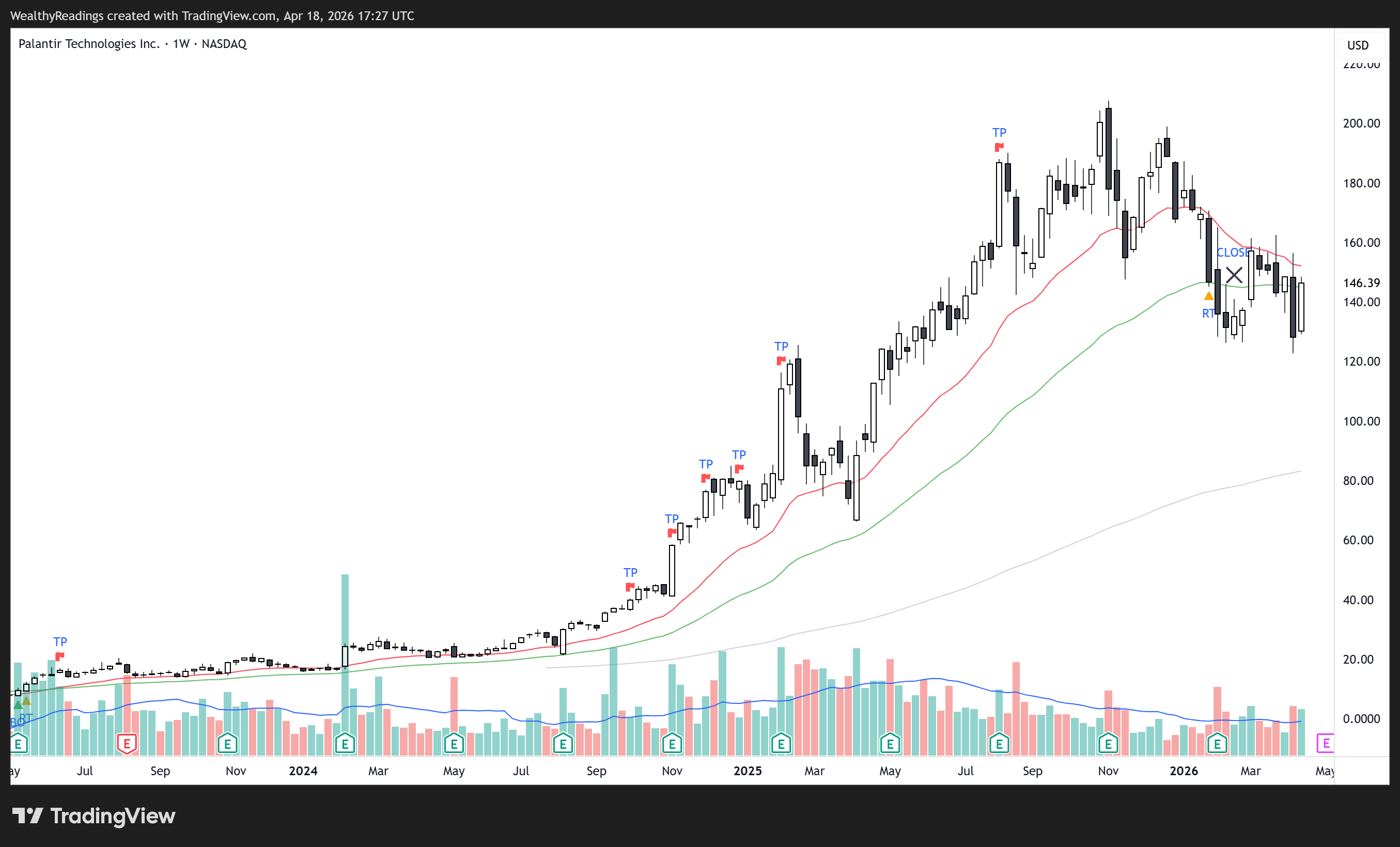
What were the reasons to sell before? System-wise, none. Psychologically speaking, well, the stock had run a lot, was trading at 100x sales, an even stupider P/E and the entire social media sphere was calling it an obvious sell because of how “expensive”. Yet, the company continued to accelerate revenue growth and to push multiples, and those who sold or trimmed at $40 - like me, felt pretty stupid, missing out on a fortune maker.
Selling a position shouldn’t be done because of bias, external conditions, pressure or to secure gains because “it has run too much”. Trimming is possible, but it also has to come with rules. I have three indicators I look at to trim.
Notice those small red flags on the chart above? Those are a homemade extension alert, based on a few conditions. It isn’t a perfect indicator - none are, but it is a good start to know when things get hot.
Second, volume. A great stock is a stock which goes up on high volume or explosively up on low volume. That either means a large amount of buyers accept to pay more for the stock, or that there are no sellers for this stock at this price. Both mean the wish to buy/hold is stronger than to sell.
Lastly, momentum, an indicator about stocks’ progression pace; it gauges the strength of the uptrend. With the passing months, a stock will logically attract less and its momentum will slow down. If its price continues to go higher on a decreasing momentum, it usually means the stock is slowly losing its aggressive buyers, and will either stabilize or decline.
Taking Palantir’s example once again.
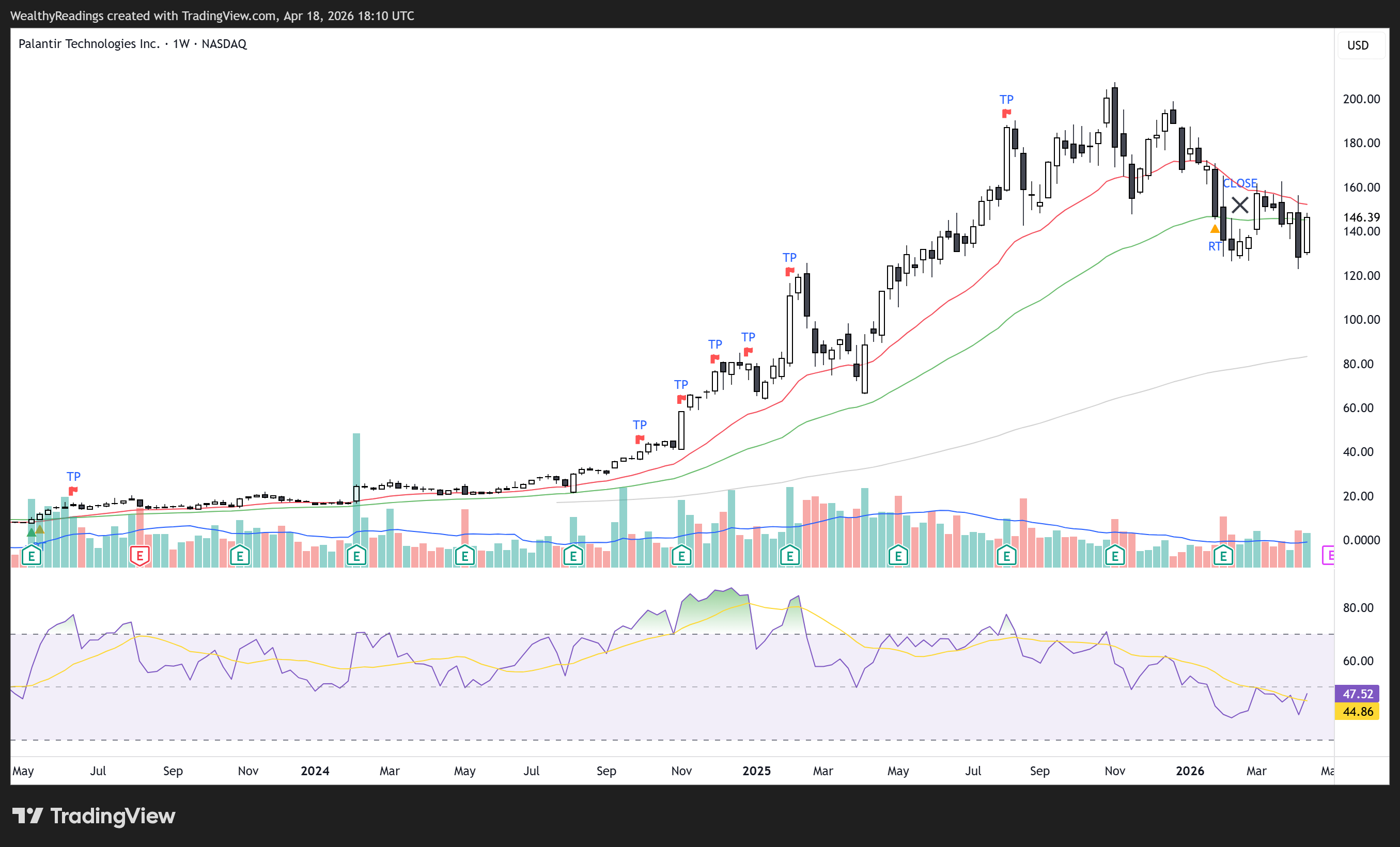
Let’s ignore the first red flag on the extreme left as it was triggered during the breakout - which logically comes with an extension. The ones in the center of the chart were triggered on growing volume and accelerating momentum, an extension fueled by aggressive demand for the stock. The fifth one was triggered on a lower momentum spike but still healthy volume.
There is a case to be made to trim on those flags, even if volume and momentum are still healthy. My buying alerts triggered at ~$10 so a first trim after an 8x on clear extension can be judged healthy.
Things get interesting on the ~$180 flag in August 2025. We are now up ~70% since the previous flag, momentum is not following anymore, meaning the strength of the move is slowing down, confirmed by an ever-decreasing volume. The signs are here this time with the three indicators. From here, the chances of significant returns are low statistically and it might be time to rotate liquidity. As for trimming or selling, it is up to each of us, but the system is clear then: something must be done.
In the entire run, Palantir gave two system-wise periods to trim, until the sign to close the position was given when it broke its W50 ~$140. Sitting on our hands and doing nothing while our portfolio grows is the hardest thing to do in the market, but also the most important not to cut compounding too early and without reasons.
The Palantir trade following my system would have triggered an entry between $11.5 and $15 depending on buying the breakout or the retest. Two trims, ~$90 and ~$185, and a position closed ~$140.

How many of those who bought in the ~$15s did generated these kinds of returns? I’d say almost none, most sold out of fear of losing their gains, pressure, the “too expensive” or “unsustainable run” narrative, or any other psychological reason. The exercise is always easier after the fact, but it remains valid nonetheless as a system based on clear indicators can be tracked back.
That is why so many have the right pick but have never made life changing money, they do not let their winners run. And why I run a concentrated portfolio and cut my losers rapidly. It allows me to let this kind of position run; cutting losers means more liquidity going to structural compounders.
There aren’t many winners like Palantir in the market, owning one is enough for significant outperformance and life-changing gains. As long as we let the run.
The Taxes Situation
This is different for everyone as it depends on where you live but at the end of the day, we are all taxed. Living in Europe, most of us have a flat tax on profits triggered when selling a stock. This should be part of our selling process.
If you wish to trim a core position without fundamental changes - meaning one you could buy again lower, do the math based on your tax system to be sure it is interesting. The higher the gains, the bigger the drawdown you’d need before buying back for the trimming to make sense. Here’s a small table assuming a 30% flat tax.
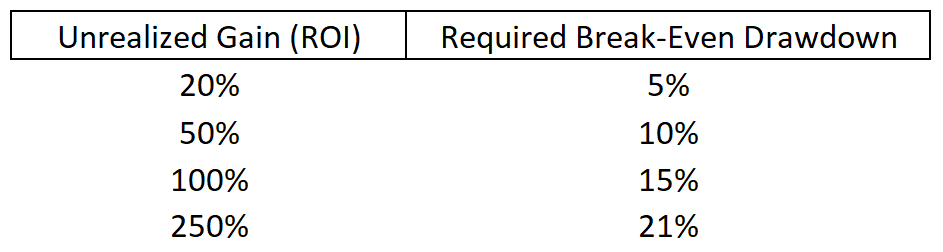
If the pullback you are expecting isn’t large enough for you to buy back significantly more shares post taxes, then you’d be better off just holding.
Timely Use Case
The market ran, a lot, and I already start to see talks about closing positions… Because they are up. That’s not really serious in my opinion; I understand the “fear” of losing profits - and share it. After a 70% return in two weeks, I can assure you I’d love to close some - I did with my swings which is also why those are so important as they also act as a psychological buffer.
Maybe I should close core positions as well. After all, I do not know what will happen on Monday, maybe a black swan, maybe another war… Maybe nothing.
If I were to plan every weekend for a Black Monday, I would take profit every time a position turns green. This isn’t reasonable and would hurt long term; black swans are rare and systems should be built based on the most frequent situation: healthy uptrends.
Let’s look at Soitec, my biggest position built sub $50 on the previous higher high retest and after a W50 breakout on volume, now up more than 100% in two weeks.
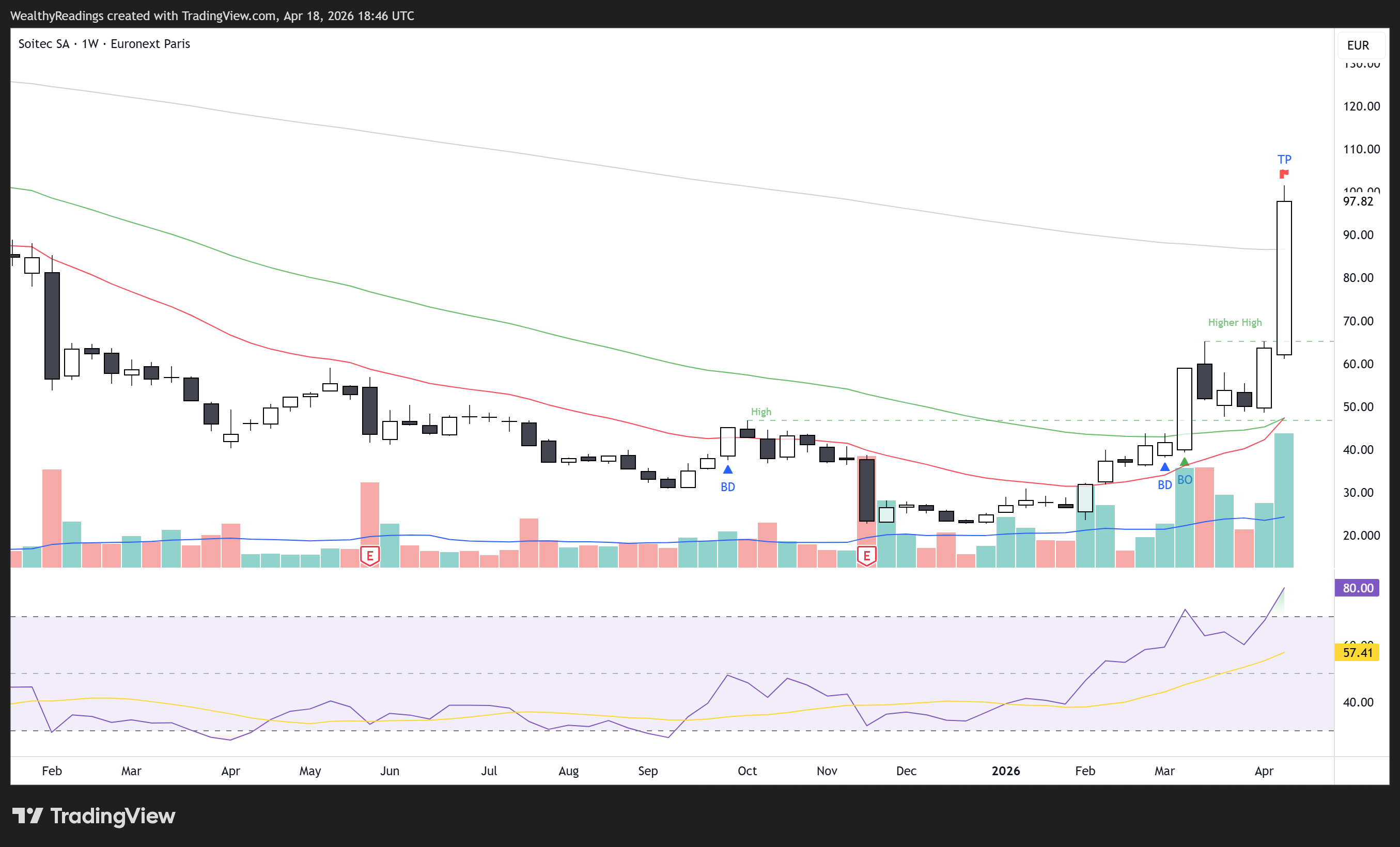
What do we see?
We have a red flag. Logical as it comes on a violent breakout and extension.
Volume is massive. This week saw the highest volume spike of the stock’s history, demand is historic and combined with a 54% push, it’s safe to conclude that buyers were overwhelming sellers and accepted paying a higher price for the stock.
Momentum is very strong, logical as well as this is the first singnificant push for this stock.
This setup is not a trimming setup, the only reason for me to trim here would be “because my stock ran 100%” which isn’t a system, but a bias. Maybe it’ll fall 30% on Monday, I cannot be sure of anything but Soitec is structurally starting a strong uptrend here, not ending it, so any pullback should meet buyers at the right price - mine being the previous high as usual ~$70.
This is why I buy these specific setups, because they indicate the start of a bull trend. If that bull trend fails, I will sell and not look back. But Soitec is giving me every green light I could dream of, which usually is what we want, right? This is a “get ready to buy more” setup, not a trim setup. I have all the confirmations I need to go heavy on the next retest, assuming it happens on healthy fundamentals.
If a black swan happens, so be it. I will lose today but in the course of my investing life, I will win more often by assuming that tomorrow will be normal and let my winners run than by assuming the exceptional.
That’s what systems are for. Consistency over time.
Disclaimer: I am not a licensed financial advisor, analyst, or broker. This content reflects my personal opinions and investment decisions for informational and educational purposes only. I hold positions in securities discussed and may buy or sell without notice. Nothing here constitutes a recommendation to buy, sell, or hold any security. Past performance does not guarantee future results.
Always conduct your own research and consult a qualified professional before making investment decisions. I accept no responsibility for any financial losses.
Tickers: HIMS DUOL AXTI IQE PLTR SOI
This is SO useful. my biggest enemy has always been recency bias, which I am trying very hard to break. Going from buy and hold to buy, hold, reassess, trim is hard.
A question: You press the Sell button as soon as it breaks the SMA50 and the market sentiment is worsening or you wait a few days after it breaks the SMA50 analysing the stock or something like 5/10% above the SMA50 is enough to trigger your reaction?
I have a stock that has reached SMA50 but is maintaining around it, even though the market don't like the dillution the management is doing in order to grow.