

Hello everyone! I have been trying to move fast on this one to share it quickly, as we will talk about photonics and the market has been pushing stocks higher on this narrative lately, so I tried to wrap it up as soon as possible.
I found GlobalFoundries pretty randomly, not even looking at the trendy photonics narrative, but because my screener found it which is surprising as most photonics names are already up hundreds points over the last months. And after digging for a few hours, I followed Druckenmiller’s method:
Buy first, study later.
And as I studied more I bought more, so I already own a position today and I will detail everything with you, from what photonics are to why GlobalFoundries was left behind, and what we can expect from the stock.
Copper, Optics, Photonics, Scale In/Out.
Lots of concepts, but we’ll go step by step without going too deep into the details; we aren’t physicists. I already talked about data centers and how they are built in my Arista thesis, I’ll go over some vocabulary and concepts so we all start from the same base.
Internet is the name given to the physical interconnection between data centers, usually done by cables, sometimes submarine, sometimes dug below the ground.
A data center is the name given to the physical interconnection of hardware at the same location, under the same roof.
A rack is the name given to the interconnections of hardware within one vertical… well, rack.
Companies buy hardware, interconnect them together within a rack, interconnect racks together to “create” a data center, and then interconnect those data centers, creating “the internet”. Brief and oversimplified, but effective.
Now we can start talking about interconnexions themselves.
Copper & Optics.
Hardware communicate with each other via electrical signals passing through cables. Originally - and still today, many of those cables are made of copper for two main reasons: its conductivity and its price - it’s cheap.
As technology evolved, copper showed its limitations in term of bandwidth and efficiency. Signals are lost or deteriorated as density increases and the metal heats up past a certain speed of signal exchange, which creates constraints.
New technologies emerged to answer those two issues and help signal transit faster: optics. More expensive but much more efficient.
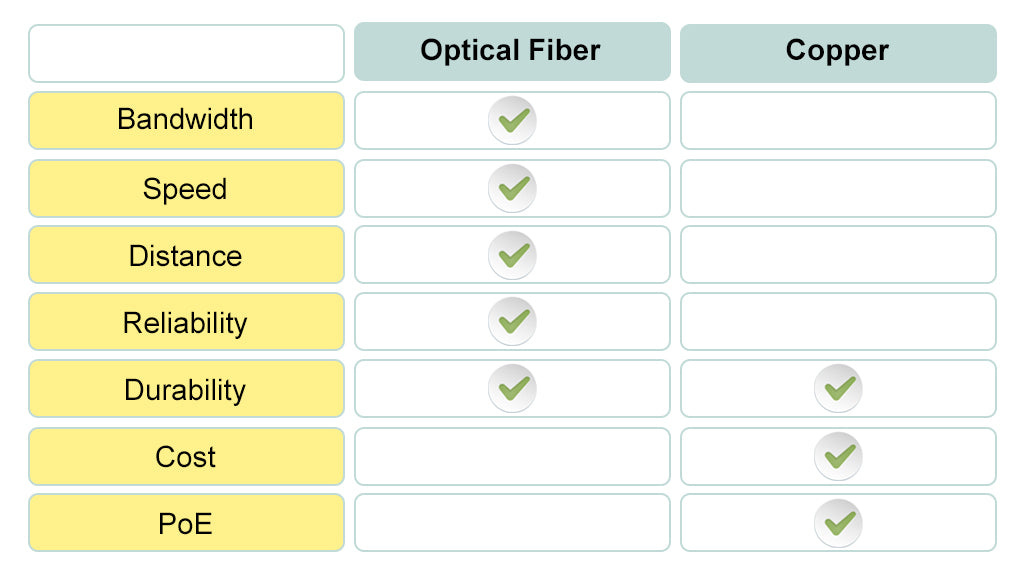
With this, data centers evolved, using optics in some cases and copper in others, the latter mostly within hardware, racks or compute clusters, while optics were used between racks or nearby data centers - what we now call scale-up and scale-out respectively in the AI era.
Let me introduce one term that matters a lot for AI data centers: east-west traffic. At a high level, east-west traffic simply means data moving between machines inside the data center rather than in and out of the data center. Traditional applications were dominated by north-south traffic, users talking to servers. AI flips that model. Most of the data now moves laterally between compute resources and the switch fabrics that interconnect them.
In AI systems, GPUs and XPUs must constantly exchange data to train and run large models. That lateral machine-to-machine communication is what now dominates network load.
This shift to what is commonly referred to as scale out and scale up networking exposes multiple system bottlenecks and forces a reset towards maximizing system level efficiency on multiple levels. At the same time, power consumption is approaching 1,000 TWh annually. When power becomes the constraint, the industry no longer optimizes individual components. It optimizes entire systems. Interconnect efficiency becomes critical.
GlobalFoundries Q4-25 Earning Call
Upgrading systems means upgrading every parts, focusing on bandwidth and latency, or in English words the speed and quantity of information which can be transferred per unit of time. The more, the better.
Compute Intensity
What we call AI is the result of compute clusters iterating together until they find the answer to your problem, like hundreds of humans brainstorming until they find the final answer.
We’ve already talked about GPUs; the brains, the compute capacity, how they work and how Nvidia revolutionized the industry. But as shared above, this isn’t enough anymore. As training/inference developed, models complexified and only increasing the brain capacity wasn’t enough, we needed those brain to communicate with each other faster; the nervous system was weak, incapable of matching the “thinking” pace.
Imagine if you find the answer to your part of the equation, but you have to wait ten second before communicating it. Imagine if hundreds of brains had that limitation. This is what I mean when I say the nervous system is weak. And this is what management meant when they talked about the industry’s need to optimize the entire system.
So the entire chain was upgraded with optimizers like AsteraLabs’, improved connectivity like Arista Network’s or Nvidia’s NVLink, and more. But we are still limited as demand and innovation isn’t slowing, on the contrary, which brings us to another barrier, not yet crossed: optics, the nervous system.
This is where physics takes over. Using copper becomes fundamentally challenged beyond 200G per lane. It cannot economically support the reach, bandwidth density, or power efficiency required for sustained GPU to GPU communication at scale.
GlobalFoundries Q4-25 Earning Call
As I said, copper and optics still coexist. In traditional data centers, each piece of hardware has a purpose and the flow of data is sequential, each fulfilling a need, which means data transit isn’t the same between all hardware and copper has its place.
With AI datacenters, data transits constantly between GPUs and all GPU have the same function: to compute and communicate the output with the “hive”, which collectively produces the final result. This means communication between hardware within the rack and across the data center is constant and must be as fast as possible; maximum bandwidth and minimum latency.
Any slowdown in the chain means a slowdown in total compute, a waste of energy and GPU uptime - and therefore money.
This is what photonics are looking to solve: transferring copper connections into optical ones further along the chain, removing the conversion delay between electrical signals/light and accelerating the transit globally, increasing data transmission speeds manyfold and therefore the compute capacity of an entire data center.
The challenge is massive. It’s not just unplugging copper and plugging in optics, it is rethinking entire hardware connectivity within and between hardware. To help you visualize, here what connectivity looks like between hardware today.
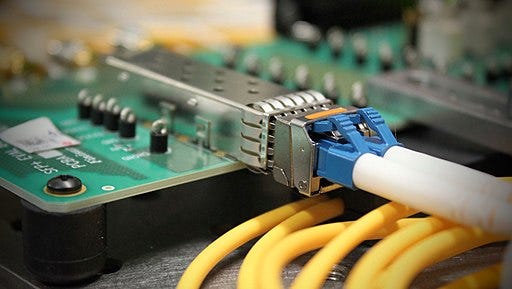
An optic fiber (yellow cable) plugged within what we call SFPs which serves as a bridge between light and electrical signals - passing through copper, within the hardware. The data transit from a hardware through copper to a converter which transit the signal in light to another converter doing the contrary and then sending the signal through copper again. Sometimes, the signal simply passes from copper within the hardware to copper cables, towards copper within the next hardware.
Imagine a highway limiting the number of people passing through. Say 2M cars can drive simultaneously. But in the middle, there’s a section where only 1M can pass (bandwidth), controlled by tolls that require travelers to change their car engines (latency and power). That creates waiting time, slowing down the entire system.
That’s what a single copper connector does within an optical system. The system is only as strong as its weakest link. This is the state of connectivity today.
SiPho and CPOs
The only solution is to replace copper and all those connectors. Enter SiPho - silicon photonics. Engineered semiconductor components designed to transmit light, and CPOs, the finished product filled with SiPho to interconnect hardware between each other or components within a hardware with photons only.
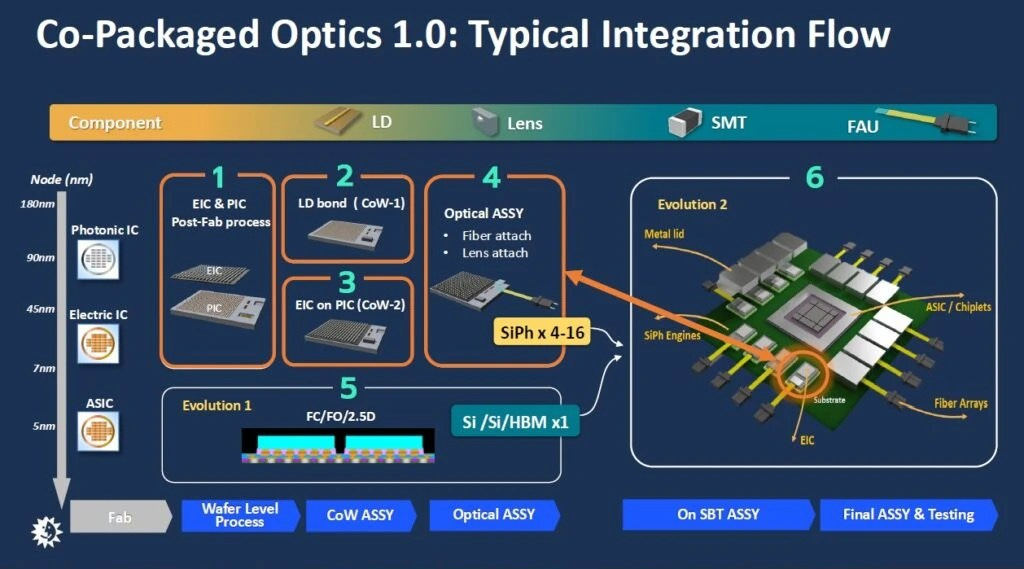
This semiconductor is meant to replace the system above entirely and you can imagine why this isn’t just a plug and play difference, this is a complete rethinking of hardware architecture - which won’t happen overnight, replacing copper within and between racks.
This doesn’t mean copper disappears; it will still be used where cost efficiency matters. But high-performance compute will increasingly rely on CPO. Jenssen confirmed this need and tendency a few days earlier at Nvidia GTC.
The AI factory is the new unit of computing. To connect a million GPUs, we can no longer rely on the old physics of copper. Silicon photonics is now central to the next generation of AI infrastructure.
By integrating silicon photonics directly into our switches, we are shattering the old limitations of hyperscale networks. We are moving from a world of pluggable parts to a world of integrated light.
We have squeezed every last drop out of copper. At 224G per lane, the physics simply demand light. The transition is no longer a choice; it is a thermal necessity.
The technology is ready, but the supply chain is not yet at the 'Industrial Scale' required for zero-defect AI factories.
Nvidia GTC keynote
As we reach physical limits in current data center architectures and demand for compute continues to accelerate, the only path forward, instead of waiting years to build more capacity, is to innovate and improve compute quality: more performance per unit of space and energy, as I’ve said many times.
This sets the stage for the company we’ll discuss today.
GlobalFoundries & Tower Semiconductor
So, again: SiPho are semiconductors, which means they are manufactured in fabs, just like GPUs and ASICs. And yes, TSMC is one of the main fab working on this as they are the preferred manufacturing partner for GPUs and ASICs for companies like Nvidia.
But they aren’t the only ones, and they’re not even considered the leader in this space. Their advantage lies in integration: they can embed CPO directly into GPUs they manufacture, making the entire workflow cheaper and faster.
GlobalFroundries is one of the key player of the sector. As I said earlier, I found it pretty randomly through my screeners and it surprised me as they are build to find potential/starting uptrend: higher lows/highs, high volume and breaking out their W50. This is partly why I believe there is something here.
Not only is the narrative hot - it’s extremely hot, but fundamentals are strong and price action is clean. Nothing happened with the stock since its IPO in 2022 but in recent months, we’ve seen rising volume and flat price action, which is typical of accumulation before a breakout. That breakout came in January and we are not going through an healthy retest.
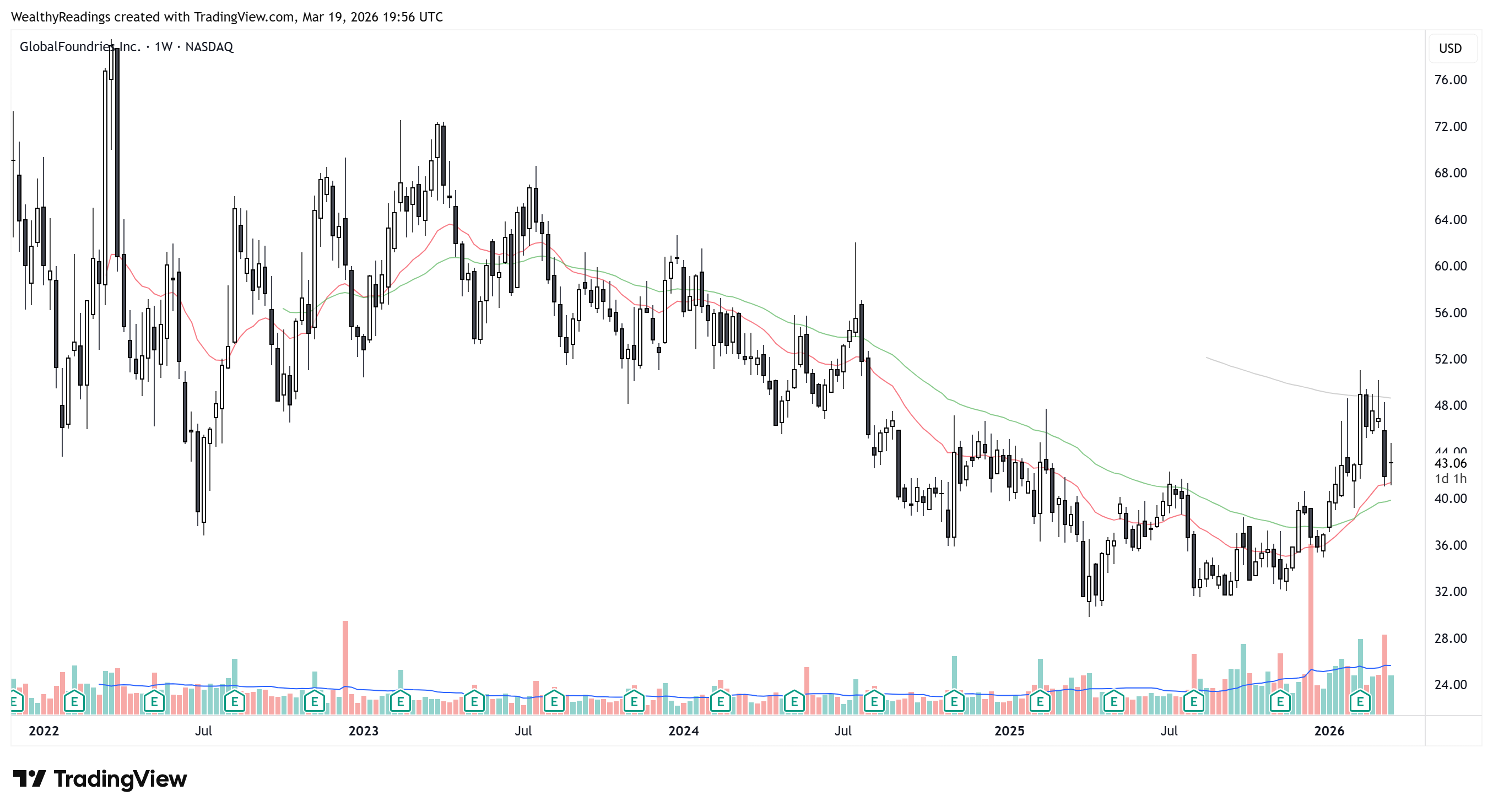
This is demand, and I quickly understood why when I discovered that its main competitor - outside of TSMC is Tower Semiconductor, one of the best-performing stocks of 2025, up 36% year-to-date after partnering with Nvidia this February for silicon photonics.
So my first question was: why is Tower trading at such a premium compared to GlobalFoundries if both are considered key players in photonics? And I found a few reasons - despites Nvidia’s partnership. But none that justifies such a gap.
Specialization. This has become increasingly important in AI, as specialized hardware means performance. Tower focuses on low-volume but highly customized SiPho and related technologies. They don’t operate at scale but instead prioritize deep customization. They also consider themselves the leader in the sector.
They know how precious, especially from Tower, SiPho demand is, as we are truly, by far, the leader in silicon photonics.
Tower Semiconductor, Q4-25 Earning Call
GlobalFoundries is a much larger company with more verticals, more revenue streams, less specialization. They have a higher volumes and more capacity. But while Tower claims leadership, the numbers are more balanced.
Silicon germanium and silicon photonics revenues represented 27% of our corporate revenues, or $421 million, up from $241 million, or 17% in 2024.
SiPho revenues alone were $228 million in 2025, up from $106 million in 2024. Specific to the Q4, RF infrastructure revenues were 32% of corporate revenue, with SiPho having achieved $95 million, or a $380 million annual run rate.
Tower Semiconductor, Q4-25 Earning Call
GlobalFoundries does not break out SiPho revenue as explicitly, but they stated that their optical networking business generated ~$1B in revenue, with SiPho expected to reach a $1B run rate by 2028 - or more.
Clearly, CPO in the scale-up sense is gonna be an accelerant to the market. But honestly, you know, if CPO takes a little longer, you know, we still stick by that number. We’ll just ship more pluggables as CPO, you know, catches up and honestly, could go the other way as well, where CPO could be bigger sooner, bigger faster, and that scale-up networking could actually drive that percentage of that billion-dollar plus run rate, you know, up above 1/3. That’s why, you know, to your point, we’ve pulled in the expectation of, instead of a billion-dollar plus revenue in 2030, it’s really a billion-dollar plus run rate before the end of 2028.
GlobalFoundries Q4-25 Earning Call
This implies ~50% CAGR over the next three years. Tower is guiding toward comparable numbers with currently ~$380M SiPho run rate, which is significant.
Extrapolating from GlobalFoundries’ numbers - 50% CAGR to a $1B run rate by FY28, we can conclude that they generated ~$250M with SiPho in FY25, implying a run rate comparable to Tower for FY26 with expectations of nearly 100% growth for the year.
Tower might be the leader, but we are not talking about a 90/10 split, more like 55/45, especially considering both companies have comparable products and roadmaps. This contrasts with Tower’s management claim that they are the only company selling 1.6T connectivity hardware.
For long range and coherent applications, we are shipping into 400G and 800G ZR+ solutions, as well as 1.6 terabit coherent interface modules. In scale-out data center networks, we’re enabling high bandwidth, low loss links with DR4 and DR8 architectures, scaling to 1.6 T, 3.2 T, and beyond.
GlobalFoundries Q4-25 Earning Call
So yes, Tower is specialized in lower volumes and higher customization. That works well in the early stages of a new industry but as the market scales, large-volume production of standardized designs will become necessary and that requires industrial capacity and execution. Volume.
I am not saying Tower will slow down, they certainly won’t, but there is a clear competition between both companies, each with their own advantage and capacities while the market is shared, not dominated.
Size. There is a significant difference in scale and diversification between both companies.
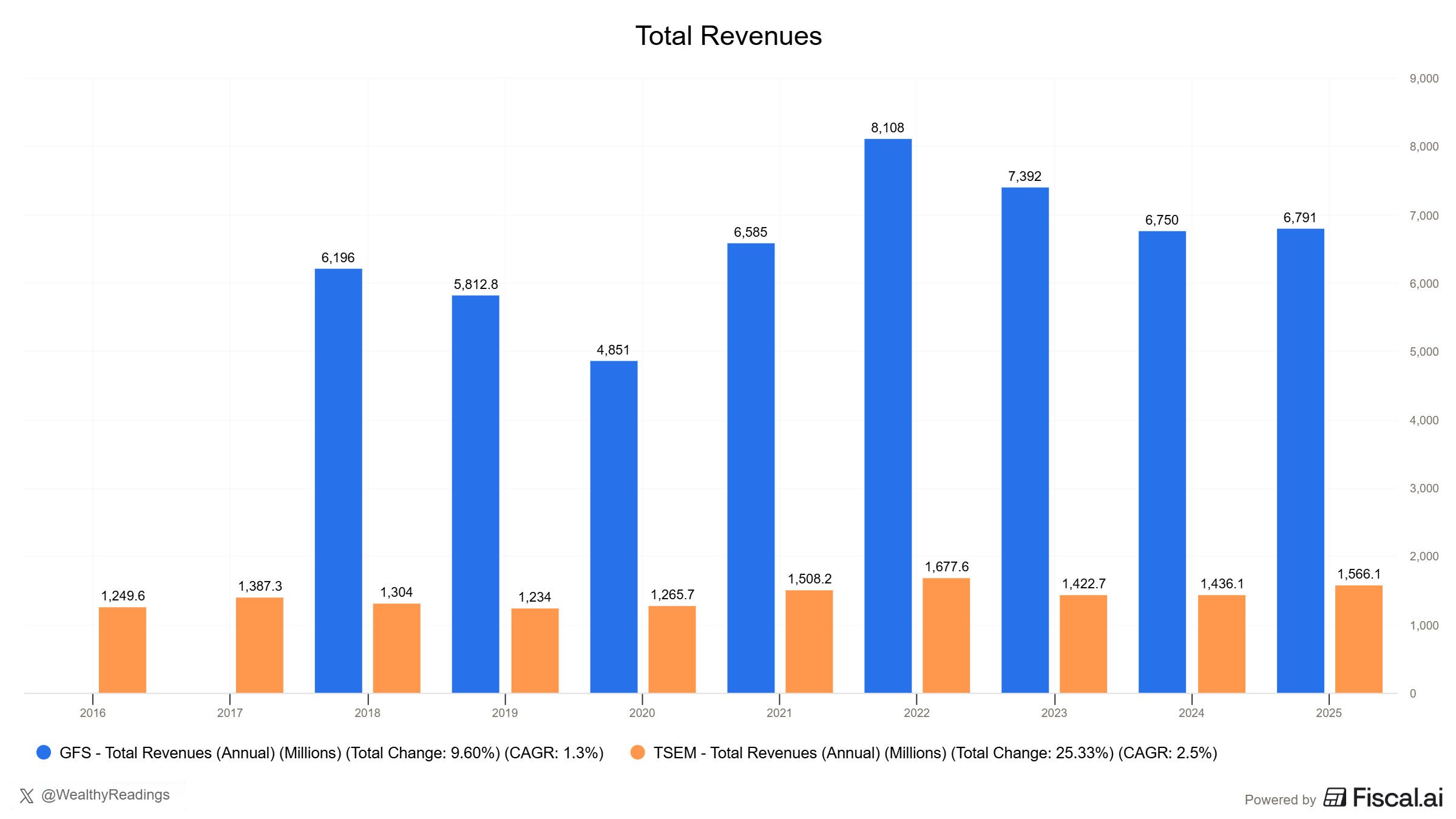
This has a major impact on market’s perception. Tower looks like a high-growth story while GlobalFoundries looks sluggish even though the SiPho opportunity is similar with similar growth. This is basic math, it’s harder to grow from $6B than from $1.5B. At current revenues, SiPho represent ~22% of Tower’s revenue and only ~5% of GlobalFroundries’
And it showed already as Tower’s stock appreciated the last months on accelerating quarterly growth while GlobalFoundries’ acceleration is also real in SiPho but not showing at the company’s level. GlobalFoundries’ legacy business is a drag and that is probably not going to change so the alternative is to have a strong growth on SiPho which shows in the company’s profile - which can happen.
Yet, both companies have comparable operating margins which should increase with higher-value products.
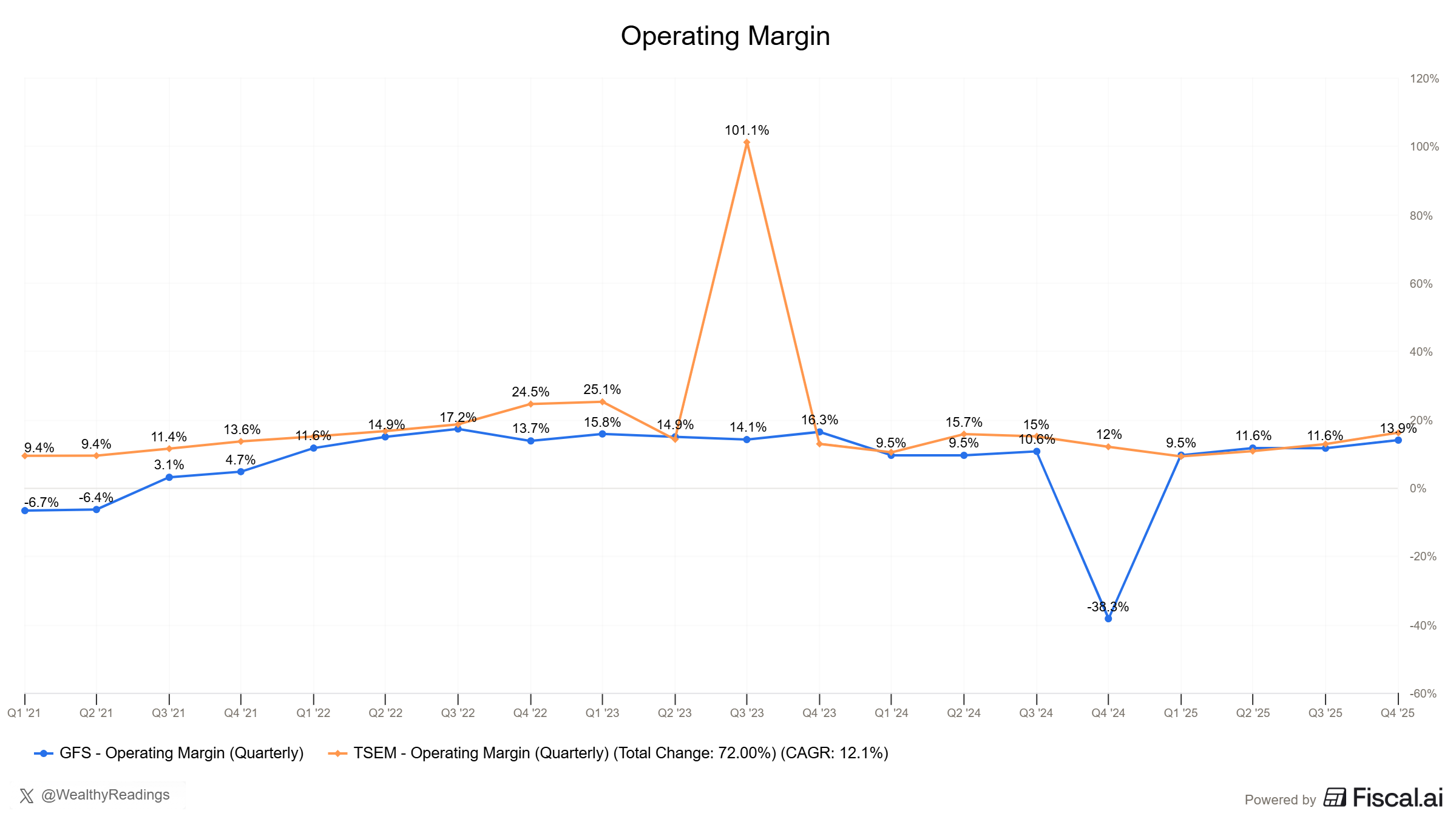
So growth might look a bit slower for GlobalFoundries but its cash generation is comparable while operating verticals with lower margins and owning the full cost of maintaining/expanding its infrastructure. Not bad.
Capital efficiency. Tower is not spending as much as GlobalFoundries; they focus on using capacity rather than building it. They install their equipment within third-party infrastructure and rent space, meaning their fabs are effectively leased capacity which reduces CapEx. GlobalFoundries owns its fabs and must fund expansion/maintenance.
This is a structural difference; both models have advantages and inconvenient - lower costs and CapEx for Tower vs control and scalability for GlobalFoundries. Tower is facing issues with Intel for example which is kicking them out of its New Mexico fabs, forcing Tower to relocate production to Japan, causing delays.
Intel has expressed its intention not to perform under the September 2023 Fab 11X agreement. We are presently in a mediation process.
Tower Q4-25 Earning Call
Not owning infrastructure can be financially efficient but creates operational risks, especially in a sector as strategic and capacity-constrained as AI hardware.
On the contrary, GlobalFoundries owns and operates its fabs in strategic geographies, including New York.
To solve this challenge for our customers, GF launched plans for our silicon photonics and advanced packaging facility in 2025 in Malta, New York, to establish high-volume manufacturing capability to support the CPO ramp. The result of this investment is expected to deliver a fully integrated silicon photonics production flow from silicon substrate to known good optical modules. This capability will dramatically shorten the manufacturing cycle time and also provide rapid turnaround from wafer fabrication to full module yield all under one roof.
This could be an advantage especially given the importance of U.S. manufacturing in Trump’s administration - tariffs, regulations, capacity constraints, subsidies, taxes...
These are the main differences between the companies. They are not fundamental but mostly in term of by perception - to my view.
Analysts’ question: One of your competitors talks about having over 80% of the silicon photonics market today, but you have very similar revenues to them. It seems like you have at least a similar trajectory into 2026, I mean, to 2027. Can maybe try to explain the discrepancy in their view versus how GlobalFoundries sees things and kind of more broadly, how might your platform approach to silicon photonics versus Tower’s more customized solution set play into this perceived difference? Thanks.
Mike Hogan: Let me just put, like, some framing and some context around how we think about where we are in Silicon Photonics. You know, you can talk to the Tower about what they think, but I’ll give you our perspective. You know, I think just simply put, we think we’re the largest player in Silicon Photonics, full stop. You know, we’ve built that position based on a decade of sustained investment and benefited from the deep customer and partner learning cycles that go along with that. Just generally have, you know, benefited from a lot of time over target to feel like we have the largest market share of all the pure play Silicon photonic foundries.
GlobalFoundries Q4-25 Earning Call
GlobalFoundry is not behind, but it looks like it. But it doesn’t have less volume or less potential.
Advanced Micro Foundry & MIPS
Important to talk about those acquisitions late 2025 which changed GlobalFoundries’ profile and competitive positioning.
AMF is a Singapore-based pure-play photonics company focused on SiPho, directly competing with Tower. This is why GlobalFoundries remains the #1 SiPho foundry and the source of its potential, now integrated within the company, its scale and financial resources to expand operations.
MIPS is an autonomous entity within GlobalFoundries, focused on physical AI processing - low-latency and real-time compute for robotics, automotive, and edge applications. A key sector for future growth verticals.
The Thesis
It seems to me that Tower’s stock has been better marketed than GlobalFoundries’, but that does not mean it has a fundamentally superior business, especially in a market that will require industrial-scale production.
We had referred to as the $380 million run rate that we had in Q4, take off of that some small amount of NRE, which we don’t specify, the silicon wafers that we shipped for the Q4, that exact amount of silicon wafers by capacity, we plan to have five times more than that in the Q4 of 2026.
Over 70% of the total SiPho capacity is either presently reserved or in the process of being reserved through 2028, firmly backed with customer prepayment.
Tower Semiconductors, Q4-25 Earning Call
If I were to point to the true leader, it’d be TSMC, not Tower. Not because it has the best photonics tech but because of its integration within GPU and ASIC manufacturing workflows and its customer base, which will be happy to integrate CPOs directly into chips by the same manufacturer.
That said, demand for photonics is real, and TSMC alone won’t have the capacity to meet it. GlobalFoundries and Tower will capture part of the market and I struggle to imagine one being excluded as volumes ramp over the next few years.
Sure, GlobalFoundries doesn’t have a partnership with Nvidia but it works with major players like AMD and Broadcom, both significant in the ecosystem with AMD supplying GPUs to hyperscalers and Broadcom designing Google’s TPUs.
GlobalFoundries is a strong development partner and a key supplier for our next generation of optical networking products.
Near Margalit, VP and GM of Optical Systems Division at Broadcom
And if Nvidia is the one making the market moves, we know they can partner with many companies within the same industry as it is in their interest to have the most diversified supply chain, not just please one or another. So new partnerships could happen as volume demand scales.
Bottom line, GlobalFoundries is and will be a key player in both photonics and CPOs, it might look a bit sluggish compared to Tower Semiconductor but treat comparable volume at comparable margins. The opportunity seems be here fundamentally, while the market is ignoring it as growth looks (and is) slower due to legacy verticals…
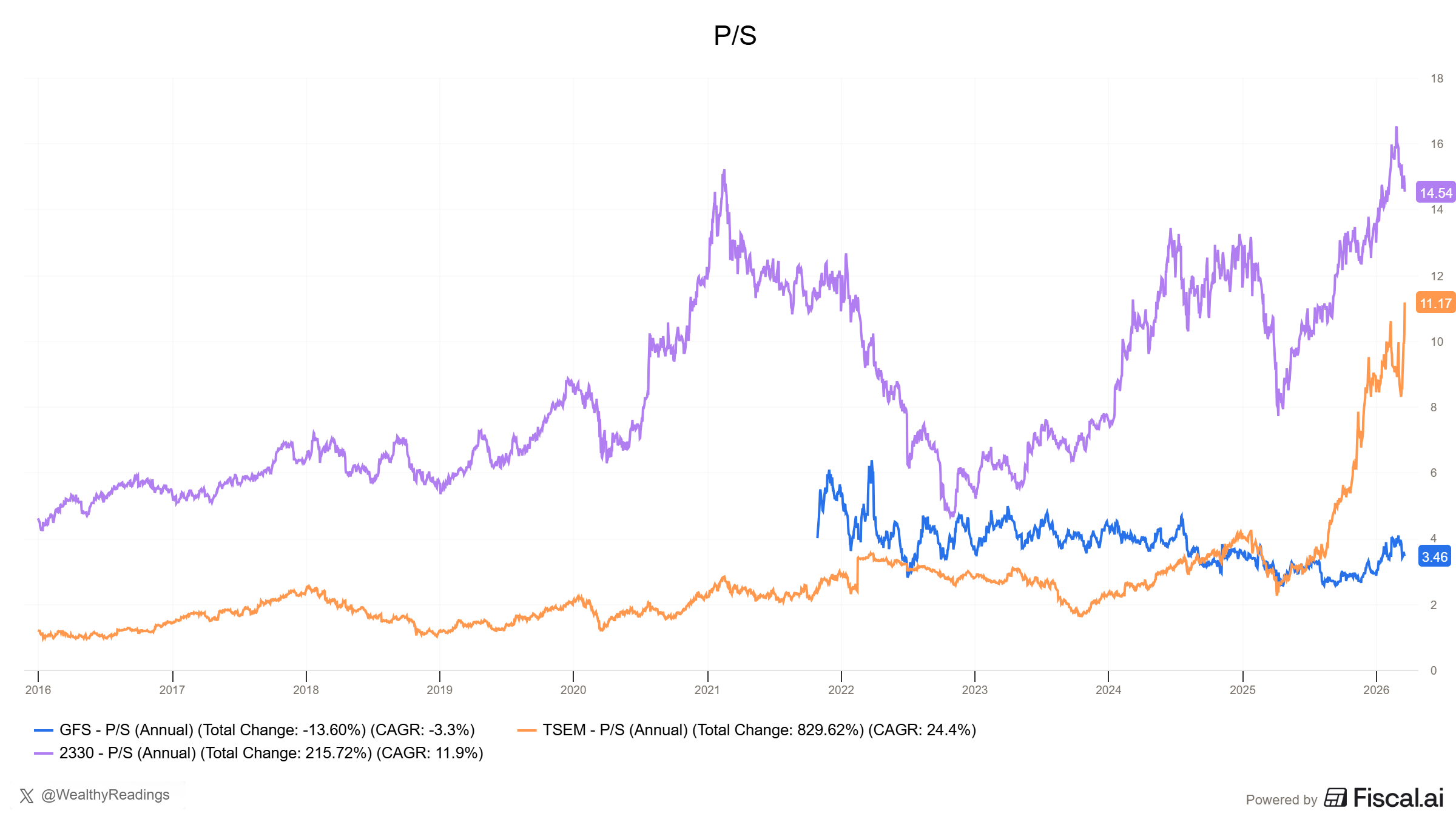
From a risk perspective, we are looking at a key player trading at average/low multiples while the industry it represents if reaching new highs and demand will accelerate. There is always a downside to any stock, but the risk reward in this specific case looks massive if photonics were to scale and volume were to go towards GlobalFoundries - and management says it will.
We also need to keep in mind the clear stock accumulation. If the market wasn’t positive, we wouldn’t see growing volume and breakouts, holding the W50.
The $1M question is: is it anticipation, speculation? Or because something is coming?
I already bought shares at ~$42 while the W50 sits ~$40, I bought before completing my research and again yesterday while writing this article as my research confirmed my suspicions. The main question is how fast demand can grow and how will the market react to a slower global growth, while the narrative and the SiPho growth should accelerate.
Will it push the premium as high as higher growth names because of the company’s strategic importance and volume capacity, despites a slower global growth, or not? I’d either way assume that even a slower growth in a key sector is enough to justify higher multiples than today. Really higher, while any partnership or positive catalyst - and many could happen, will trigger strong reactions/momentum.
Once again, it’s all about risk/reward, and this one seems solid.
Disclaimer: I am not a licensed financial advisor, analyst, or broker. This content reflects my personal opinions and investment decisions for informational and educational purposes only. I hold positions in securities discussed and may buy or sell without notice. Nothing here constitutes a recommendation to buy, sell, or hold any security. Past performance does not guarantee future results.
Always conduct your own research and consult a qualified professional before making investment decisions. I accept no responsibility for any financial losses.
Great read! Given that the transition to Silicon Photonics requires a fundamental rethinking of hardware architecture—moving from pluggable modules to integrated light—what is the biggest hurdle for “Industrial Scale” adoption: the yield rates of manufacturing these complex hybrid chips, or the lack of a standardized software layer to manage photonics-based networking?