

Oracle
How fast perception can change with lower valuation and positive comments.
Oracle was plagued by two issues.
Its cash generation was impacted by CapEx without any clear view on when that would slow down or end.
Its biggest client - OpenAI, wasn’t known to be the biggest cash machine on the private market for the same reasons: massive CapEx without any clear view on when that would slow down or end.
Both concerns were addressed during this quarter and, combined with a -53% stock drop, triggered a pretty positive reaction. Expectations are much lower at today’s price, and this is key to remember in the markets.
Oracle is still cash flow negative as it spends more in CapEx than it makes in OpCF, but the market now has visibility on when that will change and on the potential as Oracle reported a continuous revenue acceleration made possible only due to its AI services, which continue to attract massive demand and growth.
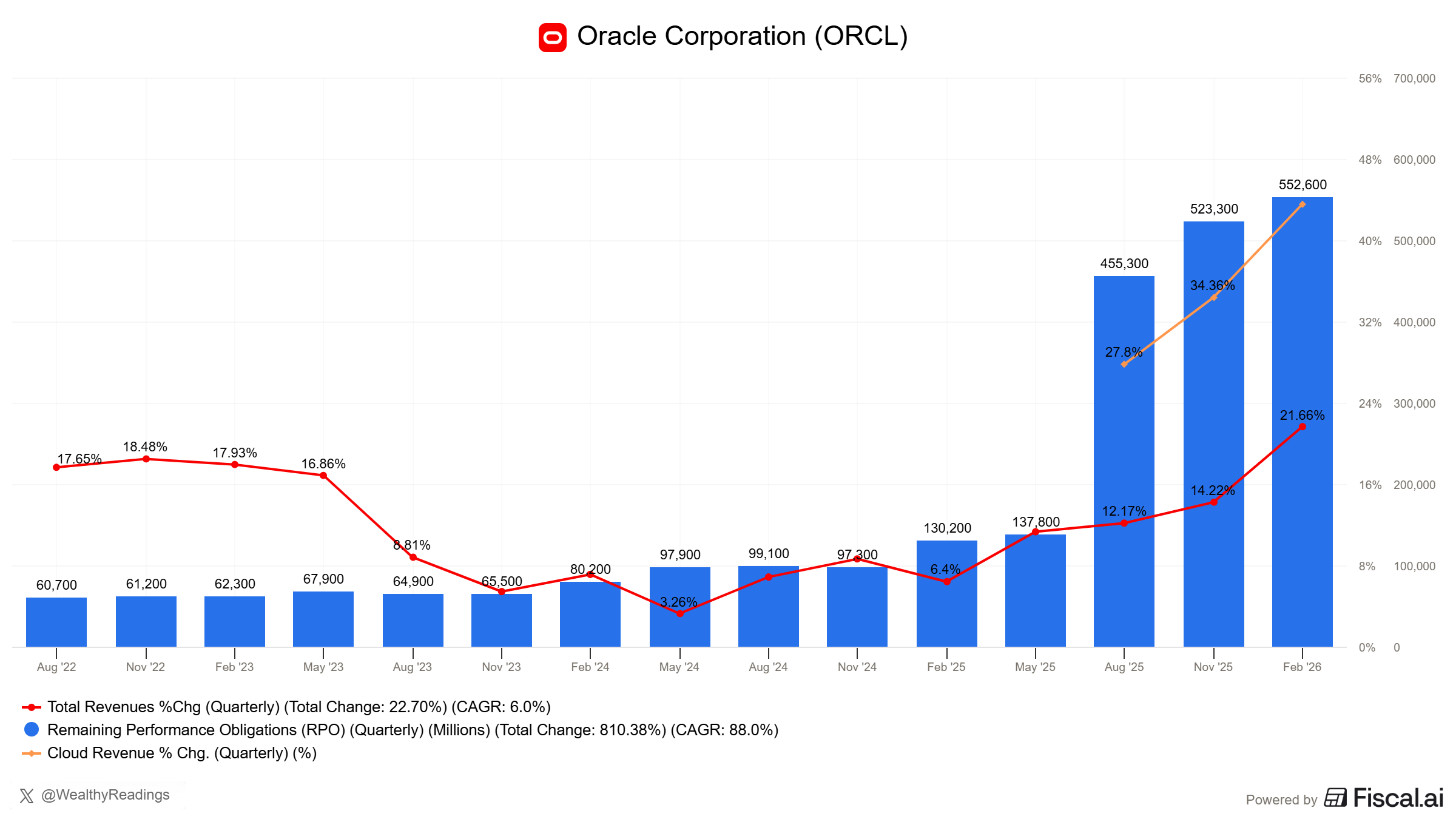
This is step 1: demand for AI compute is through the roof; we always knew this, but it’s always great to have confirmation and show a clear ROI.
Multi-cloud database revenue grew 531% YoY. AI infrastructure revenue grew 243% YoY. Both also have demand that exceeds supply and a clear execution plan from Oracle that will rapidly turn that demand into profitable recurring revenue.
We created our multi-cloud partnerships with first Microsoft, then Google, and finally Amazon to bring the best database platform to all clouds. Those partnerships unlock an enormous backlog of demand. Our database customers who want to use our database in other clouds. This quarter, we achieved an important milestone.
Step 2 is cash generation, which comes in two verticals. First, slowing spending and second, margin capacity.
Slowing spending is not happening yet, but management did not announce any more of it which is already great news while their last round of financing - which the market judged unreasonable, was oversubscribed meaning real demand for it, despites risks.
In February, we announced our intent to raise up to $50B dollars in debt and equity financing, along with the statement that we do not expect to issue any additional bonds beyond this amount in calendar year 2026.
Within days of the announcement, Oracle raised $30 billion through a combination of investment grade bonds and mandatory convertible preferred stock, with a record order book that was substantially oversubscribed. We have not yet initiated the at-the-market equity portion of the financing program.
Add to this that, just like for Nebius, many customers are now paying upfront for their future compute, helping with the debt weight for future buildouts.
This is the first step towards slowing down debt risks: not taking even more of it. They probably will next year, but until then the market won’t punish the stock more.
The second step is to repay actual debt, and while demand is not an issue as we’ve seen, Oracle still needs to make money from revenues and that is also going in the right direction.
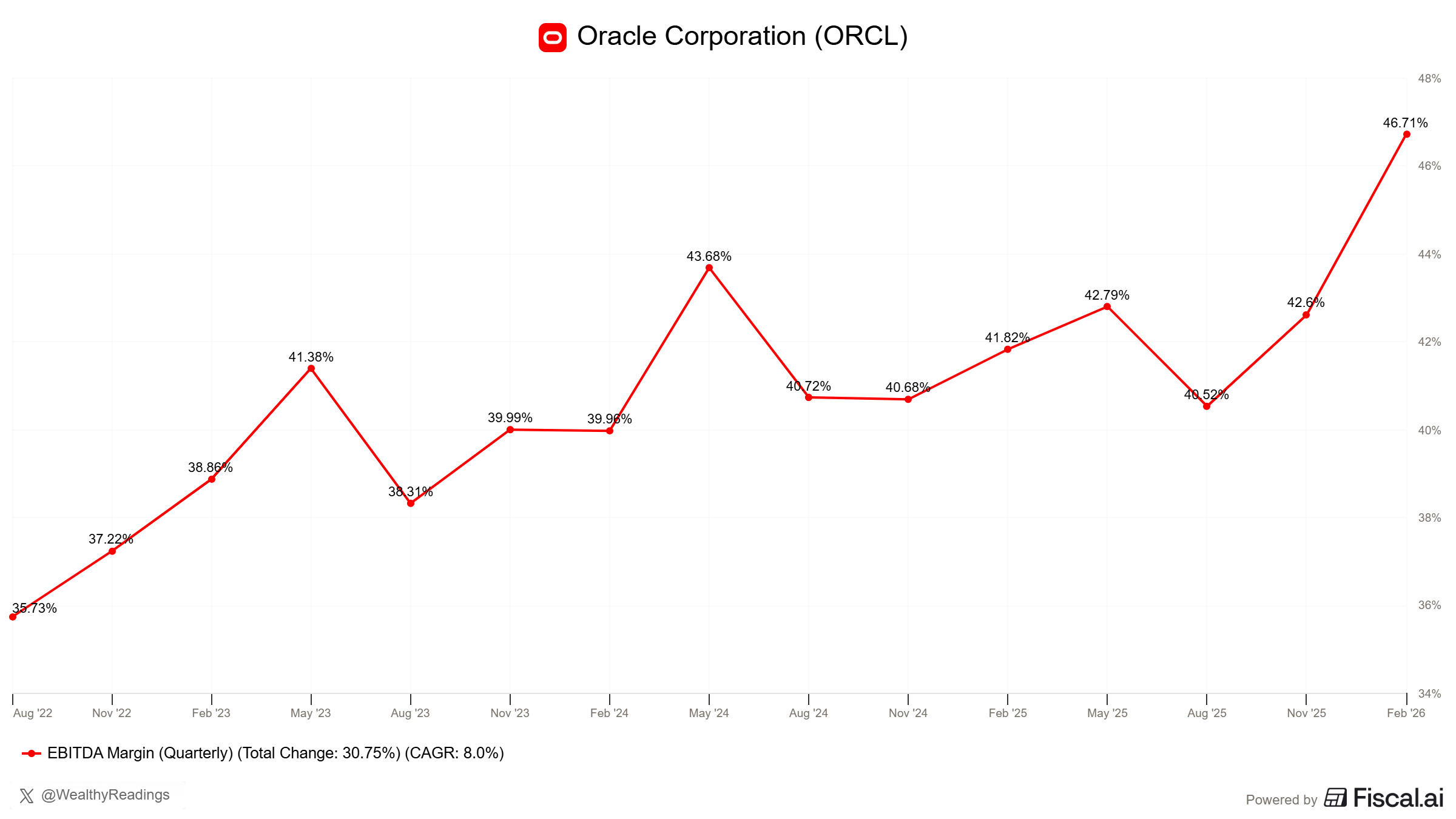
I know Buffett and Munger did not like to use EBITDA, but they also never invested in tech and sometimes we have to use it as this is the only method to judge compute providers’ cash generation capacity post CapEx spending. It isn’t only EBITDA margins which are growing, also AI compute gross margins ~32%, largely above the Street’s expectations.
Last but not least, the worries about OpenAI’s capacity to pay their bills are also slowly being reduced as the company successfully raised more money; a new $110B round completed at the end of February with Amazon, Nvidia and SoftBank. That will allow them to pay those famous bills, if only for some more quarters.
Bottom line, this was a good quarter driven by strong demand, less spending, growing revenues with healthy margins and cash generation. A quarter showing the Street that Oracle could actually pull it off, that its debt and the risks were maybe not as huge as they originally looked in the face of the opportunity ahead.
But that reaction is only due to the difference of valuation between now and then, the risk is certainly not the same at $300 or $150. It’s all about perception.
UiPath
I closed my position in UiPath when the stock lost its weekly 50 because that is what my system wants me to do as a concentrated investor: not hold weakness. But in the SaaS stocks’ current condition, losing this trendline doesn’t mean the thesis broke, it just means the market doesn’t want to buy those names.
The fundamental thesis was that UiPath would continue to accelerate as demand for AI enhanced automation would only grow, not quite like Palantir but following the same trend.
This quarter seems to confirm it with the second quarter in a row of ARR acceleration, and with a continuous acceleration in RPO, up 14% YoY for the quarter.
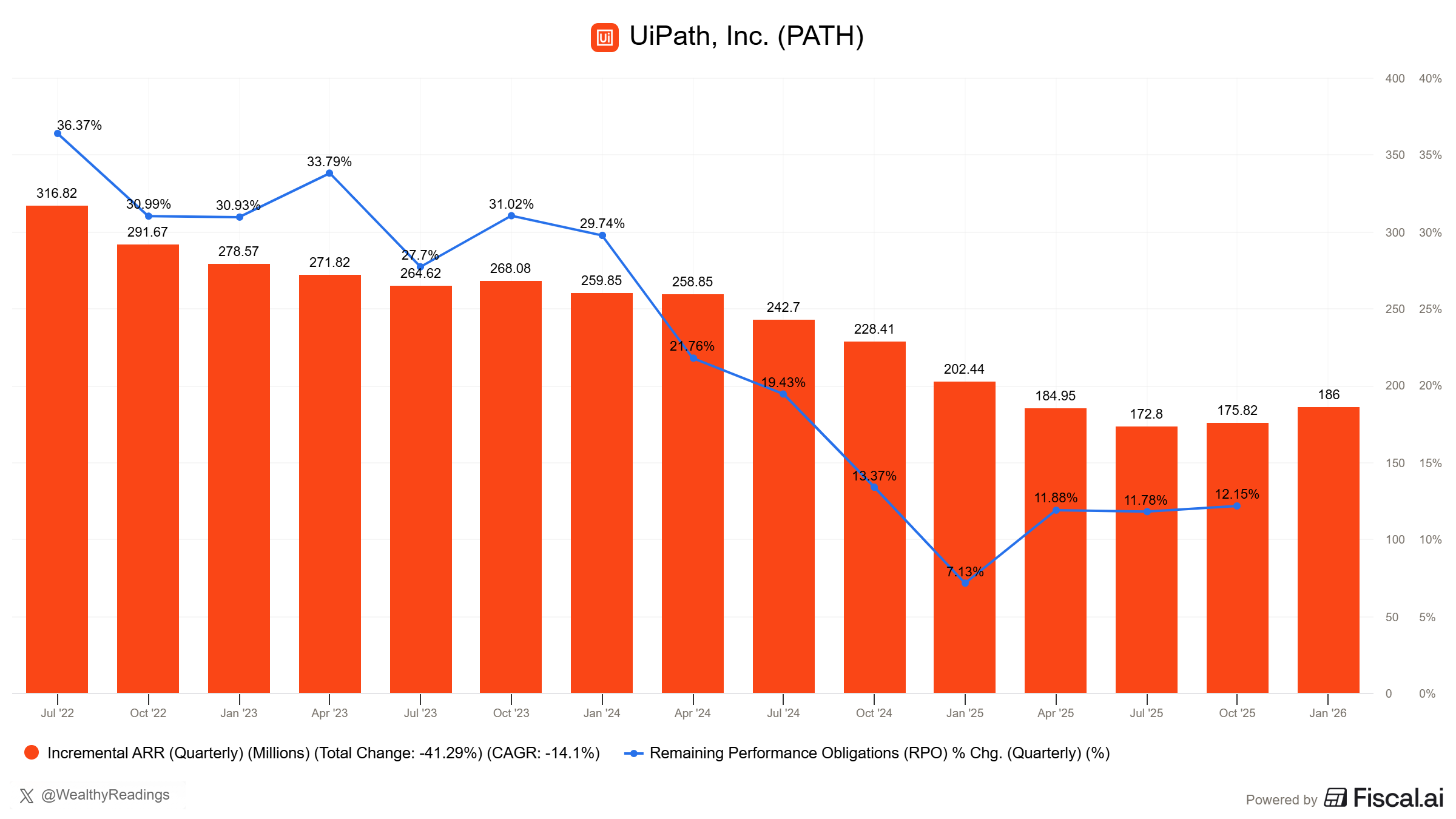
Yet, guidance points to ~$2.053B FY26 ARR or a 10.8% YoY growth compared to ~11% YoY FY25, meaning management isn’t expecting this acceleration to continue through the entire year, and this isn’t exactly what we want to see.
We are talking about a structural shift in how companies are supposed to use AI and we’ve seen this shift in the numbers with Palantir. Growth is accelerating because the tool is supposed to be so transformative companies’ cannot not use it, it would put them at a massive disadvantage compared to the competition.
Not seeing a comparable trend in UiPath doesn’t mean it won’t happen, but it means the need for their services is not as strong as I expected, yet. I did not expect Palantir like numbers today but I wanted to see acceleration, even a mild one, and it isn’t what this guidance points towards.
It might just be a bit early. I’ll continue to follow the company as the potential could be massive. But unless guidance is a bit sandbagged, I don’t expect to hold it this year. There is no point in putting money on it yet, in my opinion.
Adobe
Another name not worth buying yet to my opinion. And I don’t say it to be negative as I really like Adobe and their products, but loving their products doesn’t mean I have to love the stock.
Many believe that Adobe’s stock is down because the market is scared of disruption. I don’t entirely agree. I believe Adobe is down because the market cares about leaders and Adobe isn’t proving itself to be one in the AI era, yet.
Firefly is starting to show real results with a $250M ARR at the end of the year, up ~3x YoY and ~75% QoQ. So there is traction but this is kinda small at Adobe’s scale.
Another positive indicator is the ~80M creative MAUs, up 50% YoY, which translates to a clear interest in Adobe’s services and therefore in their AI services. The question will be about conversion and retention on premium plans, as using AI tools for fun as a freemium is one thing but holding paying customers is another.
So there is some traction, but like everywhere and for every tool with AI, and a $250M ARR doesn’t change much yet for Adobe and its $24.5B in revenues. The truth for now is that there is no acceleration, clear/rapidly growing demand, or margin expansion.
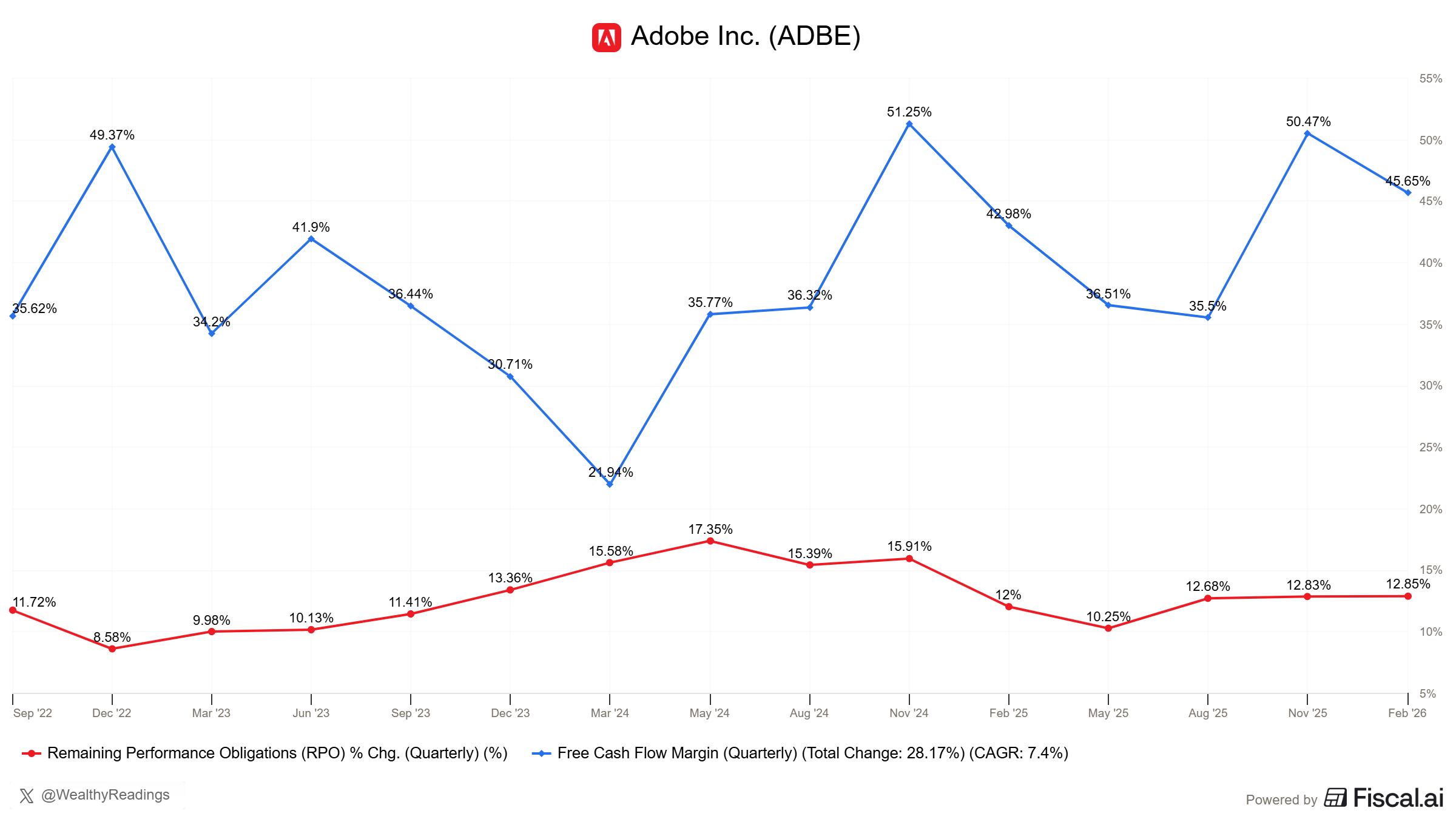
Adobe is a wonderful company but the market doesn’t reward those. It rewards future cash generation and Adobe is in a situation where they are very stable, very healthy, but without clear potential for acceleration.
And while everyone will tell you that Adobe trades at its lowest valuation ever - which is factually true, no one tells you that it also trades at its lowest growth ever and has never been priced in for such growth over the last decades.
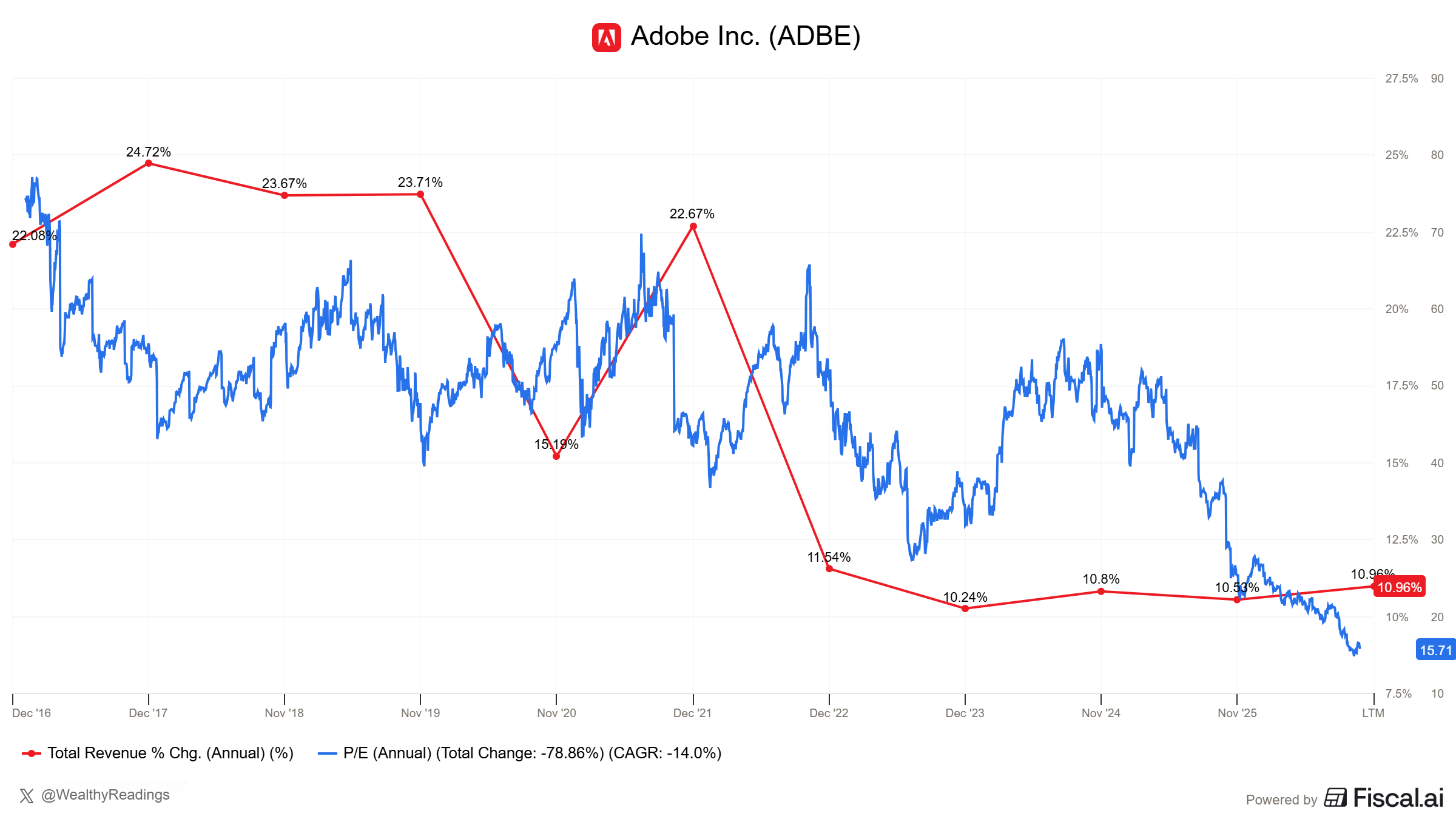
Adobe was always a fast-growing company with expanding cash generation, and the market is only repricing the stock for what Adobe could become: a very healthy value stock without many reasons for cash generation acceleration or margin expansion.
I personally am bullish on the fundamentals and believe that Adobe will thrive in the AI era and will deserve higher premiums. But this is an opinion, a bias, not an investment strategy.
Until this is proven by the numbers and validated by the market, I’ll stay out.
I am just wondering why your view on Transmedics did not change? Their expenses on fuel must be skyrocketing and that must be one of their main expenses. Therefore it should have a big impact on their margin. Not like airlines they will be able to introduce a fuel item on their sales price.