

I did my research, it’ll be alright.
I’ll exit on my buying price.
It will go back up.
…
I’m here for the long term either way.
We’ve all been through this chain of thoughts, and we’ve all been stuck in a position we didn’t want in but felt like holding would be better than cutting. Because selling a loser makes you feel like one. It makes a mistake real, and you don’t make mistakes. You’re better than that. Actually, selling that stock would be the mistake, because it’ll go back up. You know it.
Except it probably never did. Bad became worse until you finally either chose to close your eyes forever or sold for much worse than it could have been.
This article was requested of me from a Founding Member after a note I wrote on a loser I cut early which continued falling, much lower. It’ll probably bounce back one day. But that doesn’t even matter.
That’s what we’ll talk about today. The importance of cutting losers early, how it can affect your portfolio, your psychology and your returns, and how to do it without entering this unhealthy emotional loop of feeling like a loser. But first, we’ll need to take a trip through concept-land, as cutting losers happens for a reason.
But I can give you the reason to do so now: closing losers early makes you a winner.
What Game Are You Playing?
This is the first question you have to answer, and there are no wrong answers. But there are some logical thought chains that cannot be avoided.
A stock picker’s objective is to outperform his benchmark within his timeframe, while sleeping tight at night. No one would ever pick a stock if it weren’t to increase his net worth. Right? No one. Surely.
Let’s define two words: outperformance and timeframe.
What is outperformance? The first mistake many make is to treat outperformance per position. Positions don’t matter. Net worth matters. If your net worth increases faster than it would have within indexes, you’re outperforming.
Now, timeframes. I said “within his defined timeframe”. Let me be straightforward. If yours is the next 30 years, if you invest in a position today for “the next decade” or things like this, you should stop right now and go buy an index. You have no clue what the next decade will be made of and cannot buy a position with the expectation to hold that long.
That’s bullshit. Great marketing, “The next Buffett” and all. But this isn’t stock picking.
If you do not stock pick to maximize returns in a reasonable foreseeable future, you do not stock pick, and you’d be better owning indexes; focus on capital preservation, not increase. And that’s fine, there’s no wrong in that. I’d love to have $10M and focus on capital preservation, but that’s not where I am today - not yet.
What is a reasonable foreseeable future? I don’t have an answer, which is why I do not have timeframes on my investments. I hold them as long as my thesis holds. Our world moves faster than ever, our economies too, geopolitics is messier… We aren’t living in the 50s anymore. We can’t invest as if we did.
My goal - and I believe every active stock picker’s goal, is rapid net worth increase. This doesn’t mean gambling, it means responsible investing constantly looking for the highest performer.
The market is the only place where anyone can make it, as long as he/she puts in the work and learns from his/her mistakes. It is the great equalizer. But you gotta play the right game if you want to make it.
This is about cutting losers. Don’t worry.
I'm a big Druck fan and see the market and my performance just like he does.
I compete against what I would call the opportunity set. And if there was a great opportunity set that year and I missed it, I’m disappointed in myself. Like if I’m up 20% and I think I should have been up 50%, I’m disappointed myself. If the opportunity set was basically to be up 10 or 15 and I’m up 20, I’m thrilled.
This is the game I am playing. Everyone doesn’t have to play the same, but if you do, there are some pre-requirements that makes cutting losers a must-do, for some very basic - and mathematical, reasons.
What The Market Actually Is
Millions of individuals exchanging opinions at a price.
That’s really all the market is, nothing else. Prices aren’t decided by opinion volume but by dollar volume. If 9,999 retails have an opinion and one fund has another, they can balance each other. This is an extremely important distinction as it changes what moves prices.
If liquidity is equivalent between bulls and bears, stocks range. That is what happens the majority of the time in the markets, lots of movement but no higher highs or lower lows. Just useless noise. When liquidity doesn’t balance, stocks go up or down depending on the winning side.
Our job is to catch the first and avoid the second.
This month was the release of the 30th anniversary pack of Pokémon TCG, with some exclusive cards.
Stick with me here.

Every physical store sold out in a day. Can’t find any box anymore, got to order it.
This, friends, is what happens in bull trends. In a bull trend, any acceptable price sees a surge in buying demand, which pushes the prices higher as bulls agree to pay more to be involved. Shares go to the bulls who buy the highest.
Official Pokémon's booster won’t be sold at higher price - although resellers will, the only solution to purchase is waiting for production. But if they were to auction the last packs, their price would rocket.
Why on earth is he talking about Pokémon?
Stocks never sell out.
This is when you make money, not by buying green dildos but by being positioned on the stocks with potential before the market sees that potential and bulls fight to buy it. The stocks with such potential are the stocks on which bulls constantly step up at key prices, because they accept to buy higher to be involved.
If bulls don’t step up, your stock isn’t a 30th anniversary celebration Pokémon box.
Its potential is limited, so why would you want to own it?
Some Truths You Won’t Like
There are four truths in the market I learned the hard way and I believe anyone serious about investing - the way I am, should accept as early as possible, because they’ll change your way of investing - and your returns.
You aren’t smart. Sorry, I know it’s mean of me. But it’s true…
If you were as smart as you thought, you wouldn’t be reading these lines and you wouldn’t buy stocks, you’d be working at Nvidia, Tesla or Lumentum and would be paid in stock options, already multi-millionaire or close to be.
But you aren’t. Your understanding of subjects and technologies is limited, your access to information is limited, your bandwidth is limited. You are limited - and of course I am too.
Relying solely on your opinion is the worst mistake you can make in investing.
Everything is relative. Your opinion - which is most likely wrong to start with and doesn’t matter, isn’t shared by everyone else.
I love chocolate. Everyone does, right? Wrong. Two friends of mine simply can’t eat it and looked disgusted the time they tried homemade cookies made by my mom. Shame on them.
We live in echo bubbles in the age of social and feel like everyone agrees with us because that is how algos work; they’re based on positive reinforcement. You like milk? Have more.

This is what I consider one of the most dangerous trend of our time, constant opinion reinforcing. But that’d be another subject entirely.
Stocks aren’t companies. They represent ownership of a company but aren’t priced for it. They’re the representation of millions of emotional reactions to news and expectations. A good company can have a terrible stock and can destroy your investment account.
Stop thinking that you have to buy good companies to make a killing, that’s wrong. You have to buy a good stock.
Good companies are a component of investing. Not the sole one. Plus, that relies on your understanding - which is limited, and “good” is relative - everything is. I consider Meta to be a good company. Do you? Because many refuse to invest in it due to its apps’ impact on the world.
Some of you will tell me “but even you look at good companies only”. I do, I’ll explain why just below.
My point here is that there is no correlation on your potential net worth increase and how “good” the company’s stock you bought is. Strategy can return 10x more than Google and yet I’m sure we’ll all agree on which is the best - Strategy of course.
Only price matters. You are here to make money, aren’t you? Then the sole judge of your success is your net worth increase, which happens when the stocks you own go up - I won’t consider shorting because that’s a stupid thing to do.
Nothing else matters.
As a stock picker, if you had a system that would work to buy stocks only based on price, you should use it. As humans, we need an illusion of control. We need to feel like it isn’t that simple, that we’re better, that our results came because of our sharp minds. That’s why we look at 10Qs, valuation, earnings, etc… In reality none of those matter to someone capable of generating returns based on price only.
Returns are the same for everyone, regardless on how they made them.
Why don’t I only buy on price? Because to concentrate in large positions, I need peace of mind. And I cannot achieve it by buying only a chart, I need to have facts backing it up. This doesn’t mean I am right, it means my psyche works that way, it means I also need that illusion of control. I need my brain to understand the narrative and the company so I can handle volatility and sleep at night.
It's a me thing, not a returns thing. I just know myself.
We’ll talk about closing losers now. But all of those concepts are inherent to why you have to close losers. I know it looks like I am off subject. Trust me, I am not.
The Math of Concentration
Something we’ve been over already. A 100% return on a 5% size is a 5% net worth increase. Youhou. I mean it’s good, but is it really what you’re looking for? Find a stock capable of doubling, and getting only a 5% net worth increase out of it?
Because you didn’t do 100% performance. You did 5%. Which will certainly be mitigated by the 19 other positions’ losses and be closer to 0%.
That sucks.
You have a certain amount available to you to invest. Whether four, five, six, ten digits… Doesn’t matter, you have a limit. You cannot buy 50 significant positions with the potential to meaningfully lift up your net worth.
If you have more than 10 positions on a 5-digit portfolio… You’re playing the screenshot game. Sorry, not sorry.
Real winners are rare, which means you have to size onto them. You won’t ever make significant money if you never size - and that is the goal, remember what a stock picker strives for? Rapid wealth increase.
You don’t have a choice to achieve this: you need concentration. Not all ins, but real size behind attractive risk/rewards that bulls are defending. Remember how to find those? When strong levels are defended because bulls are fighting to buy at the best possible price but also before other bulls, not to miss the opportunity.
A $10,000 portfolio will be happy with a $3,000 gain, right? That’s a 30% position into a stock with a potential of 100%. You could have three of them, two successes would generate $6,000 returns. Now we’re talking.
But in every portfolio, there are winners and losers, and rarely a 66% win rate.
I mean. I know you’re the best stock picker on earth. I am too. We rarely miss, don’t we? Because we never sell. We just hold and wait for the bounce because we’re right, the company we bought is a great company and the market will realize it. Soon.
Wrong.
The problem is that concentration works both ways. It increases gains, but also losses. A 25% loss on a 30% position would be -$750. Meaningful for a $10,000 portfolio which became a $9,250 portfolio. Generating meaningful returns got harder because your positions got smaller.
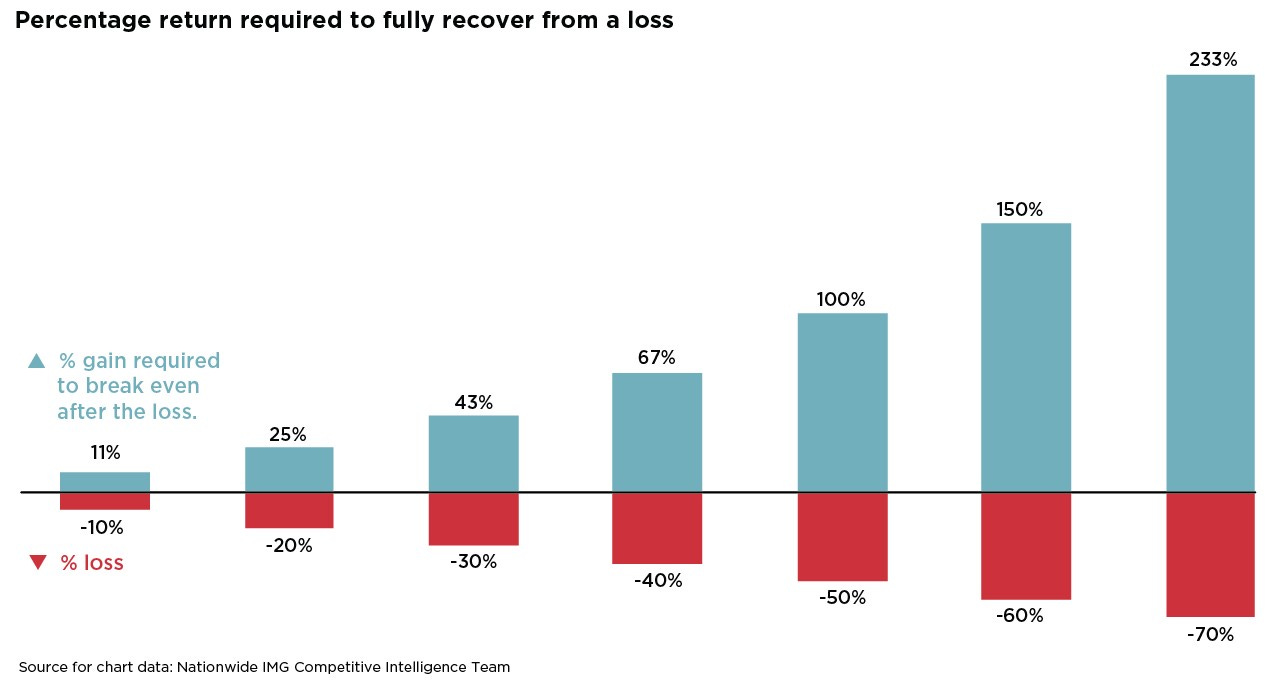
You see this table a lot on social media. Print it in your brain. Concentration raises risk. And losing capital makes winning so much harder.
Let Me Tie It All Together
Because I didn’t lie to you. Everything is related.
You want to grow your net worth fast. That means concentration. But the market is a place where millions of opinions are weighted in dollars. The big fish move it. They know more and if not, their sheer size will push prices wherever they want. Your convictions are unreliable by default.
You are playing a losing game. Forced to play big on unreliable assets.
A stock falling isn’t noise, it’s the bigger players telling you you’re wrong. Maybe they know something you don’t. Maybe they’re just heavier. Doesn’t matter. Price is them voting against you, and they always win.
So you cut. Fast. It keeps the math on track - so one wrong bet doesn’t break your recovery, and it protects you from yourself - from the ego that insists you’re right when the whole market says otherwise.
Concentration is what makes you rich. Cutting losers is what lets you concentrate without blowing up, against a market smarter and heavier than you’ll ever be.
And you know what? You’re better off in another stock either way.
Who Cares If It Bounces Back?
This is screenshot mentality, another gift from social media.
How to avoid the frustration of missing out and ego spikes? By realizing that it doesn’t matter, first, and that you still can do something about it, second.
One position is just that: one position. The amount of opportunities in the market is mind-blowing; if you’ve followed me for some time, you see that I can share a handful of them per month, whether new or accumulations. You’ll never be short of opportunities and stocks with 100% potential. Never. Even during bear markets, these exist.
Looking back at a loser after selling it ignores the most important part of investing: psychology. A bounce doesn’t mean you’d have held during that time.
AsteraLabs was one for me. I was dead right on the thesis. I sold it as bulls didn’t step up ~$130 . The rest is history.
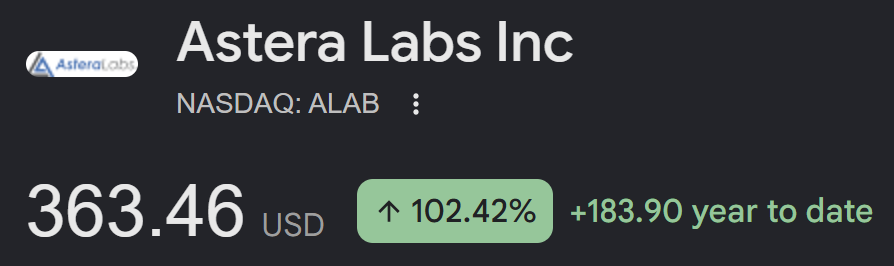
I take comfort in knowing that Jamie caught it. Hi Jamie.
You know how many AsteraLabs I had since I write this Substack? You know how many didn’t bounce back? I don’t. I don’t care. My portfolio is largely outperforming and I am extremely satisfied with my net worth increase, which means I’m doing things right, even if AsteraLabs pumped without me.
I still had more losers that kept losing than losers that bounced back. And we’re not talking about 40/60, but 80/20. Imagine the net worth decrease if I had held them all. I also couldn’t have bought my current winners with large positions. My performance would be crap…
Second, what happened to that liquidity is what really matters, because you are here for net worth increase, right? Or for screenshots? Be sure.
Selling one losers means buying or accumulating another position. What happened to it? Did it win even more? Were you able to sleep at night better? Did you stay in cash waiting for another opportunity?
Investing isn’t about individual decisions. It is cumulative. A chain of decisions.
Maybe you let one winner go. But if selling it was at the price of respecting a system that saved you more times than it hurt you, then you made the right call, and you should hope to make it again. If not, one day, you won’t cut one of your losers. And it’ll hurt really bad.
If you constantly cut future winners, your system might need some review. But be sure to have it quantified before changing anything. Survivor bias is real, so let’s not make the mistake of considering one rare occurrence to be the norm.
That being said. Selling winners happens. But there is a silver lining here, something we can do about it.
We. Can. Buy. Again.
Another psychological barrier in investing. Apparently, once we cut a loser - and we accepted it was a loser which is already hard, we can’t tango with it again. This is bullshit. You can go back ten times with your high school sweetheart but you’ll tell me you can’t buy a stock twice? Come on.
If that stock you sold because it behaved poorly bounces back and gives you one of those opportunities, just take it! I’d have loved to buy AsteraLabs again and was actively looking to do so. I was never given the chance, so be it. My cash was in Soitec by then - rightfully so.
Two stocks gave me a second chance after I cut them: UiPath and Tempus. And my portfolio’s happy I let my ego aside and bought them back.
Selling isn’t defeat. It’s responsibility. You’re just a dude respecting the market and preserving your capital to fight the next battle. You aren’t giving up, you don’t suck, you aren’t bad.
You are responsibly allocating capital.
So, How To Do It?
There’s no easy answer.
This post is meant to give you my thought process, starting from how I invest and why because cutting losers is inherently connected to my system and objectives. It’d be impossible for me to invest the way I do without cutting losers fast.
The psychology behind my loser cutting is printed within my investing system. I’d never overperform without doing so as my liquidity would be tight up in sluggish or underperforming stocks.
If you invest differently. So be it. I personally consider that cutting losers is a must-do regardless because capital preservation should remain every stock picker’s #1 rule, but you are entitled to your ways.
Everything is relative, eh?
Know what you want. Know how you want to do it. This is how you psychologically accept to cut your losers fast, by knowing what you’re doing. Because eventually, you simply won’t have any other choice but to do so.
Practically, I can give some tips on how to minimize your chances to fall into this psychological “let’s see later” trap.
Make a plan before you buy. You should always know why, when or how you would let your position go. There is always a place where bulls should step up within a healthy trend. Always.
Make the loss concrete. Look at the potential dollar value loss in your portfolio before you buy a position. How hard will you have to work to refund your loss?
Don’t second-guess yourself. The plan was made in an emotion-less situation. If the conditions were met, execute. Close, move on. Order 66 style. You’ll sell future winners, this isn’t even a question, it’ll happen. But you’ll sell more large losers and that’s enough to justify missing out once.
Selling means reallocating. There are always opportunities and the best ones are usually the ones you already own, as it means they performed very well - otherwise they’d be cut. Nothing in investing is about single decisions, it all is a chain of decisions.
Keep an eye on strong convictions. If you were right, you will be given another chance. This isn’t goodbye, this is see you later.
Closing Thoughts
I’ve been right on so many stocks over the last two years - notably Palantir Nebius and Hims, I should have multiple times more money today. This isn’t me being cocky, this is pretty factual. I don’t, because of two factors.
I never sized aggressively enough.
I cut my winners too early.
I thought hard at why and how I could fix it.
The first was because I was scared to lose too much, so I middle sized everything. Cutting losers with controlled risks allowed me to use size I’d never have dared use because I knew my maximum potential loss before hand.
The second was because I always wanted to buy something else. Cutting losers allows me to have a pocket of liquidity always ready. If I don’t have, it’s because I only own great winners and I now think twice before rotating, because I became aware of it.
In investing, you only need to be right once or twice per year. But that is true only if you size your trades properly. Being right a handful of times that way will set you for life, at one condition: that your losers don’t drag your winners down.
And that can be done only if you cut them fast.
Important Note: The tone of this write-up was voluntarily harsher than usual. I usually try to keep things very smooth and professional but with this kind of subject, I believe harsh words are more impactful and therefore more helpful than sweets. Do not take anything personally, I in no case mean to be hurtful or violent.
Disclaimer: I am not a licensed financial advisor, analyst, or broker. This content reflects my personal opinions and investment decisions for informational and educational purposes only. I hold positions in securities discussed and may buy or sell without notice. Nothing here constitutes a recommendation to buy, sell, or hold any security. Past performance does not guarantee future results.
Always conduct your own research and consult a qualified professional before making investment decisions. I accept no responsibility for any financial losses.
Great write up. Being open and ‘harsh’ is good. Thanks for the shoutout! 👊🏼😂
Great write up. I love your transparency and honesty. Always good to have these insights🤝