

We are closing a pretty big and interesting week with lots of comments to make.
Sportswear & Retail
I don’t own any of those names, but they are a great proxy for my Lululemon position as they provide a good overview of Western/worldwide demand for brands and clothing in general.
And despite stable earnings, most of them ended up selling off - although the market has been very touchy lately for other reasons so it’s hard to be sure that this sell-off won’t be bought back in the next few days.
American Brands
Four retail giants reported earnings this week (American Eagle, Abercrombie & Fitch, Victoria’s Secret and GAP). I won’t go over each one individually but will talk about the overall assessment of their earnings.
All of them show a comparable trend: quarter & year ended with better results than most - management included, expected at the beginning of the year, as 2025 started poorly.
FY25 ended well. They succeeded in pivoting and found ways to fuel revenue and comparable sales growth; clients went to their stores and bought their products more than the year before.
Guidance is very uncertain. They talked about healthy comparable sales and revenue growth in the single digits, but the key data point is that most growth comes from non-premium verticals or international demand. The Western consumer is present but picky, focused on cheap products, while real growth and demand comes from overseas.
Margin profiles should be stable; most guided to flat or expanding margins as they optimize their operations. But there is a very big “if,” as FY26 will be the first year with nonstop tariffs and those will put pressure. The real question is whether management will be able to compensate for them with price hikes or optimizations - cutting costs, AI usage, supply-chain optimizations, etc, and if the consumer will react positively to those.
If not, their guidance will miss, and with such uncertainties around consumers and external factors, the market isn’t very optimistic.
Overall, the quarters were correct, as was guidance. But these stocks had run up as management shared their plans to navigate a complex environment and succeeded during 2025 while valuations were very low. They are now back at healthier valuations with a picky local consumer and margin pressures.
Stocks were punished, not because of bad earnings or guidance, but because the market had already rewarded them and is now pricing in struggles for longer. Lululemon hasn’t been rewarded for anything yet as it hasn’t shown its strategy was yielding results, but will face comparable headwinds. It remains possible that the market rewards the stock if execution if comparable to these even with potential pressure during FY26.
On Running
I’ll treat On independently as a company I have followed closely for years which doesn’t compare with others, proved once again with strong earnings; double beat on both revenues and EPS.
The two important metrics for a brand are revenue growth and DTC proportion. As long as customers go directly to the brand to buy products, it means they want this specific brand and not just shoes, and that trend is now stable for On after years of growth.
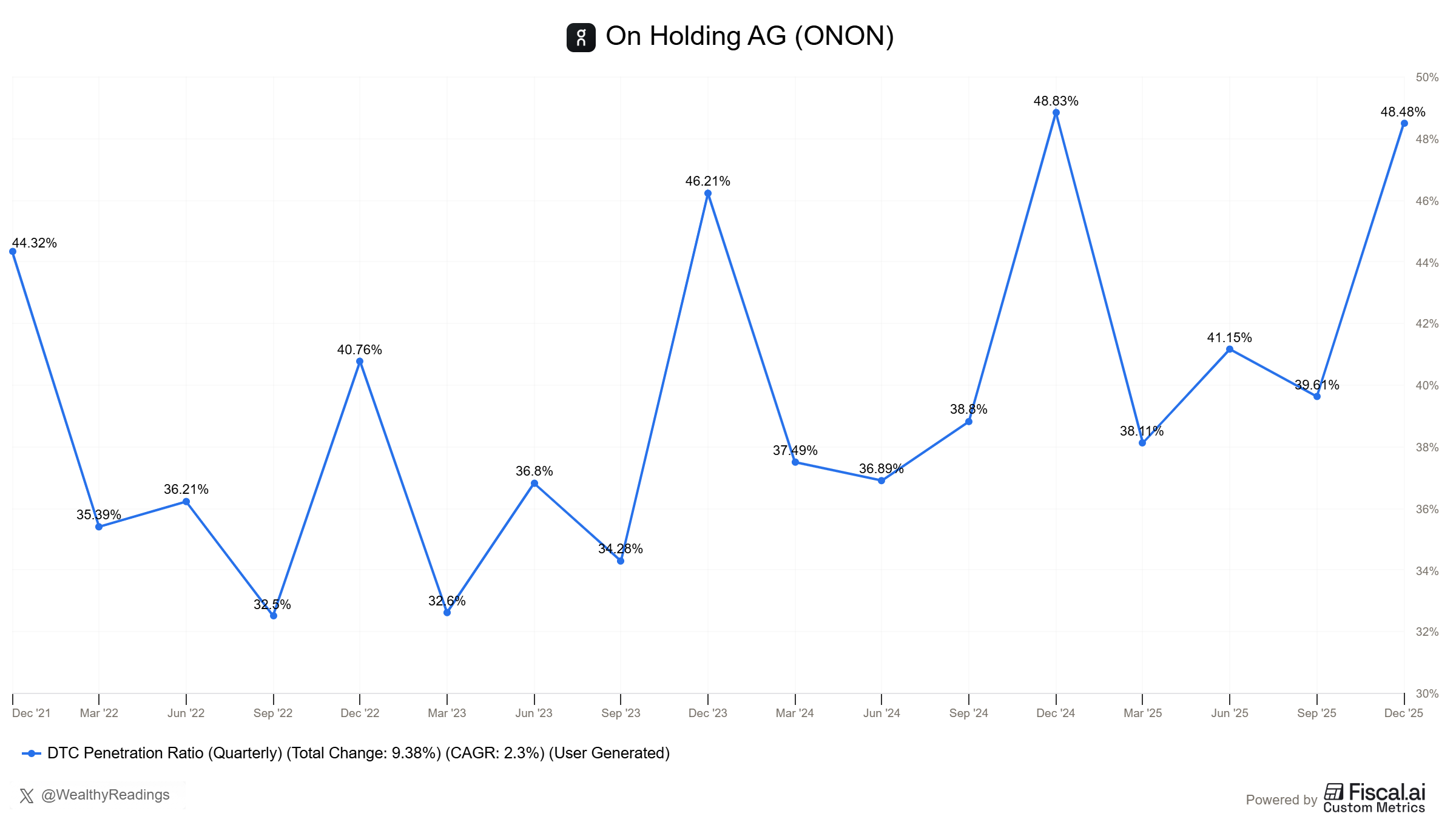
Stable isn’t bad. When half of your products are sold directly through your own channels, upside is more limited. Still very healthy.
On faces another challenge: currency fluctuation, as the company is Swiss and reports in CHF. A 22.6% YoY growth would be 30.6% on a constant-currency basis, with America growing 23.4%, and margins staying high excluded of those currency fluctuations.

On does not face the same struggles as its peers, none. Growth is worldwide, guidance is healthy, margins are stable. The only headwind comes from being a Swiss company reporting in CHF, a currency even stronger than the U.S. dollar, which is terrible for an exporter.
I’ve already detailed how currencies impact export/import dynamics, so I’ll let you look at that, but this is what the market disliked about On’s quarter, or misunderstood. As we have more and more algorithms or investors looking only at numbers without trying to understand the situation, what they see is a 15% decline in net income, lower net margins, and lower cash generation.
But it isn’t a fundamental issue or a demand issue. It is a currency issue. That doesn’t change the fact that the stock is falling because of it but we know that this situation will change once currencies dynamics shift; On will be rewarded twice as much then.
Technology
My original thesis that hardware companies should do well and be rewarded by the market while the rest of the AI trade would fade or do nothing has been accurate enough since I shared it in December. Since then, hardware stocks have pushed higher while most of the market has stayed flat or fallen.
And hardware companies continue to do extremely well.
Broadcom & Credo
These two are excellent proxies for Astera Labs; the first designs computing units (notably Google’s TPUs), and the second is a competitor in scale-out optimizations.
Both printed revenue growth and expanding operating margins, sustained by very large/growing demand for their products as datacenter buildouts simply have no other option than buying better hardware until infrastructures are ready for physical expansions.
Broadcom notably sees massive growth in demand for custom ASICs, and revenues reflect that.

The thesis was on point. Customization is indeed the next step for AI buildouts, even if the market doesn’t reward stocks with as much optimism as it used to. Broadcom is still largely below its ATH while a quarter like this should have pushed it higher - although compared to the market this week, being green’s already something.
Most importantly, management confirmed one important detail during their call: copper is here to stay for a long time.
The best way to do that is use Direct Attach Copper. That's the lowest latency, lowest power, and lowest cost. You want to keep doing that, especially in scale-up, as long as possible. In scaling out, we're past that. We use optical. That's fine.
We can do it with copper, we can push the envelope from 100G to 200G to even to 400G. We have SerDes now running 400G that can drive distance on a rack to run copper.
All I'm trying to say is you don't need to go run into some bright, shiny objects called CPO, even as we are the lead in CPOs. CPOs will come in its time, not this year, maybe not next year, but in its time.
This is what I was already saying months ago in my AsteraLabs thesis.
Finally, a quick word on optics. This has been a big narrative before Oracle’s quarter & the debacle that followed, with many green candles printed on companies working on optical connectivity. For now, this is a fantasy, we do not have optic connectors within the hardware - they are only between racks. Copper is king and will be for some time as it will take years of R&D to get optic connectivity in such small environments. The gap in data transaction speed will be massive when the technology is ready, but we are still far from it.
It apparently doesn’t change anything in the market’s reaction as Astera Labs continues to be sold, to my biggest disappointment. I know this stock will rocket in a few months, quarters, or maybe years. This is the company that will allow datacenters to scale compute faster until infrastructures are sufficient.
But the market is worried about a few margin points instead of focusing on the bigger picture, and this dissonance between stock and fundamentals is also happening with Credo, which is more focused on scale-out but is facing comparable backlash: a gross margin guided to ~65% from ~69% today to focus on scaling.
Growth comes with spending as manufacturing faster cannot be done for free. This, plus their revenue guidance of ~50% growth, makes it look weak after 200%+ quarterly growth - volume naturally slows percentage growth. It is easier to grow from small numbers, while after more than a year of ridiculous growth, scaling becomes harder.

The stock was punished ~15% post-earnings. It has caught up most of it since, but is still stuck below key moving averages with no support below.
Both Astera Labs and Credo were punished for being hyper-growth stocks, and their stellar quarters or future R&D couldn’t change anything about that… They will continue to do wonderfully in term of business but it is hard to know when the market will reward them again.
Both are outside of my system, and their fundamentals can be as wonderful as they are; as long as a stock doesn’t fit my criteria, I won’t be buying it.
AmbiqMicro
I am looking at Ambiq as a competitor to Nordic Semiconductor. Both focus on System on a Chip (SoC) - a single chip that contains the necessary components to power the hardware. Ambiq has a specialty in compute, while Nordic has a specialty in low-energy connectivity. But now both compete to win the same market: low energy AI wearables, but do so from different verticals - we’ll see that a bit later.
And Ambiq’s quarter confirmed a very large and growing demand.
While the company was focused on low-margin power-efficient chips, mostly sold to Chinese manufacturing hubs for all kinds of wearables, this quarter showed a clear shift in demand, geographically and in terms of usage.
We took deliberate steps to prioritize customers who view our ultra-low-power technology as a critical enabler of Edge AI while reducing exposure to efficiency-focused, feature-neutral customers, primarily in mainland China.
This is the primary reason for the company’s double beat in revenues and EPS, as the AI chips sold to Western clients come at a higher price and margins. This is happening because AI is starting to be deeply integrated into wearables and requires more efficient systems.
2025 was a milestone year... we estimate that more than 80% of the units we shipped were running AI algorithms.
So demand in the sector is real, which confirms my thesis for Nordic & its pivot to integrate NPUs within its connectivity chips.
Ambiq management is ambitious for FY26, they talk about a potential $100M in revenue due to this new demand vertical with Q1-26 guidance sits at ~$21M, which suggests a clear acceleration through the year.
From my perspective, the market should still favor Nordic because its nRF54 is built to deliver the most efficient compute while Ambiq designed its chips to be energy efficient only. Nordic’s chips are additive to a core compute chip from Intel or Qualcomm, which are the real stars of the show. They only are here to help them improve compute performances, not replace them.
Integrating high-end compute into a radio chip is easier than integrating radio into a compute chip, especially when AI wearable demand is about efficiency. Sheer energy efficiency isn’t what manufacturers need. They need optimized compute and conectivities, and that is what Nordic sells.
That being said, Ambiq confirmed the rapidly growing demand for this kind of chip and as I believe Nordic has the better product; we can expect demand for their chips to be even higher.
Only good news here.
Consumers
I will not go into deep detail here, but it’s interesting to note some market behaviors, notably around Target’s earnings.
Target.
I’ve had the company on my watchlist for some time as the price action fit my criteria: a long downtrend that stabilized with growing volume and broke above its weekly 50. I did not share it because the fundamentals were shaky; yet the stock is up 21% YTD, more than 15% since it triggered my entry signal.
Why is the market rewarding such a struggling business? Restructuring.
The market stabilized the stock once it heard that word and started to reward it in anticipation of the first results, which finally became visible a year or so later. This quarter is the first one with positive comparable sales growth, expanding margins due to cost cuts, and EPS growth.
Nothing shiny for FY26, but guidance shows a business that could go back to healthy stability, and that would be enough to justify a repricing as Target was trading at its lowest multiple of the last decade only a few weeks ago.
This confirms that lots of sectors and stocks will continue to be repriced as the market turns away from risk and toward low-valuation healthy companies, even if they do not deliver triple-digit growth. If such results can yield ~20% returns in two months, I’ll continue to focus on comparable names as the risk/reward is incomparable to AI/growth names at the moment.
Smith & Wesson
A second rapid earnings review for the firearms manufacturer, which is going through a new cycle of growth, for sad reasons as it probably happens due to a feeling of insecurity, but the market is what it is.
The stock is up ~30% since I presented the thesis a bit more than a month ago, while the option play is up ~65%. The stock pushed higher on great earnings, as described a month ago: inventories cleaned up, new products in demand, price increases accepted by final clients, which also led to margin expansion and higher cash generation.
All of this is supposed to continue as guidance is also very healthy, with double-digit growth expected for the next quarter, which was my bull case.
I wouldn’t make my base case a 1.5x sales as growth is hard to predict and a double-digit growth year still seems far-fetched today, but if the trend continues we’d be looking at a higher multiple than today’s and easily a 20% - 30% push from my $10 target.
This has been an excellent trade and we’re now back at ~1.3× sales.

As this comes with double-digit growth, expanding margins, guidance pointing to more of the same, we could reach that famous 1.5× sales. As I am not in the trade I won’t need to manage it, but if some of you took it, congrats.
A great thesis yielding great returns.
Disclaimer: I am not a licensed financial advisor, analyst, or broker. This content reflects my personal opinions and investment decisions for informational and educational purposes only. I hold positions in securities discussed and may buy or sell without notice. Nothing here constitutes a recommendation to buy, sell, or hold any security. Past performance does not guarantee future results.
Always conduct your own research and consult a qualified professional before making investment decisions. I accept no responsibility for any financial losses.