

We’ve been talking about it for a month now.
The thesis was simple. Tighter funding and real-world constraints would delay buildouts, which delays revenue recognition and cash generation. And the market wouldn’t forgive those delays, given what it expects from growth names: acceleration.
Earnings are now in, and the TL;DR is simple. What I was afraid of, and what made me sell all my AI names - except Arista and Meta, is here: real-world constraints, financing issues and, despite both, accelerating capex, combined with unexpected external risks. The perfect combo for the market to stop paying a premium as risks keep rising.
This could have been expected. What hurts the most is that basic risk management would have changed most portfolios’ returns. It has for me by respecting price action, without guessing the future, simply by acknowledging my limitations.
Over the months, I’ve shared some investing 101 articles that could have helped many during this period.
Why holding onto growth beta names doesn’t work. Some harsh words that could save your wealth.
What the market is and how it really works. Because whether you like it or not you only make money if your picks go up.
Why you shouldn’t buy downtrends and always respect price action. Basic market mechanisms, look at Duolingo today if you don’t believe it.
They aren’t a requirement to read this earning review. But you should read them.
Many have already gone over the numbers. I’ll focus on what few have covered: why these stocks moved the way they did, why the volatility, and why I wouldn’t touch them with a stick just yet.
The positives that do matter
Everyone has covered ARR, backlogs and guidance. You’ve seen the numbers, often in 200-page reports, so I won’t go over them in detail. Only the few that really matter.
But realize this: 90% of an earnings report is about what happened, and 10% about what could happen, not what will. Great investors read between the lines. They understand that what isn’t said is worth more than what is.
Intel, for example, was trashed this month not for its numbers or guidance, but for delays it didn’t talk about, which analysts understood came from incompetence. Some people are very smart. Focus on reading their work when looking for fundamental review, not others.
I won’t be dumb enough to say there are no positives. There are.
Demand is real. It’s a fact, and it shows everywhere: ARR growth, revenue growth, earnings calls, guidance, etc…
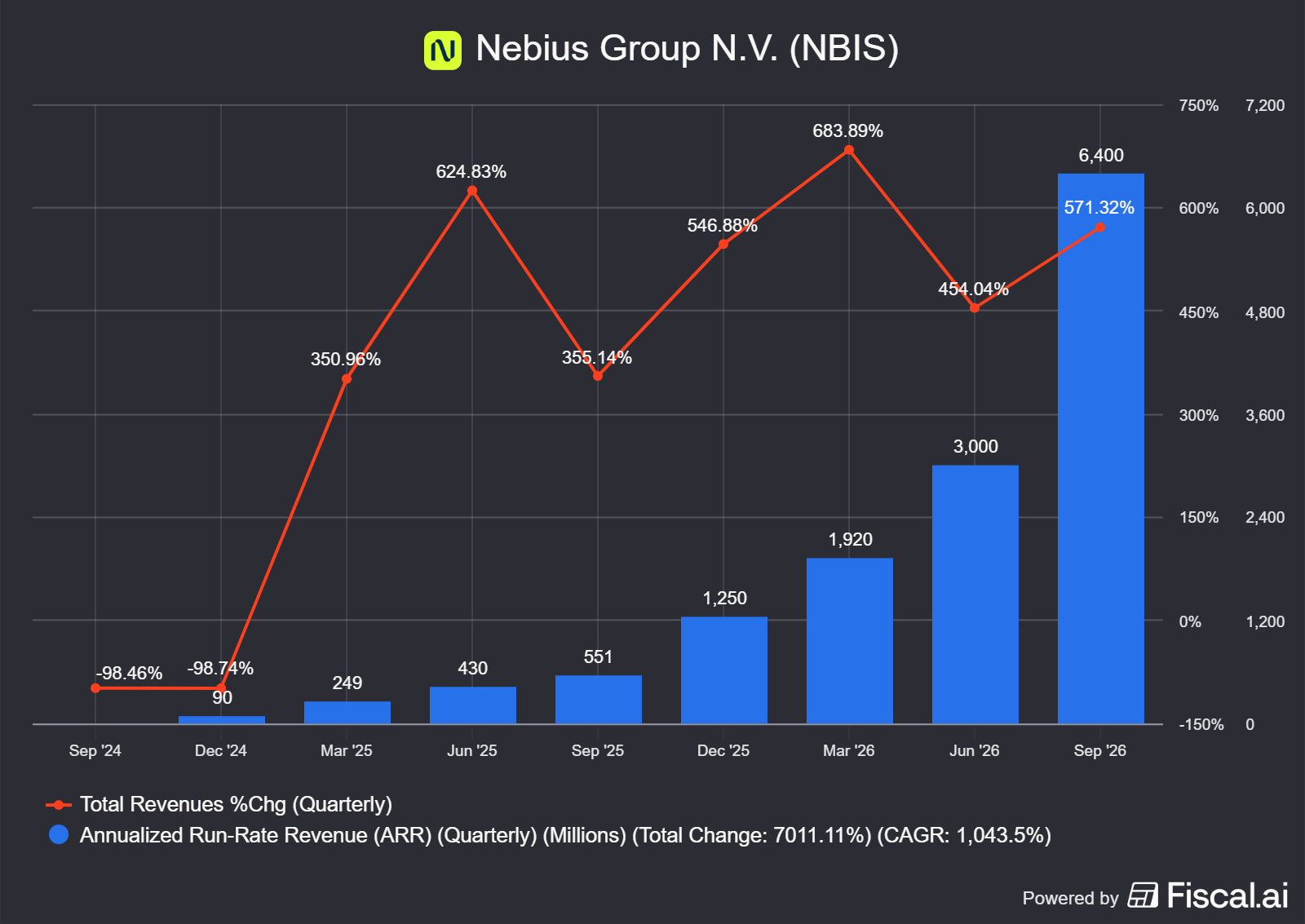
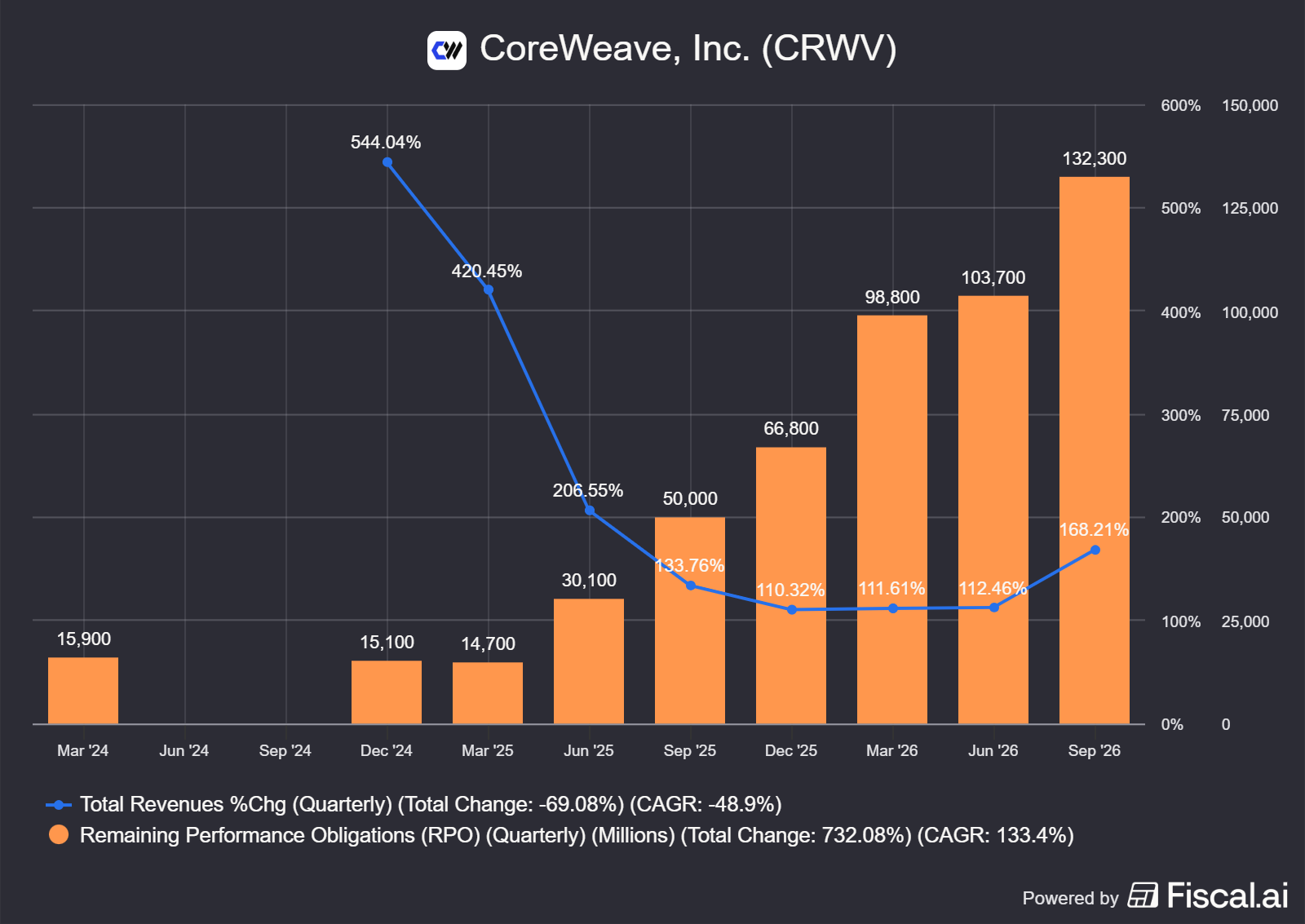
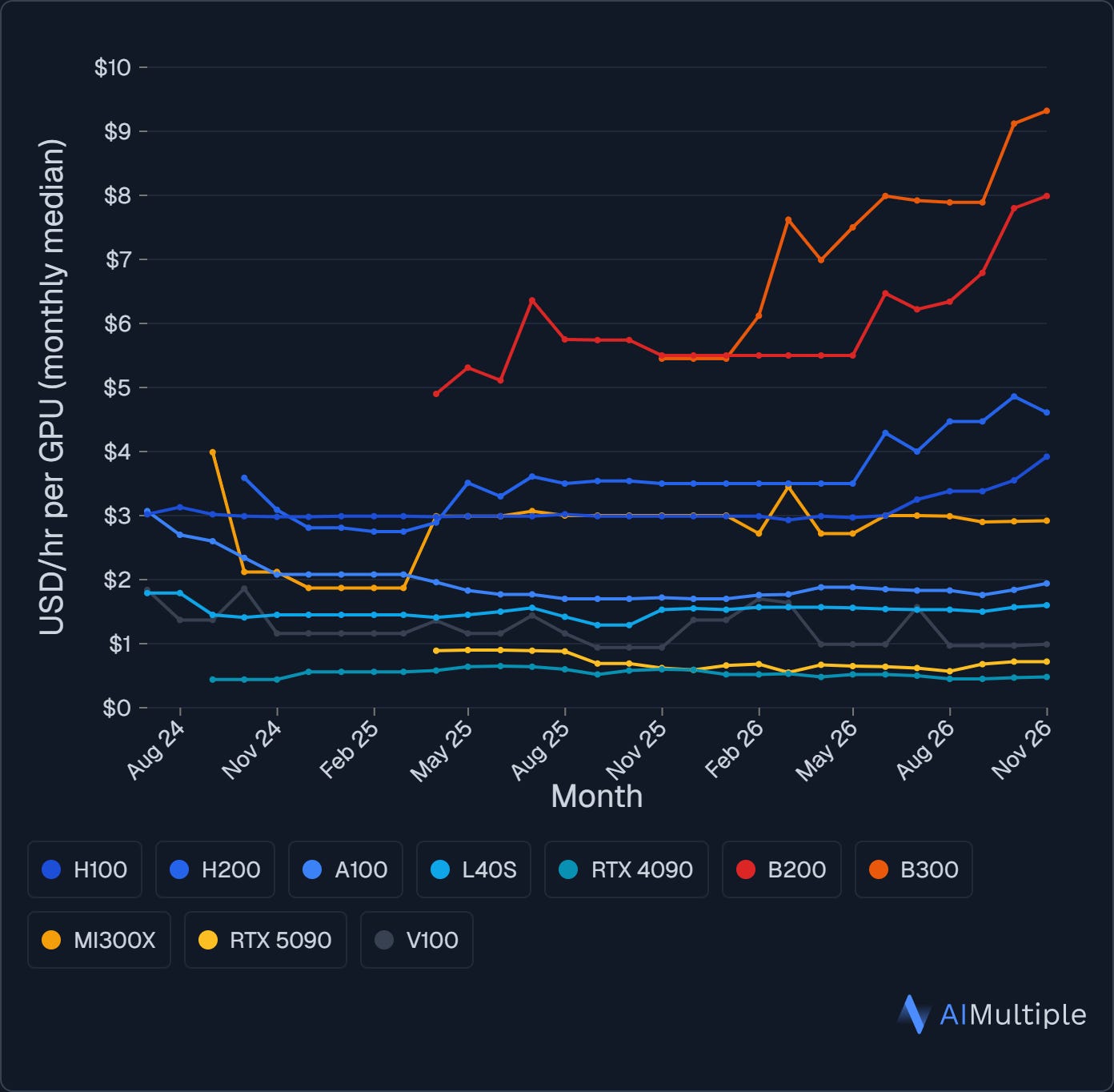
Pricing power is real. Clients are fighting for compute and paying more for it, even for old hardware. At CoreWeave, pricing for A100s and H100s increased 30% to 50% QoQ, above their original contracts. IREN contracted H100s at double previous pricing.
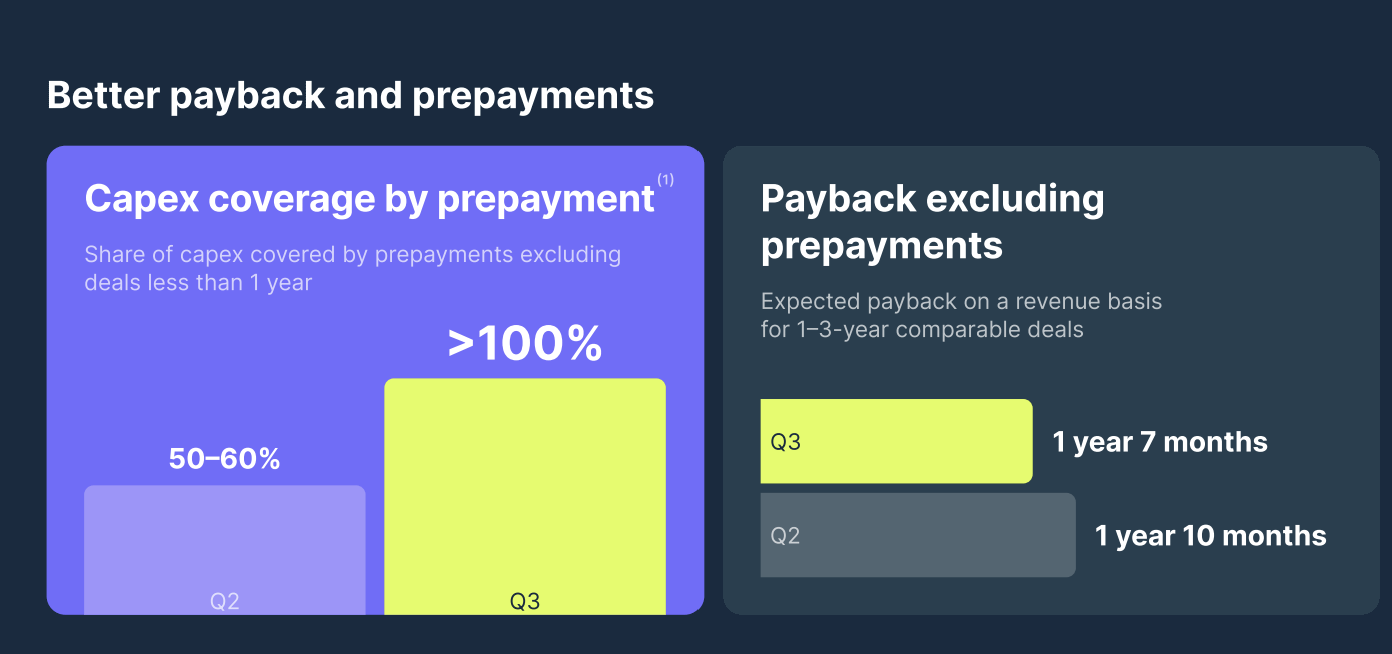
Clients are paying up front. IREN signed a five-year contract at about $22M per MW with 90% of the GPU capex prepaid by the customer. CoreWeave expects about $9B of prepayments and deposits in the next three months. Nebius prepayments’ covered more than 100% of capex on deals of one year or longer signed in Q3, up from 50–60% in Q2.
New kinds of buyers. This is the one I care about most. Nebius signed its first multi-year deals with Databricks, Datadog and Snowflake. A few days ago, I said the only thing that would make me rethink my bear case was software companies starting to prepay for compute themselves. It seems to be happening, although I do not know if they did prepay and scale is a big question. I’ll come back to it in a minute.
Old capacity becomes new revenue. CoreWeave says that at current pricing, 2027 renewals would generate ~$4B of incremental ARR with no additional capex. That’s free money on hardware that’s already paid for.

So yes, a bullish quarter. Who could have thought? Well, me. I’m very bullish on AI and said earnings would be great, fundamentally.
Now let me explain why none of what you just read matters.
A stock isn’t a company
The market doesn’t price what is. It prices what will be. If you invest based on the last three months, however good they were, you already lost.
A stock is the market’s expectation of future cash generation compared with others. If you run the best restaurants with 60% margins but AI is expected to generate 70% and maybe more, the market will favor AI. Look at PayPal: wonderful company, great cash generation, dead stock. Why? No potential to grow that cash generation.
Second, investors buy stocks on a narrative. They build it, and build expectations around it. It can evolve as fundamentals and risk appetite evolve, but there’s always a reason to buy a stock, a metric that matters more than the others. For neoclouds, it was buildouts.
Stocks don’t compete on fundamentals. They compete on expectations and attention.
So my neutral-to-bearish take has always been about the stocks. Not AI, not the companies, not their business. I’m extremely bullish on Nebius as a company and on AI as a technology. That doesn’t make the stocks good investments.
The only equation that matters
Everything can, and should, be simplified as much as possible. It’s a life hack: nothing is as complicated as we make it look. Your returns are nothing but your position size multiplied by your pick’s return.
Neoclouds are no exception. Their business and revenues are incredibly simple.
Revenue = capacity × price.
Price has a ceiling, as we’ll see. So growth really comes from new capacity, and that’s exactly what - and why, the market priced and focuses on. Without acceleration, cash generation won’t come in time, so there’s no reason for a premium. This is why I compared Nebius to AST Space Mobile - and got insulted for it.
With that in mind, let’s go back through each positive.
Demand doesn’t matter if you can’t meet it
This is the #1 reason neoclouds got sold.
I’m a restaurant. Everyone is hungry. I could very well tell investors I’ll raise my burger price and volume, and sell 500,000 burgers a day. The first question investors will ask isn’t “do you have demand for it?” but “can you?”. And it’s the right question.
Neoclouds are supply constrained. They don’t have enough compute to meet demand. Their revenue grows when they bring new capacity online. Higher prices are a bonus, not a thesis.
That means building data centers as fast as possible, and that runs straight into the real world: money, land, power, hardware, partners delivering on time... Too many ignore that the real world is an extremely complicated place, and that nothing happens as planned over long timeframes. It’s not just numbers on a screen.
IREN talked about more than 5GW of secured power and a 35GW pipeline for… god knows when. Just numbers thrown in the air. Meanwhile, FY27 capex was cut by $5B to $10B because of more selective capital markets, without reducing capacity guidance. How do you build without spending? Then the CEO said this:
When you see the market turn the way it has in the last few months, the first thing we do is just pace that construction and pace that CapEx spend and just hold it off and wait for market conditions to turn. So, this is the flexibility of the model when you own and control everything.
They also had to push their $4B ARR target from year-end 2026 to January 2027, maybe February, because they couldn’t deliver Microsoft’s data center on time. Yes, I know why: Microsoft changed the specs, plus supplier timing. That’s the real world happening, which is exactly my original point.
Nebius lost credibility. Its 2026 guidance was cut to ~$3.1B due to third-party capacity delays. Once again, data centers won’t be turned on in time. The >$7B ARR target now lands in February, two months later than originally guided.
Real world, again.
The credibility loss doesn’t come from the delay itself. It comes from the fact that management reaffirmed its ARR guidance three months ago. They didn’t see this delay coming then. That’s how fast the real world slapped them. Management also chose this quarter to stop guiding ARR. Not ideal when you just missed extremely high expectations…
If you can’t plan one quarter ahead, no one will believe your long-term guidance.
CoreWeave said as little as possible. That way, you can’t miss.
They focused on the current situation, talked funding and capacity at large and gave no guidance for FY27. The closest we got: the CFO said that if they only build their existing contracted capacity, FY27 CapEx would stay in line with FY26. Translation: no acceleration.
I assume they had no delays, so they had no bad news to disclose and chose not to comment on sensitive subjects. IREN and Nebius had to.
For those arguing it isn’t the neoclouds’ fault, that third parties caused the delays: you are entirely right. But who’s responsible doesn’t matter. What matters to the market is the delay in revenue recognition, and how big it is.
Prices have a ceiling
Until supply catches up - and with slowing buildouts it’ll take a while, the only lever neoclouds have is price, making their clients compete. The deepest pockets win, and the others can go eat a banana.
Hyperscalers, the ones who can pay, won’t pay above a certain price because they’re also the ones prepaying. Nobody prepays a year of compute and pays market price on top. In exchange for the cash, they get preferential prices. Eventually, prepaid contracts will own most new compute as neoclouds focus on safe cash inflow for safe expansions, and that compute will come with a capped price per GW.
Prepayments are a double-edged sword: they secure capacity and finance buildouts, but they cap compute pricing. That’s why the market doesn’t look at pricing but buildouts as their main narrative.
Prepayments exist because neoclouds can’t finance themselves
Clients prepay for one reason: they have no choice. Neoclouds can’t find cheap funding anymore, and it’s public. CoreWeave said it won’t issue new unsecured debt at current yields, and Nebius said it’ll only go back to corporate debt only when market conditions change and that bonds market was closed to them - literally as they apparently got refused.
So when you ask for capacity, the answer is “prepay or nope”. Those who can, do.
In theory, that’s great news. If every client prepaid, funding would be fully covered. Nebius says prepayments are now its standard structure. But prepayments come at a lower price per unit of compute, so neoclouds have a choice to make: finance buildouts or keep pricing power? Prices have ceiling, again. That’s one.
Two, money doesn’t make land, energy or hardware appear out of nowhere. Funding is the main bottleneck, but not the only one. The real world keeps happening, and logistics remain an issue. We’ve seen many reports of delays due to external conditions lately, at Oracle, Amazon, Microsoft, Broadcom, etc…
Still, prepayments are a positive for the industry. But there’s another variable.
Who prepays is the real question
Look at who’s driving the acceleration. CoreWeave’s largest clients are Microsoft, Meta and OpenAI. IREN’s are Microsoft and Nvidia. Nebius’s are Meta and Microsoft. Very few companies can pay billions up front and wait for the compute.
My assumption - and it’s only an assumption, is that most prepayments come from hyperscalers and AI labs. Maybe not in number of deals, but in dollar volume. I doubt Nebius got many billions in prepayments from its new SaaS clients, meaning most of its prepaid buildouts rely on the same players as usual.
Hyperscalers are affected by funding too, just less than others. The overall funding need is the same with or without prepayments, it simply moves from over-leveraged neoclouds to hyperscalers and over-leveraged research labs.
And the biggest of those hyperscalers is pulling back. Microsoft is reported to be tightening oversight of its neocloud partners, stepping away from projects it sees as risky, and debating internally whether to sign new neocloud deals at all. Let’s see how it turns out, but questions are being asked, risks are increasing.
Back to the bull case. Databricks, Datadog and Snowflake signing is the right signal, but I’d love to know for how much, for how long, and whether they prepaid. The AI trade needs a new source of liquidity. This could be it, but SaaS names will really need to step up to fill the gap left by disappearing debt and slowing dilution…
If those companies start prepaying at scale, I’ll rethink my case. For now, it’s a signal to watch, not a news to buy.
And there’s more.
That’s without other external factors
The real world is hard on their industry, but it’s even harder outside of it.
Politics. After the midterms, a few states are looking at tighter regulation on new data center construction, including Texas, where most new data centers are to be built. Some say it won’t affect projects already started. Even then, it would be dramatic. Left to see but again, risks rise.
Geopolitics and inflation. We’ve been here for months, so you know the drill. But as nothing moves and the economy starts to absorb the load, what could have been transitory should now have medium to long-term impacts.
Jensen’s pants. Our next subject.
Jensen
This week, Nvidia’s board accepted Jensen Huang’s resignation as CEO and board member, effective immediately. Colette is interim CEO while the board looks for a replacement. There’s a lot of noise to reinstate him, and no one knows what will happen. But an admitted affair with a woman US intelligence believes is a Chinese spy, plus a reported affair with a subordinate, should take more than a petition for a board to change its mind.
The impact is unknown. But the risks are massive.
I won’t pretend this analysis is mine. It comes from Junkan and other analysts, smarter ones, who know much more than I do.
Many believe Jensen was key to the AI trade: his aggressiveness, knowledge of the supply chain, and relationships (not the sexual ones that is). Losing him could mean losing support for neoclouds and other companies, as a new CEO might focus on Nvidia rather than the industry. It also means losing a sharp negotiator with 30 years of relationships to cut deals and secure capacity. That hurts Nvidia more than the neoclouds, but Nvidia’s financing and early access to GPUs are key to their business, and to survival for some.
The entire industry benefited from Nvidia’s aggressiveness under Jensen. Will a new CEO share it? Who knows. But the market will demand proof before repricing that potential.
Buy the dip (no…)
The risk in neoclouds is much higher today than when I first bought Nebius under $30. Yes, the bull case is still attractive. Executing perfectly would generate massive returns. But we focus too much on the opportunity, and not enough on the risk.
The volatility is extreme and impossible to anticipate. Most trends are broken. The news isn’t as bullish as it used to be. A single headline can make or break a day. Meanwhile, macro isn’t improving, and I’ve already detailed the consequences of high interest rates, which aren’t coming down tomorrow.
To be clear: I’m not bearish on the companies, only on their stocks. I’m not one of the doomers who think they bankrupt or AI will be forever useless. I think the stocks will struggle over the short/medium term. But struggling stocks can destroy wealth as certainly as bad ones, and many have already lost too much buying every dip on reckless content and advice from FinX gurus.
You saw my rant on X already, so I won’t go there again. This isn’t the place. Some liked it, some didn’t. I understand both.
But there’s an important lesson here, and it’s what separates an ideological investor from a normal one. When a well-argued bear case gets hundreds of insults, the trade has become ideological. Better to be out, whatever the outcome. Nothing sells better than ideology, and social media is the perfect place to build it. Many bought the last 50 dips because it was the right thing to do. Maybe are still convinced holding is the best thing to do, even while being down 50%. They still believe in their god(s). I hope they won’t get destroyed, but I believe otherwise. I’ve seen what holding Hims or Duolingo has done to many.
Even if neoclouds bounce on Monday, the damage is done. It’ll take time to repear.
I sold my AI names except Arista and Meta more than a month ago. It was a decision based on rational thinking and consistent execution, not bias. That’s what I’m building on this Substack: a consistent process to succeed in the market, not a church of believers. Selling companies you grew attached to is a must, not a maybe.
I won’t focus on high-beta names with extreme volatility and broken charts while other sectors show up with much less risk and better price action, meaning investors are buying them while selling AI. There are better opportunities elsewhere.
Less risks. Strong fundamentals. Even in AI.
Ideological stocks always happen. It happened with Hims. It happened with Palantir. It happened with Duolingo. It will happen again.
That doesn’t mean you have to be part of it. We cut Nebius with a 589.46% return since our first purchases, and 336.97% on the total dollar-weighted position, in a year and a half. One of my best trades ever.
My ideology is execution.
TL;DR
Stocks move on narratives and expectations relative to other opportunities. They compete for both liquidity and attention. Neoclouds pumped on expectations of accelerating AI buildouts. Those expectations hit a hard wall due to external factors: geopolitics, supply chain, funding, third parties, etc. This earnings season showed clear cracks in the narrative, with a potential slowdown in the short term.
I believe neoclouds will do great as companies. AI will do great as a technology. I’m not calling the end of either. But I expect buildouts to slow as real-world constraints show up more and funding gets harder, and the market won’t pay a premium for companies that rely on acceleration without acceleration.
What would bring me back: concrete improvements in funding, re-accelerating buildouts with a good outlook and proofs, and investors stepping back into these stocks, with consolidation and breakouts on price action, as usual.
Until then, there are better opportunities elsewhere.
Disclaimer: I am not a licensed financial advisor, analyst, or broker. This content reflects my personal opinions and investment decisions for informational and educational purposes only. I hold positions in securities discussed and may buy or sell without notice. Nothing here constitutes a recommendation to buy, sell, or hold any security. Past performance does not guarantee future results.
Always conduct your own research and consult a qualified professional before making investment decisions. I accept no responsibility for any financial losses.
The main point is increasing capacity is going to be limited because of the power constraint and the land constraints. Therefore, if the supply goes down but the demand goes up, the only effect it has on the industry is the prices will go up because the capacity will be rented out to the highest bidder. For Nebius or CoreWeave, growth won't happen as fast because they're not allowed to build more facilities to increase capacity. The only way they can increase capacity is by decommissioning old hardware and commissioning new hardware, which has a larger margin, I'm assuming. I think what will happen is these neoclouds will start building a cash hoard and deploying it to make upgrades so they can effectively increase capacity without increasing the footprint of physical structures. Basically, their growth will come from the upgrade cycle, not expansion. So with this new way of thinking about it, the stock price has to be adjusted for this type of growth, not the old type of growth. There will be a good price point, that's to be seen.