

We will talk about energy, again, because it is (one of) the best verticals today, with many tailwinds; from the current war in Iran and the western realization that we have a dependence which needs to change, to the fast development of AI which keeps increasing the pressure on consumption and on the grid, and requires entirely new architectures to be AI ready.
Most investors are currently focused on the AI hardware upgrade cycle, from memory to photonics, passing by networking and more - and they are right. The inference optimization is a key vertical nowadays and I’m part of it with some of my holdings. But energy remains at the heart of every economic activity: without it, nothing happens, and without it, all that new hardware will sit idle in a powerless data center.
Of all the bottlenecks you hear about on social media, energy is the least mentioned, yet the most important. And just like hardware, it has to go through an entire innovation cycle, because it isn’t optimized for AI today. We need new infrastructures as much as - more even, new networking systems.
And that’s what we’ll talk about today.
The current situation and the need for innovation.
The new electrical systems design.
How to capitalize on it.
As this is the second write-up on energy, I’ll redirect you to the first one for the overall introduction: the growing usage of electricity, the massive consumption from data centers that will only accelerate, the current issues around how and where electricity is generated and transported, and the core problem for data centers - the fact that they need more energy, today.
That first write-up focuses on the need for energy, not the electrical architecture of data centers. It covers why we need so much, and how data centers can produce or find more. This second write-up focuses on how they plan to optimize it for AI.
Current Situation & Problematic
Electricity was my worst nightmare in engineering school, and yet here we are.
Today’s electrical infrastructures were built years ago for low voltage and stable loads, for a good reason: that was the need at the time. The standard model was 480VAC with as many AC/DC conversions as needed - if that was Chinese you need to read that first write-up; it was the safest and cheapest, with nothing pushing against it. That means tons of copper wires and various hardware in the path which take up space that could hold more compute.
Complex infrastructures, hard to scale and upgrade.

These infrastructures remain the norm as nothing changed since. Data centers and enterprises consumed more electricity, but volume alone wasn’t enough to change the architecture. What would force a change is if we consumed differently, and that’s exactly what’s happening with AI.
Compute racks - notably because of GPUs, have a different need. They’re more aggressive, volatile, and power hungry than other industries. A cluster’s consumption can jump from 10% to 90% in the blink of an eye, putting extreme tension and heat on the power chain.
Compute densities that once averaged 10–50 kW per rack are now routinely exceeding 120 kW, with projections approaching 1 MW per rack in the near future. This dramatic increase is driven by AI servers hat pack high-performance cores into tightly integrated architectures for ultra-low latency communication, creating unprecedented demands for power density.
On electricity 101, you learn about three metrics to understand electricity. Power - the total delivered, equals current - the flow of electricity; and voltage - the pressure moving the electrons.
Power (W) = Current (A) × Voltage (V)
As racks require more power, engineers have two levers: increase current or voltage. With data centers, the solution was to stay at low voltage - the safest and cheapest option. But low voltage means high current, and that comes at a price: the more current passes through copper, the more the metal heats. If that rings a bell, it’s because we have the exact same problem inside the hardware; that’s what photonics is trying to solve with light - the second biggest narrative today.
For electrical infrastructure, the last lever available is to raise voltage, keeping the copper from heating, because that heat is complex and expensive to manage. So they came up with two ideas: ±400VDC (400V Direct Current) and 800VDC. Both are different architectures, requiring different hardware, with different potential.
Today, the latest Nvidia GPUs can still run on 48VDC - current architectures. Problems start with the next version of Rubin: a single GPU will always function on 48VDC, but an entire rack won’t get enough power to run at 100% capacity. The next generations will require at least ±400VDC, which is enough to power ~1MW racks - most of them nowadays, while multi-MW racks will require 800VDC - most of them tomorrow.
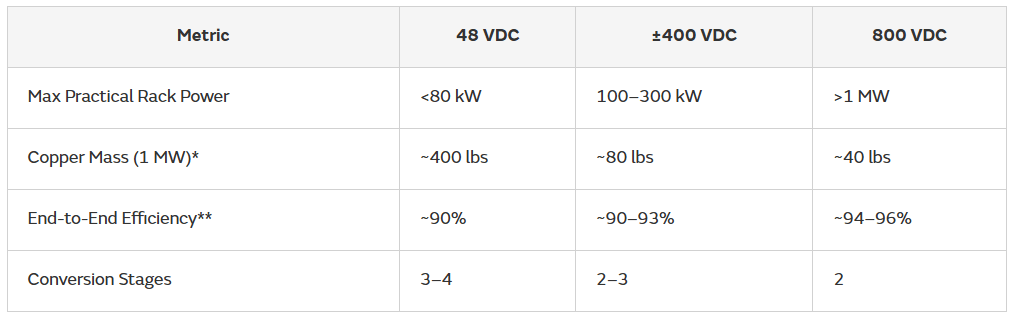
Raising voltage raises end-to-end efficiency - fewer AC/DC conversions, less copper, less heat, etc... Over 150% more power moves through the same copper at 800VDC. Much easier infrastructure to manage and maintain, just complex to engineer.
The future vision centralizes all AC-to-DC conversion at the facility level, establishing a native DC data center. In this approach, medium-voltage AC is directly converted to 800 VDC by large, high-capacity power conversion systems. This 800 VDC is then distributed throughout the data hall to the compute racks. Architecture streamlines the power train by eliminating layers of AC switchgear, transformers, and PDUs. It maximizes white space for revenue-generating compute, simplifies the overall system, and provides a clean, high-voltage DC backbone for direct integration of facility-level energy storage.
Here is the blueprint of Nvidia’s 800VDC.
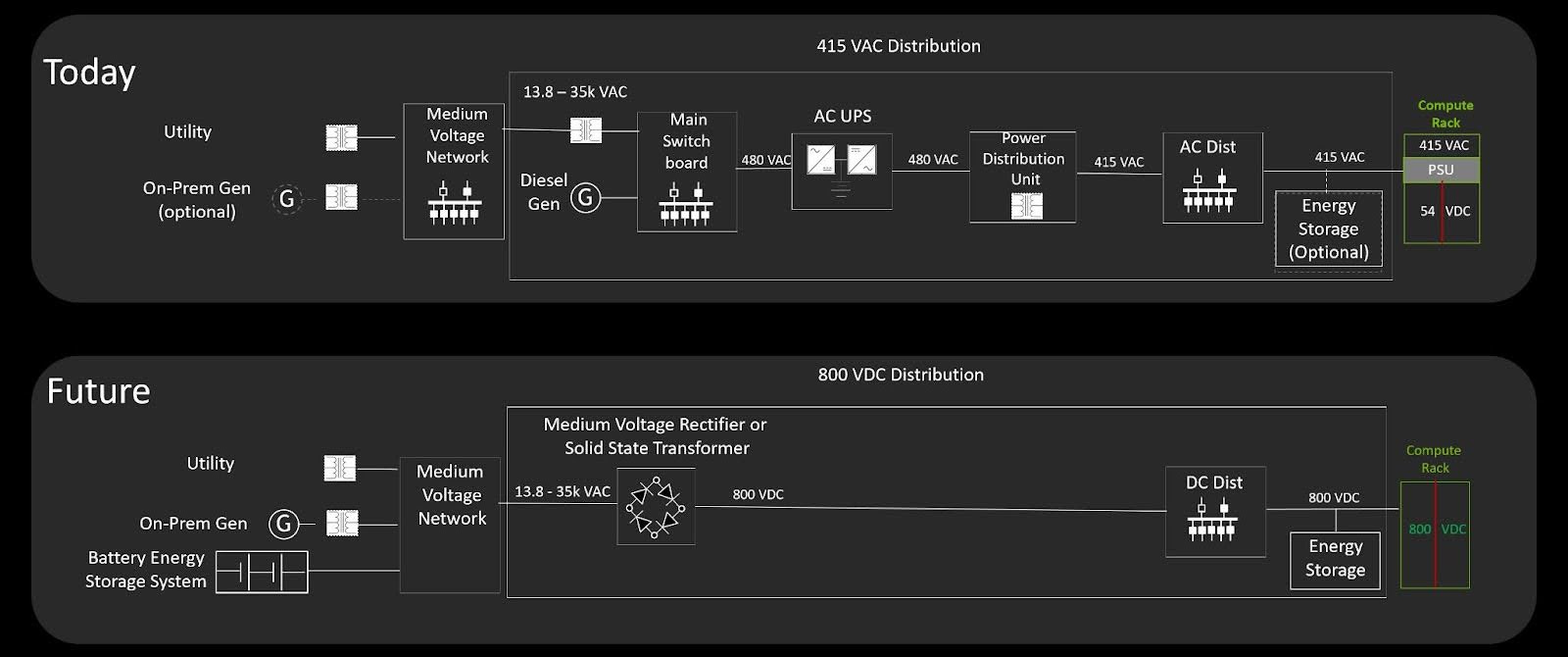
±400VDC is the safer of the two, the one we know how to install, already in use in a few rare data centers - one of them Google’s. 800VDC relies on hardware that’s still being developed and tested today; it isn’t a ready-to-deploy solution. Everything has to be built from scratch, just like for AI hardware, which is exactly why the opportunity is so large. We’re living through a moment where entire hardware architectures have to be created to meet the demand of a brand-new technology. From scratch.
And you can’t migrate from one to the other; the two infrastructures are completely different by design, so data centers have to be built with that in mind from the start. Today’s choices have to account for future compute: even if the real need for 800VDC isn’t for right now, buildouts will be designed around it to anticipate. It’s the only architecture that can efficiently power multi-MW racks, and those are coming.
Timing’s the main risk behind these investments, but also the opportunity. The market knows and anticipates the move to 800VDC, but has no confirmations yet. Most expectations point to 2027 at the earliest and we could easily have any financing issues, delays, or changes in design by then. But the buildouts will happen and under the right conditions some of these names will deliver multiples over the next few years.
Those two architecture are the future, a necessity to improve efficiency and reduce costs. They aren’t a maybe, but a when.
Hardware
Solid-State Transformers (SSTs)
SSTs are the central piece of hardware managing the AC/DC transition, replacing the many components that handled it before. Connected to the grid, BESS, or BTMs, software-optimized to deliver or convert AC/DC depending on the need.
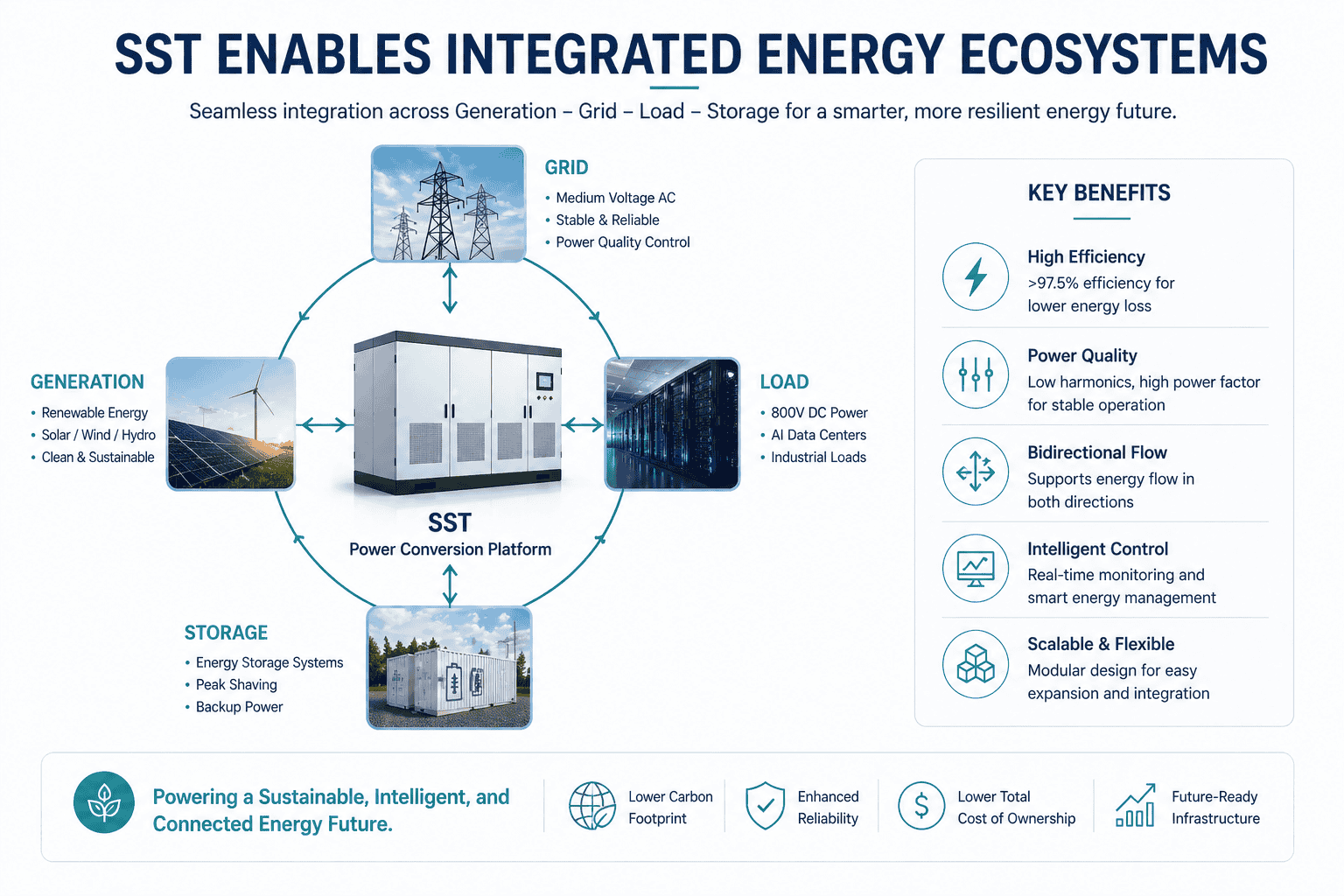
They are the central black box, filled with hardware doing the heavy lifting.
Power Semiconductors - SiC & GaN
SiC and GaN are wide-bandgap materials replacing traditional silicon to manufacture power semiconductors - transistors, as silicon is inefficient at these voltages. It’s still sufficient for ±400VDC, though even those mostly use SiC already. These materials are used to manufacture MOSFETs and HEMTs.
Both transistors control voltage, raising or lowering it wherever needed. MOSFETs, with a much higher voltage tolerance, usually handle extremely high voltage at the dangerous points of the circuit, while HEMTs handle the lower voltage with extreme precision, like the final delivery to the GPUs. They’re the maestros of the circuit, always delivering exactly what’s needed, not more, not less.
DC-DC Conversion - Bus & Point-of-Load
The “tubes” inside the data center that manage the power, integrating MOSFETs and HEMTs. A single GPU doesn’t run on 800V, so voltage and current have to be fine-tuned for each component, just like irrigating a field takes tons of water, but you don’t dump it all on one crop, you spread it across the whole field. SiC and GaN manage the voltage; Bus and PoL are the converters that put them to work.
Bus is the larger step-down, taking the power upstream and bringing it close to the racks, while PoL is the surgeon, delivering the last centimeters with extreme precision to the hardware.
Busbars, DC Breakers & Connectors
Safety. As I mentioned, working at 800VDC is like nothing we’ve dealt with before, and safety is actually one of the reasons deployments are slowing down.
Busbars are rigid bars, made of copper and/or aluminum, that conduct the power, replacing cables. In 800VDC those busbars get smaller and lighter while needing better insulation for safety and liquid-cooling - since heat is still present.
DC Breakers are safety switches, meant to shut down all or part of the infrastructure when needed, and 800VDC changes how they work. In AC, voltage drops to zero many times a second, so cutting it mechanically is “easy.” But at 800VDC the voltage is constant and extreme, and cutting it would generate heat in the form of plasma - you really don’t want that. So instead of a mechanical switch, 800VDC uses Solid-State Circuit Breakers, SiC semiconductors that can freeze the current in microseconds.
Connectors are what they are, the pieces linking the bus/PoL to the racks. And once again, at 800V, you want safer connectors than the ones used at 48VDC.
Power Supply Units & Racks
The final piece of the puzzle: the famous racks, where the hardware gets plugged in and interconnected. Same story, at 800V you need a safer architecture and power supply units inside the racks. Those can also be optimized as a lot of hardware isn’t necessary anymore - notably AC/DC converters and components now handled higher up the chain.
Heat management
Every unit of power pushed into a rack comes out as heat, and airflow isn’t enough to cool the hardware. This can’t be avoided. It’s the same constraint thousands of people are working on inside hardware: how to remove the most heat in the least space. Liquid cooling is the most efficient option, since it moves far more heat than air for the same volume, and it can run right inside the racks - which is why they usually are designed together.
It comes with a straightforward but specific plumbing. Coolant Distribution Units pump liquid to the cold plates inside the racks - a simple metal plate sitting on top of the GPUs (or any hardware), running a closed loop of liquid that pulls the heat out, gets cooled down, and comes back for another turn. The difficulty is making cold plates thin enough but completely leak-proof; a single leak could destroy an entire rack - so these are safety-critical parts.
There’s also research on immersion, where the hardware is dipped directly into a non-conductive liquid. Higher performance, but not quite there yet - and not directly tied to the electrical infrastructure either way.
Volatility Management
Probably the most important vertical, and the one everyone seems to forget. A GPU cluster doesn’t draw power smoothly, it jumps from 10% to 90% in a blink and drops back just as fast; an electrical nightmare. The power chain likes it steady and stable, not volatile, spikes that could pull energy meant for somewhere else, creating lags or overloading some equipment.
The fix, shown in Nvidia’s 800VDC blueprints, is to place a buffer close to the racks in the form of batteries the clusters can draw from. It sits close to the source with no impact on the global power chain: the battery charges itself from a stable input and releases the spikes the cluster needs, making the volatility invisible to the rest of the chain.
The grid only ever sees a smooth GPU load, while the other side of the battery is a constant storm. This hardware is usually called BESS, and it comes in two parts: the battery, and the software optimizing the spikes and the recharge. Storage used to be optional, now it’s shifting from its original purpose into an optimization role. It’s not there to deliver missing power; it’s there to manage the chain.
And this whole system is built into the 800VDC architecture.
In Brief
This is the reasoning and the architecture behind the new 800VDC infrastructures that will become the new normal for AI data centers.
Data centers connect to the grid/any behind-the-meter source: batteries, generators, or renewable production through their Solid-State Transformers, the single point of AC/DC conversion, which increases efficiency. From there, MOSFETs and HEMTs inside the Bus converters carry the power into the data center, and Point-of-Load deliver it to the final hardware, inside racks interconnected by busbars and connectors, and kept safe by a Solid-State Circuit Breaker “kill switch”. The whole architecture is liquid-cooled, and volatility spikes are absorbed by BESS, the buffer that lets the rest of the circuit stay stable.
Those are the most important and impactful changes made to today’s data centers to power the next generation of GPUs and compute hardware in the safest and most efficient way.
The next part of this write-up will cover the opportunities tied to this new architecture, and how to capitalize on them over the next few years: from the stable giants to the more speculative pure-plays, and how to play them short, medium, and long term. We know the basics, now here’s how we turn them into profits.
