

The thesis continues to play out as expected.
Space is slowly becoming a new region to colonize, with almost everything still left to build. The next decade will be a race to establish infrastructure, secure access and exploit the region’s opportunities. Controlling space will become a source of military power, geopolitical leverage and, eventually, economic value. This is why the U.S. government is accelerating spending, missions and R&D programs to develop the technologies required for this new infra.
Space is becoming one of the most important strategic regions in the world.
We see it with RocketLab and accelerating demand for launches/services.
For Launch Services, demand is extreme. In Q2 and since the end of the quarter closed, we have signed more than $437M in bookings for Electron, HASTE, and Neutron. This includes a record $266M contract for up to 18 suborbital missions for the U.S. Space Force, our largest launch contract ever. Also, we have seen a massive surge in Space Systems contracts with more than $581 million signed in Q2 and post-quarter.
Q2 and the weeks after saw us awarded significant contracts across Space Systems, including a $397 million contract to build and launch multiple Flatellite spacecraft for the Space Force Space-Based Airborne Moving Target Indicator program. This program is a high priority for the Department of Defense.
With ASTS with governmental contracts for communication systems.
Meanwhile, the U.S. government customer has been a major focus for us, and we see great progress this quarter, both in terms of revenue capture and building the backlog. We drove revenue against several existing contracts and received three new contract awards.
With Firefly for defense and space colonization hardware.
After seeing our end-to-end capabilities, Carlos shared that our recent MoonFall program award is not only important for space exploration, it is also important for national security as future missions could collaborate with the Space Force.
Additionally, space is a national security priority, as shown by significant year-over-year increases in the U.S. Space Force budget, major conflicts around the world, and evolving missile threats. Market signals from customers point to orbital launch only getting more supply-constrained. Demand for government and commercial constellations and missions outstrips the rocket capacity available both in the U.S. and globally. Moon Base, national security, Golden Dome, and assured access to launch are driving significant industry tailwinds for space.
Or with Voyager for the same reasons.
that demand across defense modernization, national security, and the rapidly expanding space economy continues to accelerate
One company saying this is interesting. Many companies saying the same thing is information. It gives us our thesis confirmation: space economy is moving forward.
And after months of weakness, we’re finally seeing the other part of the thesis start to work: price action. Not everywhere though. The market is clearly making a distinction between space and defense. Most companies operate in both, but not to the same degree. For now, the market rewards companies with stronger exposure to defense.
That distinction is creating the setups I care about.
Numbers Confirm the Thesis
All companies I follow had strong quarters. Not just optimistic commentary, but actual revenue, contracts and backlog growth.
Rocket Lab delivered a double beat despite a negative revenue mix and payment timing, a record $2.36B backlog with 45.5% of it expected to be recognized over the next 12 months, and management guided to 10% sequential growth.
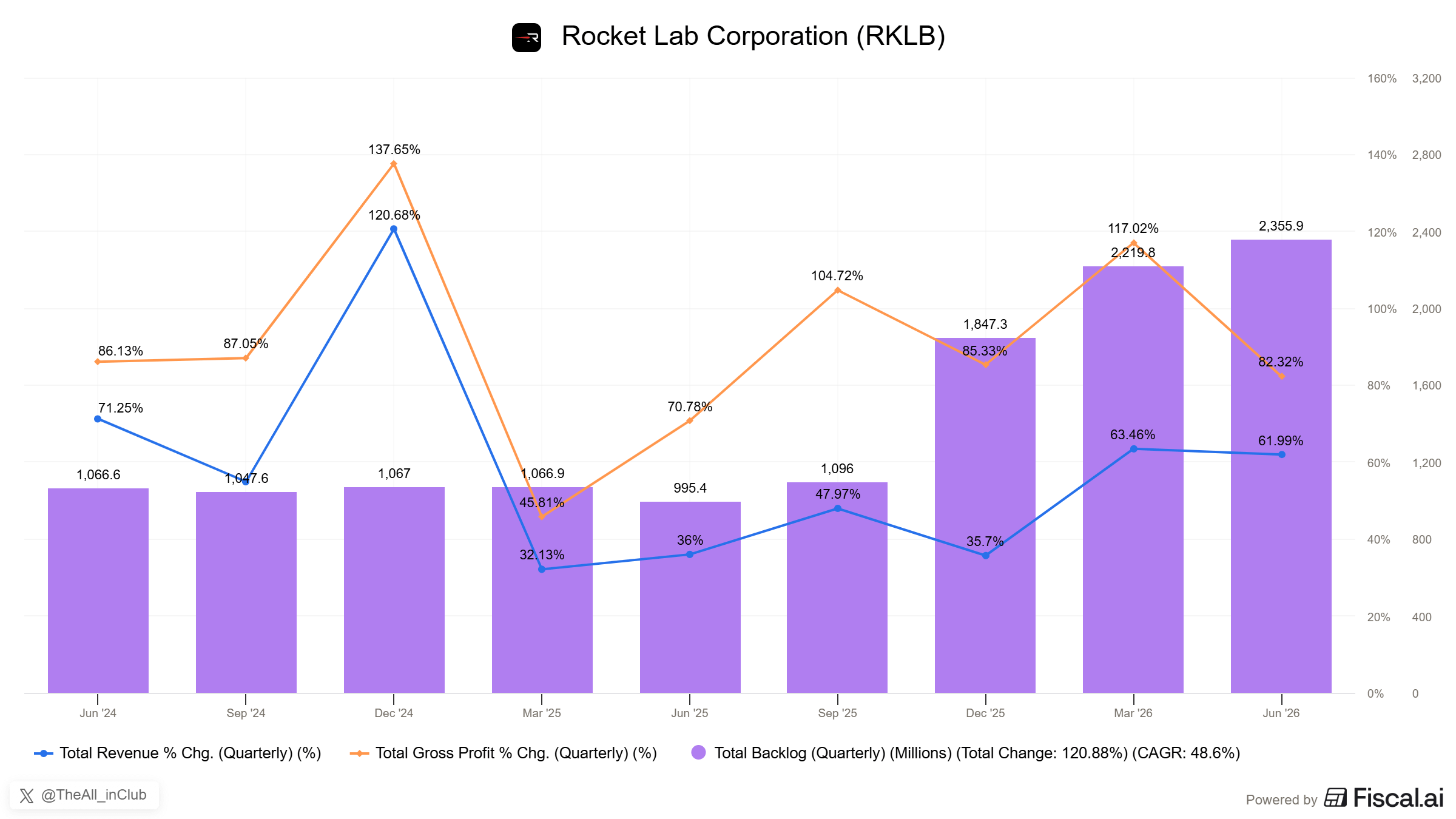
But it came with two negatives.
Neutron first flight was delayed, which means more R&D spending and a longer wait for commercial revenue. But management’s explanation makes sense: more work to reduce risk and scale faster after the first launch. Not thesis breaker, this is just classic space R&D.
Production currently lines up with our target delivery of Neutron to the pad in Q4 2026. While the window for an end-of-year launch is narrowing, the work we’re doing now is about risk trading, balancing the timing of our first launch against how quickly and seamlessly we can scale our 10th launch.
Iridium acquisition is a question mark. Rocket Lab wants to keep Iridium’s core business while using its spectrum for new services, without giving details yet. I’d trust them - they have the track record on their side, but this is still an execution risk.
We will expand upon it and scale it into untapped markets and pioneer new space-based services.
It is through these growth areas that Rocket Lab will put Iridium spectrum to more effective use, extracting substantially greater capacity and throughput from the same finite spectrum allocation.
Rocket Lab is the only space pure-play I follow that has reclaimed its W50. I shared an alert with Founding Members ~$75.5 when the stock retested after earnings as I believe this was a clear overreaction. The position is up ~6%, and I’ll detail my view on it later in this article.
AST SpaceMobile also delivered a strong quarter. There wasn’t much that changed the thesis. Management continues to execute satellite manufacturing, launches and contracts with proper cash management, while preparing for future cash generation once the constellation becomes operational.
If anything, the bull case got stronger as they announced new contracts (notably with Rakuten Japan for a $1B market) from different customers and different use cases, including commercial telecom and government.
This follows continued work with FirstNet emergency and first responder networks in the U.S., with partner AT&T, and recent announcements with multiple governments through partners like Vodafone and Rakuten.
Redwire is perhaps the simplest example of what matters for these companies.
Space stocks move on contracts, execution and balance sheets. Successful operations and sufficient financing capacity lead to more contracts. More contracts lead to higher revenue and future cash generation. Which leads to a higher stock price.
Simple.
Redwire reported a reduced debt load, strong execution and record backlog.
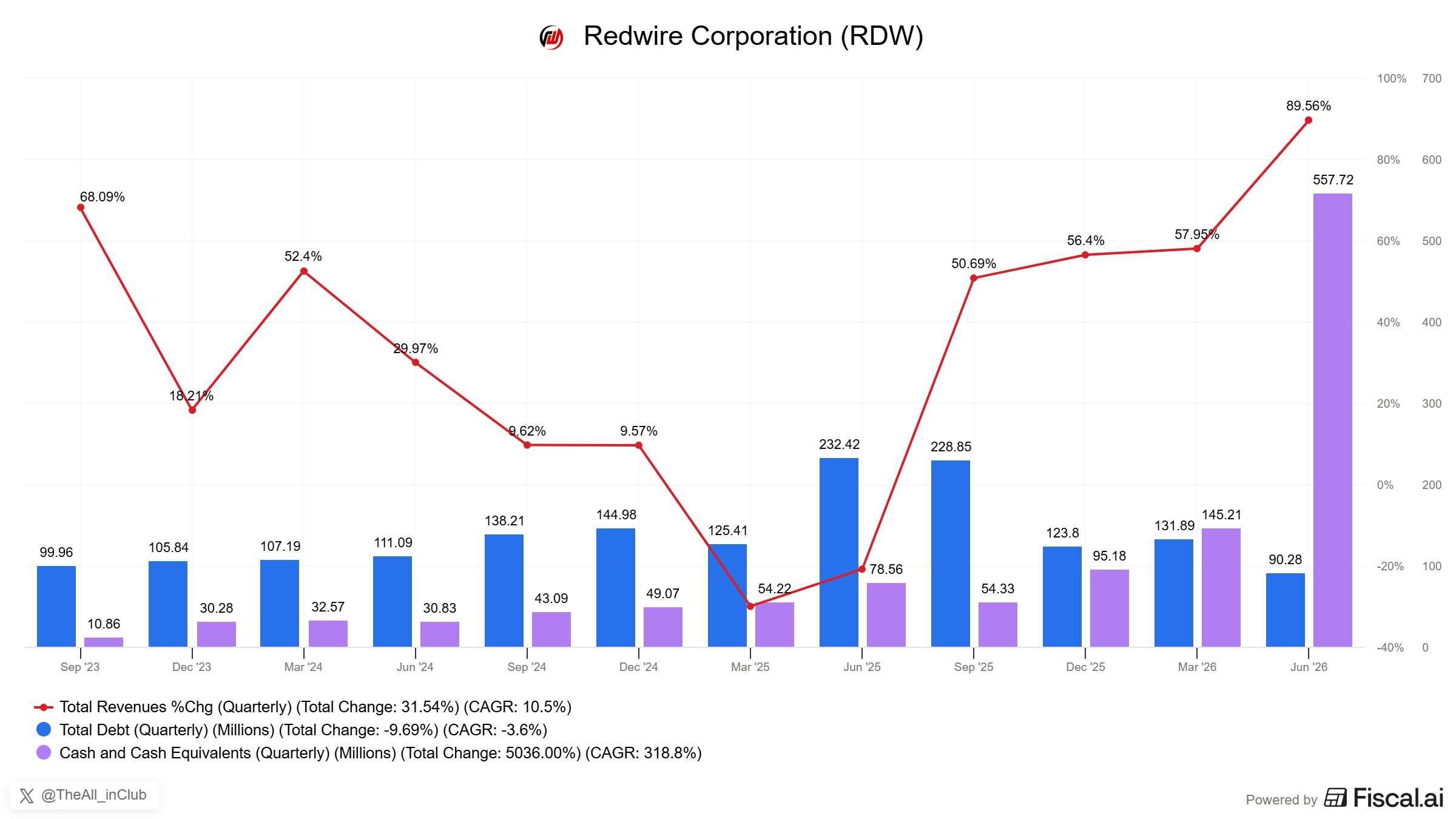
Guess what? Stock went up. How surprising. More on this later as well.
Firefly delivered more of the same, expanding manufacturing capacities to meet demand, while winning more lunar missions, commercial payload contracts and Golden Dome-related contracts, without major delays.
It isn’t my favorite company or setup, but the numbers confirm the broader thesis.
Intuitive Machines is similar. The company is involved across NASA lunar programs, Golden Dome and other national security programs, while its backlog grew from $1.1B to $1.8B, and confirmed the broader thesis.
Combined with our existing leadership in lunar transportation and infrastructure, we believe these capabilities have expanded our addressable market from roughly $20 billion only a few years ago to well over $150 billion across civil, commercial, and national security space sectors.
Again, the important part isn’t one contract. It is the pattern. Demand is spreading across all parts of the space economy.
And then, we have Voyager. I’ve been watching this name for several months after it appeared on my screener earlier this year, even if I never spoke about it. Here’s a brief recap of their business.
Voyager is a defense technology and space infrastructure company operating across three complementary businesses: Defense & National Security, Space Solutions, and Starlab.
Defense & National Security supplies propulsion systems, communications, guidance, navigation, signals intelligence, missile-defense technologies and edge computing to customers including the U.S. Department of Defense, Missile Defense Agency, U.S. Space Force and major defense primes such as Lockheed Martin, RTX and Northrop Grumman.
Space Solutions provides the infrastructure needed to operate in space, including spacecraft communications, mission hardware, robotics, science payloads and mission services for NASA, international space agencies, research institutions and commercial space companies such as Blue Origin.
Starlab is Voyager’s long-term growth project: a commercial space station being developed as a successor to the ISS after its planned retirement ~2030. The project is backed by NASA and developed alongside partners including Airbus, Mitsubishi, MDA Space and Palantir, positioning Voyager to become a long-term provider of commercial orbital infrastructure.
Before this quarter, the problem was simple: Voyager was spending on R&D without evidences that it would translate into meaningful contracts and revenue. The market doesn’t like that, not enough to reward a stock.
This quarter changed the picture.
Voyager reported a record $336M backlog up 51% sequentially with $113M of new bookings during the quarter, and management raised guidance.
Perhaps the most significant takeaway is that demand continues to build faster than what we’re converting into revenue. As bookings consistently outpace revenue, backlog continues to expand, reinforcing our confidence that today’s growth is supported by durable customer demand rather than quarterly timing.
Looking at the balance of the year, we continue to expect revenue to accelerate through the second half, with approximately 40% of second half revenue generated in the third quarter and 60% in the fourth quarter.
Starlab also reached $500M in signed commercial reservations. Clear long term demand for a NASA funded project paid per milestones. One step at a time. This quarter was about de-risking the stock with market fit confirmations and new significant contract wins - notably a partnership for the Golden Dome.
The market loved it.
My Favorite Setups
Space companies have different problems from the companies I normally cover, and their stocks move on different factors. They are not simply scaling revenue and margins. They receive contracts, build hardware, launch or deliver it, finance the next stage and repeat the process.
Execution matters enormously. Delays mean more spending, more financing needs, less trust and potentially fewer contracts. And because most of these companies also rely on debt or equity financing, dilution is another risk for the stocks.
Their playbook is simple: execute, control costs, secure contracts and raise capital strategically when the stock gives them the opportunity; similar to neoclouds.
The market tends to price the sector together. When one company wins, investors often buy the whole group, because government spending is spread across suppliers to maximize the chances of success. That creates a lot of volatility from sector sentiment, contracts, delays, financing, dilution… which give very interesting buying opportunities.
This quarter’s earnings continue to confirm the sector thesis. More importantly, price action is starting to tell us which companies the market believes will capture the most value.
Right now, I see two clear setups and one additional name worth watching.
I’ll go through why, where I want to buy them, what would make me change my mind, and why I’m staying away from the rest of the sector for now.
