

Everything you need to understand Alibaba’s investment thesis is here.


Continuous acceleration in clouds/AI demand and revenue growth. Clear signs of acceleration in Chinese households’ consumption. Multiple verticals to improve businesses and cash generation in the medium term.
Business.
As a reminder, the Alibaba bull case rests on two key pillars.
The acceleration of the AI revolution locally, boosted by the fact that China won’t allow local companies to rely on U.S. services.
Growing domestic consumption.
We had the confirmation that these two verticals are the top priorities of the Chinese government for its next 5Y plan. Whatever our personal opinion of China, when the government sets objectives, it usually pursues them aggressively and smartly. This isn’t Europe.
Clouds’ growth.
This comes as no surprise. Not to me, nor to bulls: the AI revolution is definitively taking root in China, all signs point to it.
Certainly, we see that customer demand for AI is and remains very strong. In fact, we’re not even able to keep pace with the growth in customer demand as in orders in terms of the pace at which we can deploy new servers. We certainly do see that demand for AI is accelerating.
In terms of where that demand is coming from, it’s really coming from all aspects of enterprise operations as AI adoption continues to not only accelerate but deepen with applications across product development, throughout manufacturing processes, and also in terms of supporting the enterprises and customers use their products. In all of those places, AI adoption continues to deepen.
Of course, all of this activity around model training and inference requires the use of compute as well. Essentially, we’re talking about huge potential and continually growing demand among real customers engaged in real-world use cases. Therefore, our conviction in future AI demand growth is strong.
If these words sound familiar, it’s because we’ve heard them before, many times. Two years ago, in earnings calls from Google, Meta, Amazon, Microsoft… and we still read the same sentences in today’s calls.
China is now where the U.S. was more than a year ago: the first clear signs of AI real world improvements, demand acceleration, cash generation, etc...
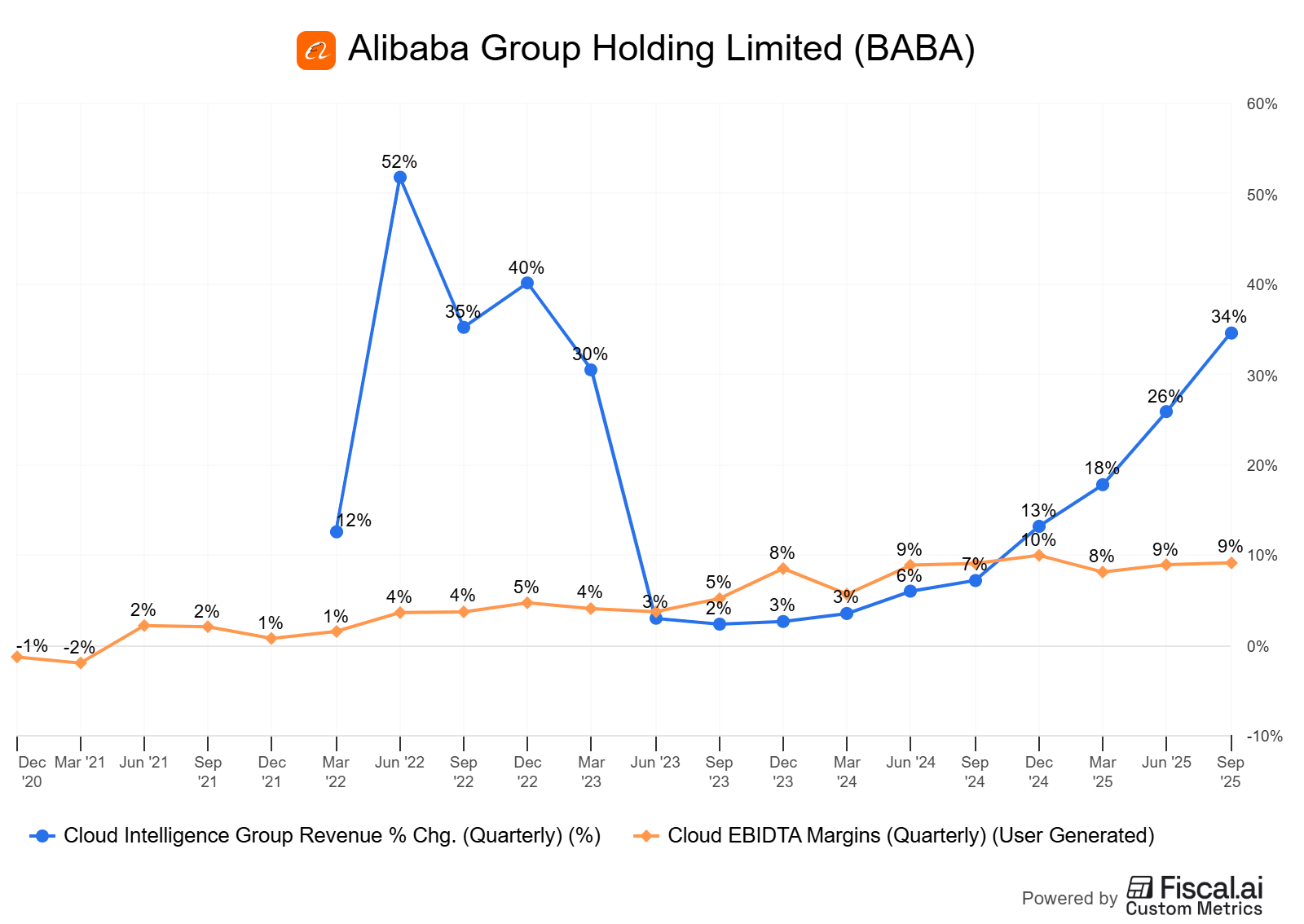
The trend couldn’t be clearer.
But Alibaba’s case goes further. Unlike the U.S. giants who fight for business, Alibaba is the undisputed leader in its region.
In China’s AI cloud market, we’re also the clear leader, with a market share larger than the combined total of the second to fourth largest providers.
And the region is much larger than China itself as Asia will eventually catch up & rely on local servers and capacities in regions where U.S. companies are less present. Plus, Alibaba is the only company offering a full‑stack service - infrastructure, models and applications.
In the cloud computing market, 2 major trends are becoming increasingly apparent. First, as AI applications scale, more developers and enterprise customers are choosing vendors with full-stack AI technology portfolios. Second, customers are deepening and broadening their use of AI, which is significantly increasing demand for compute, storage, and other traditional cloud services.
This is what sets Alibaba apart. It controls the entire chain, from data centers to final services, which means being very competitive in both pricing and quality.
There also are rumors about internal GPUs developments, just as Google developed its TPUs. Their vertical integration took longer but now outperforms competition as we see today. Given China’s limited access to Nvidia’s GPUs, if the company were to develop & integrate in-house GPUs, it could multiply what is already a pretty large opportunity.
An example of Alibaba’s AI full stack is its QN App, an AI application comparable to ChatGPT although interconnected to Alibaba’s ecosystem, meant to onboard users and create habbits around AI usage. The application generated more than 10M downloads in its first week.
Before passing the the last advantage Alibaba has over competition, let me talk about CapEx as we know all of this comes at a cost: heavy investments.
The RMB 380B CapEx figure that we had previously mentioned was a planned figure for a three-year period. Based on what we’re seeing now, and as I just mentioned, the pace at which we can add new servers is insufficient to keep up with the growth in customer orders.
Essentially we’re working as fast as we can to be able to satisfy all of that customer demand. In that context, if we’re not able to satisfy all of that customer demand especially well with the current pace of investment, then we wouldn’t rule out further scaling up that CapEx investment. That is somewhat dependent on supply chains and availability. In overall terms, certainly we will be investing in AI infrastructure aggressively in order to meet the demand of customers.
In big picture terms, I would say that the RMB 380B figure we had mentioned might be on the small side, certainly in terms of the customer demand that we’re currently seeing.
This is classic, and I won’t complain. It’s a better use of capital than buybacks or dividends from a market’s point of view - though those won’t stop.
Passing to the last advantage Alibaba has over competition: its core business.
China Consumption & Application.
I see what I expected: accelerating consumption in Alibaba’s local e‑com. Most of the growth came from platform upgrades, better take rates and rising advertiser adoption of marketing tools.

This acceleration is organic for now, driven by improved core services & consumption, but not yet boosted by AI.
User retention and purchase frequency have outperformed expectations.
Alibaba is a super company. It owns cloud services, e‑commerce platforms, logistics, entertainment, delivery, social media, advertising & more.
A long list of businesses that can & will be improved by AI just as we saw advertising reach and conversion grow with Meta and Google. Except Alibaba won’t redirect ads to other platforms; it will redirect them within its ecosystem, driving spending on its own platforms and growing its own revenues.
In other words, AI has a perfect synergy with the rest of its businesses.
On the other hand, the synergy between AI and the broader Alibaba ecosystem is a powerful multiplier. Alibaba is the only company in China with both a leading large model and extensive lifestyle and commerce use cases. QN will gradually integrate e-commerce, map navigation, local services, and more, becoming an AI-powered entry point for everyday life. With AI innovation and ecosystem collaboration reinforcing each other, we’re confident in our ability to deliver substantial user value.
Alibaba’s cloud business is the spark to ignite everything else, in a geography where demand for compute will only accelerate & Alibaba is the best company to deliver it and will gladly do so, while internally using it to improve its other verticals, which are already accelerating without any AI improvements yet - and would certainly do so organically without any enhancement.
Financials.
The improvements are not yet fully reflected in the financials, but they are here.

We can see a clear pickup in growth from direct consumption, although much of it came from services like customer management. Chinese consumers are increasing their spending, while sellers remain aggressive. The branch saw a decline in cash generation due to investments in Quick Commerce.
We already discussed the cloud vertical, which is the second very bullish data point in this report and it is EBITDA positive with a 9% margin.
International e‑commerce is also very healthy in terms of growth and continues to fluctuate as usual. It remains just a bonus to my bull case, but a positive bonus is better than any malus. Plus, the branch was EBITDA positive this quarter.

It is always hard to judge such a conglomerate, but once again the financials reflect investments across its businesses that generate growth. Who would complain about that?
In terms of cash, Alibaba closed the quarter with $41B of net cash, bought back worth for $253M of shares outstanding and lost $3B of cash due to intensive investments in AI infrastructure.
Investment Execution.
As you’ve understood, I remain extremely bullish. This quarter gave me everything I needed to confirm my convictions, so I will continue to buy Alibaba.
The company seems to be at the start of an AI revolution that will allow it to improve and optimize every part of its businesses. Most of them have massive potential, as we saw in the U.S., and that will be combined with the government’s push to boost both consumption and AI.
Alibaba owns AI, cloud services, social medias, e‑com platforms, logistics, advertising, entertainment and an AI‑built application. It is the Chinese combination of Amazon, Google & Meta, owning portions of the core businesses of all three locally. And it is only at the beginning of its AI transformation. When we know how that boosted our U.S. companies, we can see the potential here.
I won’t do a standard valuation, but I will note that Alibaba trades at lower multiples than all of those companies.
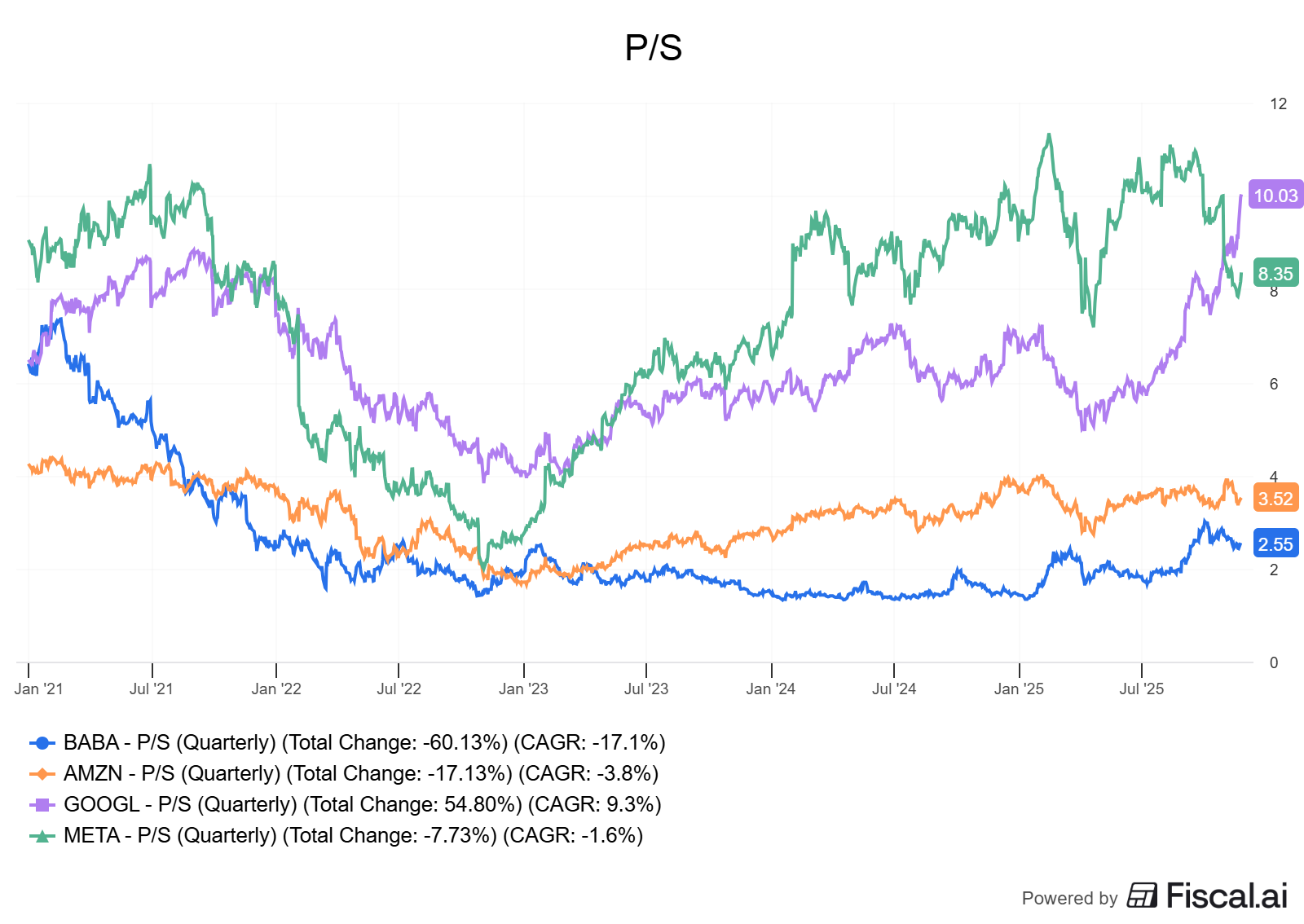
I don’t mean to say Alibaba deserves bigger multiples than each of them, as it doesn’t have comparable growth yet and is a Chinese company. But those multiples will catch up, at least that’s what I believe, once AI optimization is applied across its businesses and Chinese demand for AI services continue to accelerate.
I cannot say where Alibaba should be in this chart. But I do not believe it deserves to be last, and if it did, not that far from Amazon considering its market share in both AI and cloud services but also local and international e-commerce platforms. Now while China is bound to grow consumption and AI demand.
As for the obvious bear case on U.S./China geopolitical relations, I’ll repeat what I say every quarter: the risk is overblown. Both countries are dependent on each other and recent months have proven that. As of today, Xi and Trump are best buds and even if that fluctuates, the conclusion remains the same. We would need to seriously worry if one day this dynamic changes - which I do not believe would happen with Trump but that is a personal conviction.
In term of price action, the market is selling this quarter, mostly because of broader concerns around AI. I don’t believe this is due to Alibaba’s data itself.

My view remains the same. We are bouncing on the 21 daily average & the three‑year accumulation breakout, which I see as a great entry point for both new positions and accumulation.
I don’t believe Alibaba will fall below its trendline again - below $140 or so, though it could on geopolitical headlines. The stock needed to breathe after reaching $200, did so by retesting its breakout and is now waiting for bullish broader sentiment to push above $200. Just a matter of time to my opinion.
This looks like a textbook bull trend. I’m a buyer, focused on keeping my average below $140.
For those who’d like broader exposure, the Chinese equivalent of the Nasdaq, an ETF named KWEB, is in a perfect retest of its three‑year accumulation range.

This is a price I would buy if I wanted exposure to both China’s consumption and tech long term without owning an individual name. I shared on Sunday that the weekly 50 around $36 looked like the perfect buy and we had that retest yesterday.
The index is exposed to Alibaba and Tencent, the two AI giants, at 11% each, which gives you a correct exposure but less volatility.
I simply propose this as an alternative. Personally, I own both - and will buy both.
https://open.substack.com/pub/techitalt/p/the-real-ai-winners-are-hiding-in?r=5jmutn&utm_campaign=post&utm_medium=web&showWelcomeOnShare=true